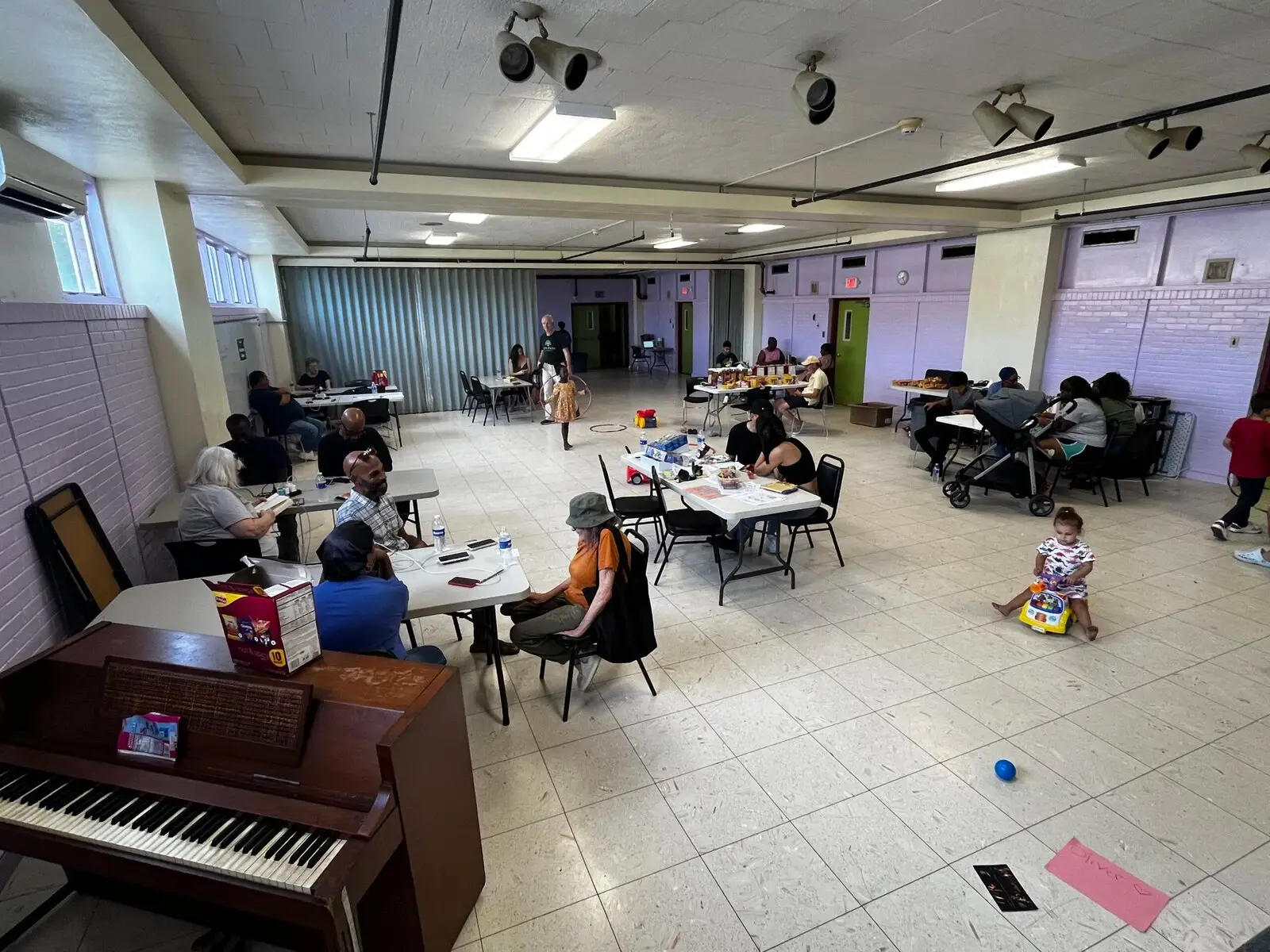
When Hurricane Francine plunged New Orleans into another prolonged power outage in 2024, pastor Shawn Anglim opened the doors of First Grace United Methodist Church and switched on the lights. “By the afternoon it was packed,” he says. “More than 100 people had air conditioning, were charging medical devices, were charging their phones.” His church is one of the hubs in a growing network of Community Lighthouses in Louisiana.
The idea emerged after Hurricane Ida in 2021, which caused the largest power outage in Louisiana’s history, leaving parts of New Orleans without electricity for 12 days. A heatwave followed, and at least 11 people died from heat-related causes because they could not use air conditioners in their homes. Anglim says the disaster “really made all of us stop and think.” Power outages coinciding with heatwaves are expected to increase dramatically over the coming decades because of climate change, and Louisiana already has the most power outages and the longest blackouts in the United States.
Anglim and other religious and community leaders were discussing ways to better serve their communities on a Zoom call when the idea of solar microgrids came up. “I thought it was the most far-fetched idea I could imagine,” he says. They put together a proposal, asked the Greater New Orleans Foundation for $1 million and received it. The project was launched in 2022 by Together New Orleans — an organization of faith communities, unions, neighborhood associations and local institutions — and its parent organization, Together Louisiana. Today, 14 Community Lighthouses operate in New Orleans and another six elsewhere in Louisiana, with a goal of eventually creating 66 more.
Liana Heath of Together New Orleans says the Lighthouses provide backup power during both routine neighborhood outages and major disasters. When their batteries are full, they feed surplus electricity into the grid, strengthening the resilience of a city that imports almost all its power through a handful of transmission lines. Volunteer “Lighthouse keepers” decide when the hub will open, who will open the door and who will check the water and battery systems, assigning responsibilities ahead of time. Anglim notes that drills help, although reality can get in the way when volunteers have to work or evacuate; other volunteers tend to turn up to fill the gaps.
Because the hubs stay powered, they also become gathering points for other aid. After Francine, the Salvation Army and a local food bank brought food to Anglim’s church, the city placed oxygen cylinders there and a local NGO distributed portable solar generators. “All these people could do something because we had power,” Anglim says. “Everything seems spontaneous, but it is spontaneous only because there was a Community Lighthouse.” Interest in the model is spreading across the US; the Metropolitan Organization in Houston, Texas, recently secured funding to open the city’s first Community Lighthouse.
The same logic of mutual aid also applies to internet access. Community mesh networks connect wireless routers so that each becomes a node, creating a collectively owned network that can cover a block or an entire area. Guifi.net began in rural Catalonia in 2004, when residents joined forces to improve internet access in an area that private providers considered unprofitable. It has since grown into a foundation that works with local authorities and connects more than 100,000 residents of rural Catalonia. In Germany, Freifunk is present in 389 cities, towns and villages, while Austria’s Funkfeuer networks reach as far as Slovenia and Croatia; since 2014, NYCMesh has offered New Yorkers an alternative to expensive and unreliable private providers.
Community emergency medical care follows a similar path. The Hout Bay Volunteer Emergency Service in Cape Town was founded in 1994 by residents concerned about ambulance delays. The area is close to state medical facilities as the crow flies, but it is surrounded by mountains on three sides and the sea on the fourth, with access only via three mountain roads. Volunteers initially responded to calls in private cars, then borrowed an ambulance from the provincial services and eventually bought their own ambulance with community funding. Today, about 40 volunteers work on weekends and public holidays in close cooperation with state emergency services. A 2022 study found that they responded in their area 42.3% faster than state emergency services and consistently beat the 15-minute target. For Anglim, the point of Community Lighthouses is not to wait and complain: “We have to take responsibility too. This is our community too.”

Comments