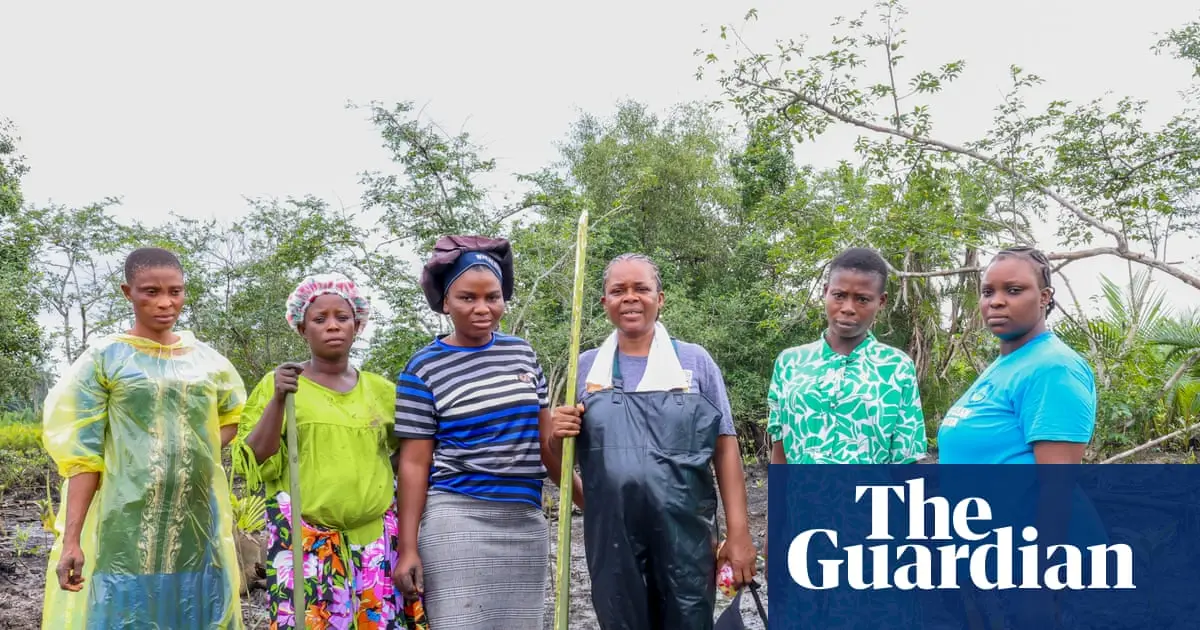
An initiative centered on women is bringing mangrove forests back to Ogoniland, in Nigeria's Niger delta, where oil pollution has destroyed wetlands and livelihoods. Since 2018, teams from the Lokiaka Community Development Centre have restored 3 million mangrove trees and 190 hectares of swamp forest, according to the report. The center's founder, Martha Agbani, has trained more than 400 women from different communities. Her aim is to put restoration in the hands of the people who depend on these ecosystems.
In the Teenama wetland, Joy Lebewi works in the mud alongside about a dozen other women, planting seedlings while also looking for crabs and sea snails to collect. More than 150,000 mangrove seedlings have been planted there. When they started in 2018, the women planted them too close together, causing the trees' crowns to crowd together as they grew. They now use a two-meter stick to measure the distance and mark the next planting spot.
Lokiaka's training takes place in the swamp forests, guided by people with experience in restoration. The women learn to care for the wetlands independently, and many have already taken the training to their own communities. The organization also works with local fishers, training them to identify species and manage mangrove shoots. In this way, the effort connects environmental knowledge with residents' daily work.
Planting also requires tackling another obstacle: the nipa palm, an invasive species from Southeast Asia that is spreading through disturbed areas of the delta. Its dense stands displace native species and make it difficult for residents to access the wetlands. In Teenama, men from surrounding communities take on the demanding work of removing it, preparing the ground for the women who plant the mangroves. The area lies between the oil-producing settlements of Kuawa and Kpean, in the Yorla oilfields.
The Niger delta's mangrove ecosystem covers about one million hectares and is the largest in Africa and the third largest in the world. The forests provide shelter for fish, shrimp and mollusks, as well as places for other aquatic organisms to grow. They also protect coastlines, store carbon and support communities that obtain food and income from the wetlands. Their destruction has deprived people who fished and gathered shellfish of a valuable basis for their livelihoods.
The scale of the damage is evident in Bodo, where Shell was required to pay £55 million in compensation to residents after two major oil spills in 2008 and 2009. About 1,000 hectares of mangroves were directly destroyed by the 2008 spill in Ogoniland. Ferdinand Giadom, deputy project director of the Bodo Mediation Initiative, which oversees cleanup work in the area, estimates that more than 500,000 barrels of crude oil leaked into the environment in less than twenty years. As he explains, the consequences affect entire generations who lost their livelihoods.
For Agbani, this destruction is part of her personal history: she grew up with the smell of crude oil, blackened rivers and trees dying along the banks. Her mother, Theresa Terabiewaa Agbani, was an activist. In 1995, while Agbani was a student, the activist and playwright Ken Saro-Wiwa and eight other environmental defenders were hanged by the state. She says these executions changed how she understood the destruction of her homeland.
In 2003, shortly after her mother's death, she founded Lokiaka to support Ogoni women farmers in protecting the environment and restoring mangroves. The area had already suffered more than five decades of oil pollution. Agbani connects environmental justice and biodiversity with women's participation, while also seeking to restore livelihoods and peace. The return of fish and crabs is, she says, a sign that life is returning.
Experts interviewed in the report stress that success needs to be assessed over time and beyond the number of plantings. Environmental scientist Erabanabari Kobah points out that planting in unsuitable locations does not ensure long-term restoration: it requires an understanding of water movement and the conditions trees need to survive. Environmentalist Collins Lebeteh emphasizes who participates, as women who depend on the degraded environment are often excluded from the relevant decisions. Agbani seeks a process that communities will control themselves, reclaiming both the forest and a say in how their land is managed.


Comments