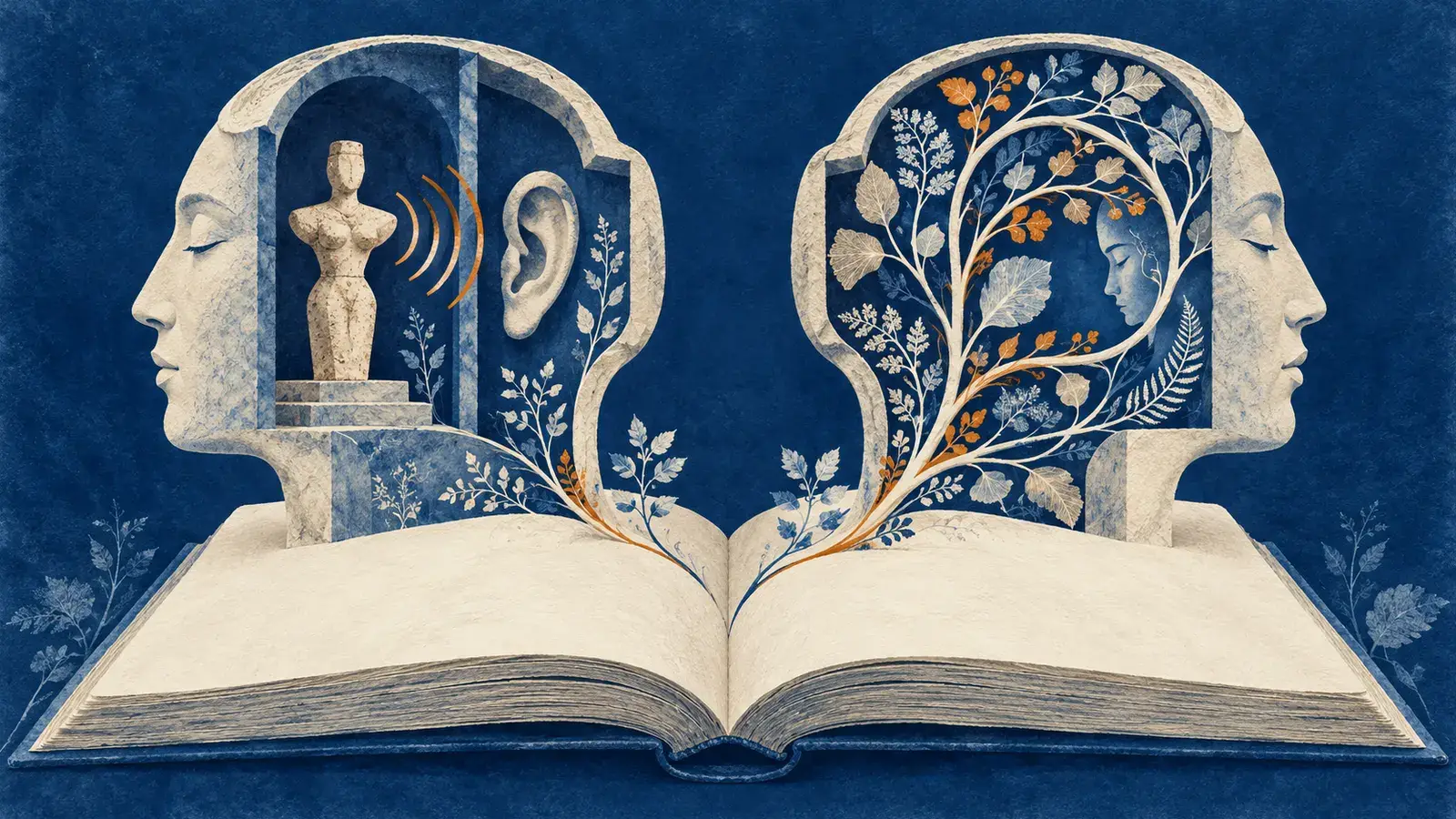
In 1976, psychologist, psychohistorian and consciousness theorist Julian Jaynes (1920–1997) published “The Origin of Consciousness in the Breakdown of the Bicameral Mind,” whose Greek title translates as “The Origin of Consciousness in the Breakdown of the Bicameral Mind.” It was his only book and remains in print in many languages.
Jaynes explores the nature of consciousness—particularly “the capacity for introspection”—and its development in ancient human history. He proposes that consciousness is a learned behavior rooted in language and culture, rather than something innate. He distinguishes it from sensory awareness and cognition.
The central term is the “bicameral mind,” a nonconscious mental state that, according to Jaynes, prevailed among early humans and relied on auditory hallucinations. People experienced these hallucinations as commands from gods that guided their actions. His analysis draws on historical texts and archaeological findings. Jaynes places the origin of consciousness around the second millennium BC and argues that the transition from the bicameral mind to consciousness was triggered by the collapse of the bicameral system.
The book is divided into three parts: “The Mind of Man,” which examines Homer’s Iliad and connects the bicameral mind with the origin of civilization; “The Witness of History,” which applies the hypothesis to Neolithic culture and the rise of civilizations in Mesopotamia and Greece; and “Vestiges of the Bicameral Mind in the Modern World,” which applies the hypothesis to modern psychological theories of authority, prophecy, spirit possession, poetry, music, hypnosis and schizophrenia.
On its release, the book was a popular science success: the first printing sold out before a second could replace it. It received positive reviews from John Updike in The New Yorker, Christopher Lehmann-Haupt in The New York Times and Marshall McLuhan in the Toronto Globe and Mail. Articles about Jaynes and his ideas appeared in Time and Psychology Today in 1977, and in Quest/78 in 1978. The book was nominated for the National Book Award in the Contemporary Thought category in 1978. A new edition with an afterword responding to some criticisms was published in the US in 1990, in the UK by Penguin Books in 1993, and reissued in 2000.
In his book “The God Delusion” (2006), Richard Dawkins described it as “one of those books that is either complete nonsense or a work of absolute genius, nothing in between! Probably the former, but I’m keeping an open mind.”
Its influence was wide-ranging. Jaynes’s work influenced philosophers such as Daniel Dennett, Susan Blackmore and Ken Wilber, while the bicameral model of the brain’s hemispheres influenced schizophrenia researchers such as Henry Nasrallah and Tim Crow. The theory of bicamerality inspired early research into auditory hallucinations by psychologist Thomas Posey and clinical psychologist John Hamilton. New research in the late 1990s and new brain imaging techniques brought renewed attention to Jaynes’s ideas.
Jaynes himself described reactions to his book as ranging “from people who feel that [the ideas] are very important to very strong hostility.” He added that arguing that consciousness lies in history is not accepted: if psychologists accepted it, they would have no incentive to return to the laboratory.
Marcel Kuijsten, founder of the Julian Jaynes Society, wrote that there had been very few in-depth discussions, positive or negative, in the decades since publication, dismissing the criticism that “Jaynes was wrong” as overly simplistic.
The book has been translated into at least seven foreign languages and left its mark on pop culture: the message “Your bicameral mind / Mind your bicameral” is etched into the runout groove of the vinyl release of David Bowie’s song “Boys Keep Swinging” (1979), while the concept played a central role in the series Westworld (2016–2022) in explaining the psychology of its android hosts; the first season’s finale is titled “The Bicameral Mind” (2016).
At the heart of the book remains a provocative hypothesis: that introspection, something we consider deeply personal and take for granted, has a historical beginning and cultural roots.




Comments