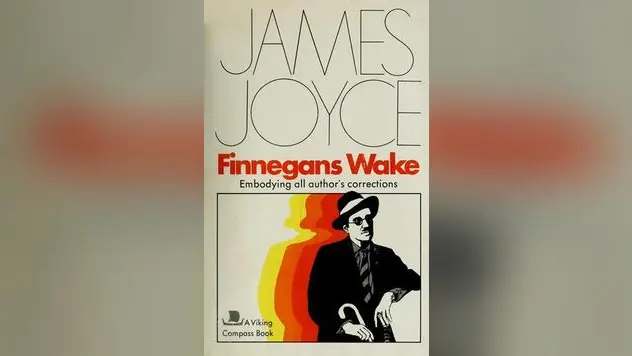
“Finnegans Wake” is a novel by Irish writer James Joyce. It began appearing in installments in 1924 under the title “fragments from Work in Progress,” and its final title was revealed only when the book was published on May 4, 1939, after seventeen years of writing. Joyce died twenty months later, in Zurich, on January 13, 1941.
The book's language is based on English, but Joyce transformed it by combining and altering words from many languages, creating his own idiom full of wordplay and compound words. According to commentators, this technique was an attempt to convey the way memories, people and places blend together and change in a dreamlike or half-awake state. In a 1926 letter to Harriet Shaw Weaver, Joyce described his intention: “A large part of every human existence is spent in a state that cannot be conveyed through the use of waking language, cut-and-dried grammar and a plot that moves forward.”
The work's initial reception was largely negative, ranging from confusion over its radical reshaping of language to open hostility toward its apparent lack of meaning and respect for literary conventions. The Dial refused to publish four chapters of the third part in 1926. Joyce, however, maintained that every syllable was justified and told Richard Ellmann: “I can justify every line of my book.” He told Sisley Huddleston that twenty pages had cost him twelve hundred hours of work.
Despite the obstacles, readers and scholars have reached broad agreement on the central cast of characters and, to a lesser extent, the plot. The book explores the lives of the Earwicker family: the father, HCE; the mother, ALP; and their three children, Shem the Penman, Shaun the Postman and Issy. Following an unspecified rumor about HCE, the book follows his wife's efforts to exonerate him through a letter, his sons' struggle to replace him and a final monologue by ALP at dawn. The circular structure is emphasized by the fact that the novel ends with an unfinished phrase that completes the passage with which it begins: “a way a lone a last a loved a long the / riverrun, past Eve and Adam's…”.
The first part introduces Finnegan, a builder who falls from a ladder and dies, but briefly comes back to life during his wake. It then introduces HCE, also known as “Here Comes Everybody,” who rises in Dublin society but falls because of a rumor about sexual misconduct in Phoenix Park. The rumor spreads, becomes a song (“The Ballad of Persse O'Reilly”) and leads HCE into hiding, to trial and ultimately to release. Chapter I.5 examines ALP's letter, which she dictated to her son Shem and entrusted to Shaun to deliver, but which never reached its destination; it was found in a rubbish heap by a hen named Biddy.
Chapter I.8, devoted to ALP, is considered one of the book's most celebrated passages. In it, two washerwomen gossip about ALP's response to the accusations against her husband as they wash clothes in the River Liffey. Thousands of river names from around the world are woven into the text, suggesting that ALP personifies the river itself, while HCE personifies the city of Dublin. At the end of the chapter, the two washerwomen turn into a tree and a stone as darkness falls.
The second and third parts shift the focus to the children. In the second part, the siblings play games, study geometry and listen to stories from the bar's radio and television, while a drunken HCE cleans the bar and transforms into the ancient Irish king Rory O'Connor. In the third part, Shaun, as a postman, carries his mother's letter, delivers a lengthy sermon full of sexual innuendo to his sister Issy and ultimately becomes a medium through whom the father's voice is heard again during a séance. The fourth part consists of short, seemingly unconnected episodes and closes with ALP's final monologue as she, in the form of the River Liffey, disappears into the ocean at dawn.
Critics disagree on whether the characters are distinct or fluid. Some, such as Margot Norris, argue that the characters are fluid and interchangeable, while others see them as archetypes or amalgamations of characters that take different forms. While writing, Joyce used symbols, known as “sigla,” instead of names to indicate these clusters of characters. The concealment of identities has led to different interpretations, such as whether Festy King, who stands trial in chapter I.4, is a version of HCE or Shaun.
The work's central themes include fall and resurrection, the cyclical nature of time and history, guilt and redemption, tragic love as depicted in the myth of Tristan and Isolde, the motif of warring brothers, the personification of the landscape and HCE's unspecified crime in the park. ALP's letter appears many times in different forms, but its contents are never fully defined; it is usually seen as both an exoneration of HCE and an indictment of his sin. As Philip Kitcher points out, HCE's guilt, failures and flaws permeate the entire book.
“Finnegans Wake” has earned a reputation as one of literature's most difficult works, but Joyce insisted that it was neither random nor pointless. A group of Joyce's supporters, including Samuel Beckett, published a collection of critical essays on the work in 1929, titled Our Exagmination Round His Factification for Incamination of Work in Progress. The book remains a bold experiment that attempts to represent night, dreams and multiple layers of meaning in a way that conventional language, as the author himself believed, cannot convey.



Comments