“The Myth of Sisyphus” (French: Le mythe de Sisyphe) is a philosophical essay by Albert Camus, published in 1942. Influenced by philosophers such as Søren Kierkegaard, Arthur Schopenhauer and Friedrich Nietzsche, Camus presents his philosophy of the absurd here, connecting it to his other works, from the novel “The Stranger” to the essay “The Rebel”. He consistently rejected the label of existentialist, insisting that the philosophy of the absurd was distinct from both Kierkegaard's “leap of faith” and Heidegger's ontology.
According to Camus, the absurd lies neither in the world nor in humans separately: it arises from the confrontation between the fundamental human need to give life meaning and the universe's “absurd silence” in response. It is the moment when the “appetite for the absolute and for unity” meets the impossibility of reducing the world to a logical and reasonable principle. Once the absurd is recognized, Camus writes, it becomes “a passion, the most painful of all”.
The first question the essay poses is, according to its author, the only serious question in philosophy: does recognizing the absurd and the absence of meaning necessarily lead to suicide? Camus's answer is an emphatic no. Suicide is rejected because the absurd cannot exist without humans: the contradiction between the desire for meaning and the irrational world must be lived, rather than dissolved. Reason and its limits must be acknowledged, without false hopes.
Equally unacceptable are “philosophical suicides”: the positions of philosophers who begin with the absurd but ultimately betray it. Kierkegaard and Lev Shestov abandon reason and turn to God; Husserl, by contrast, elevates reason, arriving at abstract systems and Platonic forms. Both paths, Camus writes, betray the original absurd position. Integrity, he insists, needs no rules; “everything is permitted” is not a cry of joy but a bitter recognition of a fact.
Complete acceptance of the absurd has three consequences: revolt, freedom and passion. Revolt is the constant confrontation with the absurd, never fully accepted, always questioned. Freedom takes on a concrete meaning: the absurd man, no longer bound by the hope of a better future or an eternity, enjoys freedom from common rules. And without meaning in life, there is no hierarchy of values: “What matters is not living better but living more”.
Camus then presents examples of the absurd life: Don Juan, the serial seducer who lives passion to the fullest without promises of eternity; the actor, who embodies fleeting lives for fleeting glory, showing that appearance creates being; and the conqueror, the warrior who gives up every promise of eternity to act within human history, knowing that nothing lasts and no victory is final.
In the chapter on absurd creation, Camus examines the artist. Since explanation is impossible, absurd art confines itself to describing the world's countless experiences: “if the world were clear, art would not exist”. Analyzing the work of Fyodor Dostoevsky, particularly “A Writer's Diary”, “Demons” and “The Brothers Karamazov”, he finds that all begin from the absurd position, but “A Writer's Diary” and “The Brothers Karamazov” ultimately find a path to hope and faith, and therefore fail as truly absurd creations. The same applies, he notes in the appendix, to Franz Kafka, whose work retains a glimmer of hope.
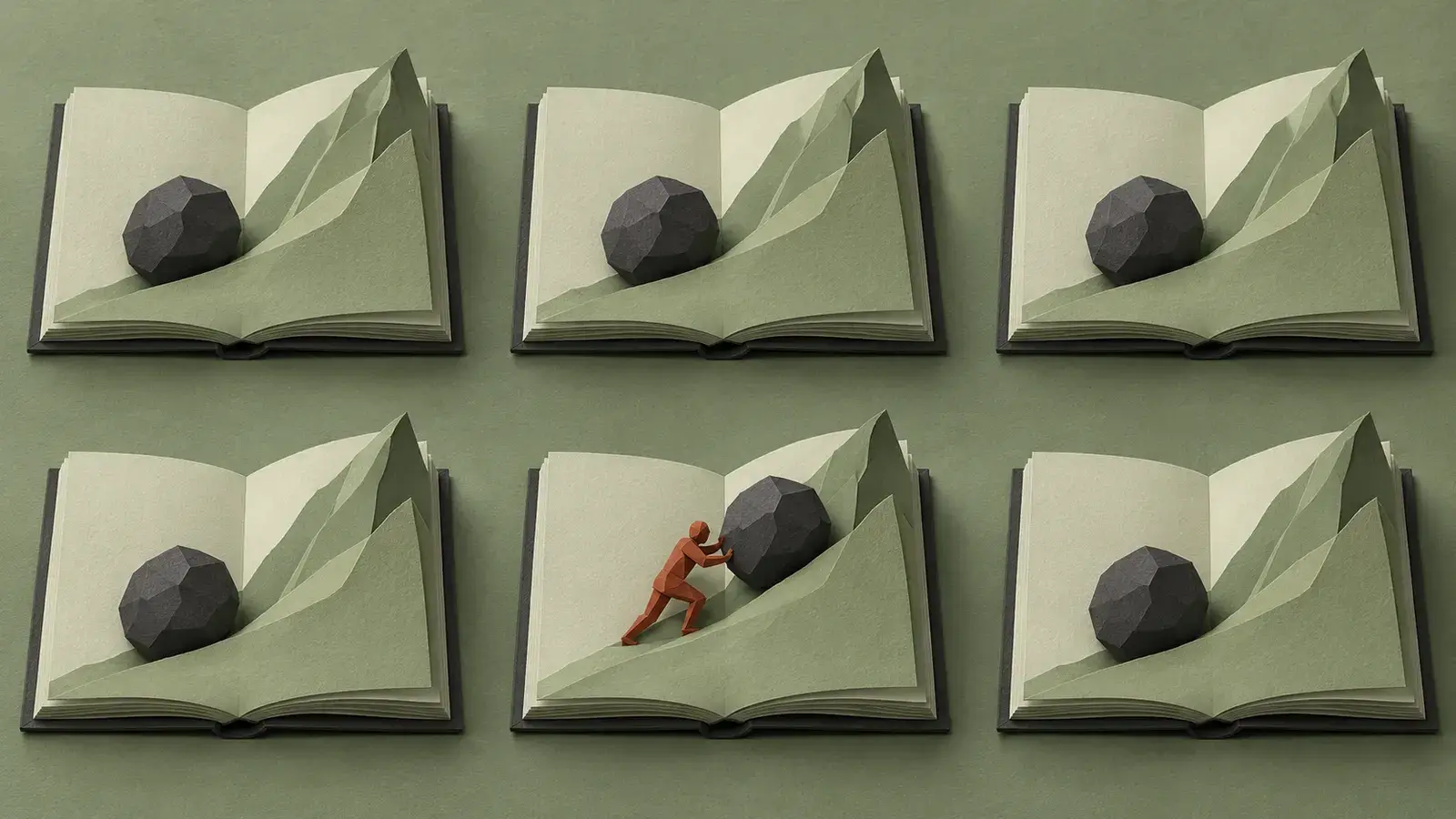
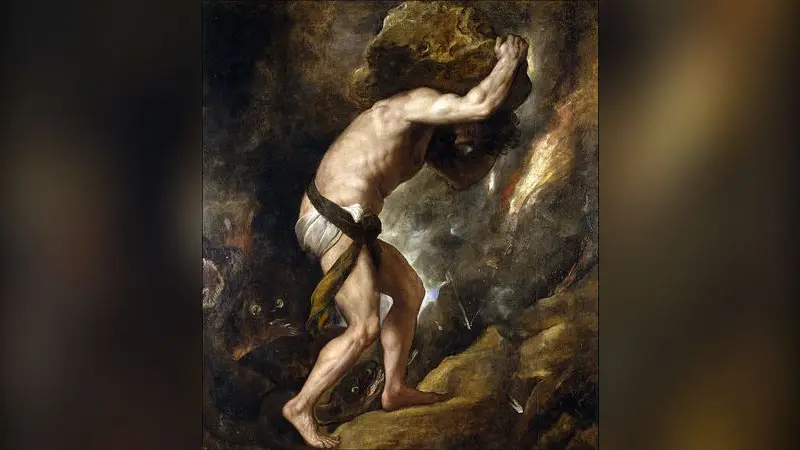
In the final chapter, Camus turns to Sisyphus of Greek mythology: the hero who defied the gods, chained Death and managed to outwit the underworld. His punishment was to push a boulder to the top of a mountain forever, only to see it roll back down each time he approached the summit. For Camus, Sisyphus is the absurd hero: he lives life to the fullest, hates death and is condemned to a meaningless task.
His relentless, futile labor becomes a metaphor for modern lives spent on pointless work in factories and offices: “Today's worker performs the same tasks every day of his life, and this fate is no less absurd. But it is tragic only in the rare moments when he becomes aware of it”. Camus is interested precisely in that moment of return, when Sisyphus walks down the mountain to begin again: that is when the hero becomes aware of his situation. “There is no fate that cannot be overcome through contempt”, he writes.
The essay's conclusion is one of the most famous statements in modern philosophy: “One must imagine Sisyphus happy”. When Sisyphus recognizes the futility of his task and the certainty of his fate, he is liberated: the struggle toward the heights is enough to fill a person's heart. Camus began writing the work in 1940, during the fall of France, when millions of refugees fled the German army. Although the essay rarely refers to the event, scholars such as Robert Zaretsky argue that this experience gave rise to his ideas about the absurd. The essay has been available in Greek translations since 1970, including the Kastaniotis edition (2007), translated by Niki Karakitsou-Dougé and Maria Kasambaloglou-Roblin.


Comments