
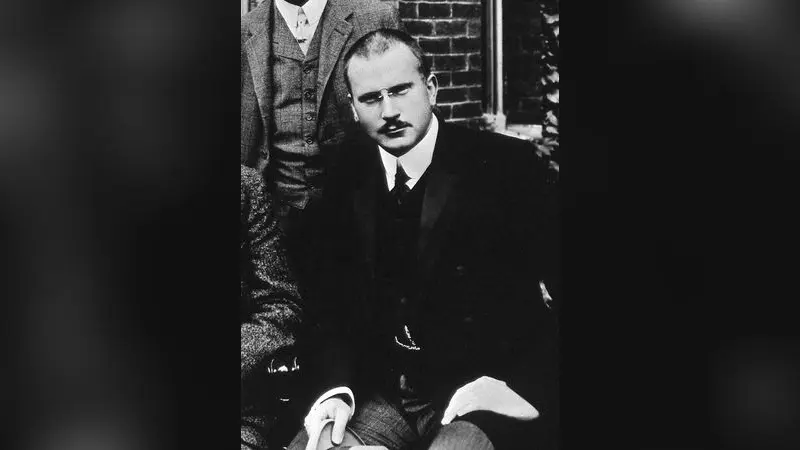
“Memories, Dreams, Reflections” (German: Erinnerungen, Träume, Gedanken) is a partly autobiographical book by the Swiss psychologist Carl Jung and his associate Aniela Jaffé. It was first published in German in 1962, and the English translation followed in 1963, two years after Jung's death. It has remained in print ever since.
The idea began in 1956, when publisher Kurt Wolff of Pantheon Books expressed an interest in publishing a biography of Jung. His associate, Dr. Jolande Jacobi, suggested Aniela Jaffé as the biographer. Jung was initially reluctant to collaborate, but as his conviction about the importance of the undertaking grew, he became absorbed in the project and began writing some of the text himself. Jung wrote the first three chapters, covering his childhood and early adulthood, as well as part of the “Travels” chapter (the section on his travels in Kenya and Uganda) and the “Late Thoughts” chapter. Jaffé wrote the rest in collaboration with Jung.
Jaffé recorded a characteristic statement by Jung about the writing process: “A book of mine is always a matter of fate. There is something unpredictable about the process of writing, and I cannot map out a predetermined course. So this ‘autobiography’ is now taking a very different direction from what I imagined at the start.
It has become a necessity for me to record my earliest memories. If I neglect it for even a single day, unpleasant physical symptoms immediately appear. As soon as I settle down to work, they disappear and my head becomes completely clear.”
The book's content and structure were the subject of intense dispute. Jung's family, wanting to keep his private life out of the public eye, pushed for deletions and other changes. The publisher demanded that the text be significantly shortened to keep printing costs down. Eventually, the disputed text—including a chapter titled “Encounters,” which described some of Jung's friendships and acquaintances—was incorporated into other chapters, while Pantheon Books withdrew its request for further cuts after protests from Jaffé and others.
Jaffé herself was accused of censorship when she began using the authority Jung had given her to rephrase some of his thoughts on Christianity, which she considered too controversial. The edition eventually published in 1963 was therefore the product of compromises and cuts.
In his book “Freud: A Life for Our Time” (1988), historian Peter Gay comments that the title “Memories, Dreams, Reflections” is apt, given the book's emphasis on dreams, and adds that “like many autobiographies, it reveals more than its author intended.”
The news bringing the book back into the spotlight concerns the complete edition of the autobiography's original protocols, which had initially been omitted and censored. The Philemon Foundation, in collaboration with Aniela Jaffé's literary executor, Robert Hinshaw, and the Foundation of the Works of C. G. Jung, agreed to publish the protocols of Jung's recollections in full.
The volume, titled “Jung’s Life and Work: Interviews for Memories, Dreams, Reflections with Aniela Jaffé,” will be published by Princeton University Press on December 2, 2025. It is edited by Sonu Shamdasani, with Thomas Fischer as consulting editor, and translated by Heather McCartney and John Peck. The 456-page volume includes unpublished material.
The significance of the complete edition lies in its restoration of material that had been excluded or altered in the book's original form, offering a fuller picture of the life and thought of one of the founders of depth psychology.


Comments