
In 1954, Aldous Huxley published the autobiographical book The Doors of Perception, in which he describes his experience with mescaline in May 1953. He recorded insights ranging from the “purely aesthetic” to “mystical vision” and reflected on their philosophical and psychological implications. The title comes from William Blake, who wrote that if the doors of perception were cleansed, everything would appear infinite to man, because man has shut himself away and sees through narrow chinks in his cavern.
Mescaline is the main psychoactive component of the peyote cactus, which has been used for thousands of years in Native American religious ceremonies. The German pharmacologist Arthur Heffter isolated the alkaloids in 1897, and Ernst Späth synthesized the substance in 1919. In the 1930s and 1940s, psychiatric research mainly examined whether the substance mimicked psychosis, but the anthropologist Weston La Barre studied the ritual use of peyote among the Huichol of western Mexico as an entheogen for prophecy, healing and inner strength. In the early 1950s, when Huxley was writing, mescaline was still considered a research chemical and was sold without restrictions.
Huxley had already turned to spiritual matters: he meditated, took an interest in Vedanta and had published The Perennial Philosophy in 1945. He read a paper by the British psychiatrist Humphry Osmond, who was using mescaline in schizophrenia research, and wrote to him in April 1952, offering to be an experimental subject. According to his biographer George Woodcock, Huxley had concluded that drugs might be “toxic shortcuts to self-transcendence,” but changed his mind because mescaline was not addictive and did not seem to have unpleasant side effects. He believed that the brain acts as a valve that limits consciousness and hoped mescaline would allow him greater awareness.
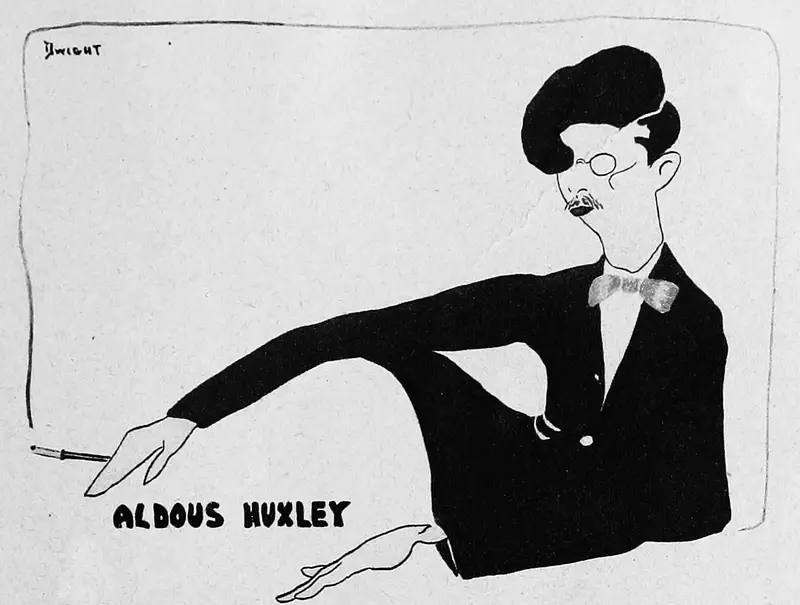
Osmond arrived at Huxley's home in West Hollywood on May 3, 1953, and administered four-tenths of a gram of mescaline at 11 a.m. The experience lasted eight hours, with Osmond and Huxley's wife, Maria, staying by his side. The group visited the Owl Drug pharmacy, where Huxley looked at art books, and later he walked in the garden and listened to music. Photographs from that day show him smiling, sometimes with his hands on his hips and sometimes with his arms outstretched, on a trip to the hills above the city.
In the book, Huxley explains that he expected to see vividly colored visionary landscapes, but instead experienced a radical change in his perception of the outside world. At 12:30, a vase of flowers became the “miracle, moment by moment, of naked existence.” He discusses Meister Eckhart's “is-ness,” Plato's “Being,” the Hindu concept of Sat-Chit-Ananda and the state of “not-I.” Time was replaced by a continuous present, and his thinking remained clear, although he saw no reason to act because the experience was so absorbing.
Huxley agreed with the philosopher C. D. Broad that the brain and nervous system eliminate nonessential information from the totality of “Mind at Large,” leaving people with a limited picture of reality.
At the pharmacy, the paintings prompted strong reactions: Cézanne's self-portrait with a straw hat seemed incredibly affected to him, while the human still lifes of Vermeer and the Le Nain brothers came closest to the state of “not-self.” In the garden, the chairs took on such intensity that he feared being overwhelmed, giving him, as he put it, a glimpse of madness; he suggested that schizophrenia might be the inability to escape this reality and return to common sense.
In his conclusions, Huxley argues that the urge for self-transcendence is universal and that better, healthier “doors” than alcohol and tobacco are needed. Mescaline has the advantage of not provoking violence, but its effects last inconveniently long and some users have negative reactions. He clarifies that mescaline is neither divine illumination nor the beatific vision, but a “gratuitous grace,” a term from Thomas Aquinas; it is helpful, particularly for the intellectual who can fall victim to words and symbols. He concludes that direct perception has inherent value and that anyone who has this experience will change for the better.
The book sparked strong reactions. Thomas Mann considered it irresponsible, speaking of Huxley's aesthetic self-indulgence and the risk of encouraging young people to try mescaline. The Vedanta monk Swami Prabhavananda, Huxley's spiritual mentor, described mescaline as a spiritually illegitimate path to enlightenment. The Jewish philosopher Martin Buber argued that the substance leads the user “merely into a strictly private sphere,” rather than a shared existence. Robert Charles Zaehner, a professor at Oxford, wrote that artificial intervention in consciousness has nothing to do with the Christian beatific vision, while religious studies professor Huston Smith countered that psychedelics can facilitate theistic mystical experiences, stressing, however, that to lead to a religious life, they need to be placed within a framework of faith and discipline.
Huxley continued taking such substances a few times a year until his death, with a serious and measured approach. In October 1955, he had an experience he considered deeper than those in the book: he wrote to Osmond that he had experienced “the direct, total awareness of Love as the primary cosmic fact.” This experience found its way into the final chapter of his novel Island.
The book also inspired Timothy Leary, who read it after his first experience with psilocybin and found that it confirmed what he had experienced, leading to his friendship with Huxley. In 1965, Jim Morrison named his band The Doors, influenced by the book's title.
Today, the book is considered a classic of psychedelic literature and a pivotal point in the discussion of the relationship between psychoactive substances, consciousness and religious experience. Huxley's emphasis on direct perception and the brain's restriction of consciousness continues to raise questions about what an altered state of mind can reveal, as well as whether an aesthetic or mystical experience induced by substances is enough for a meaningful spiritual life.



Comments