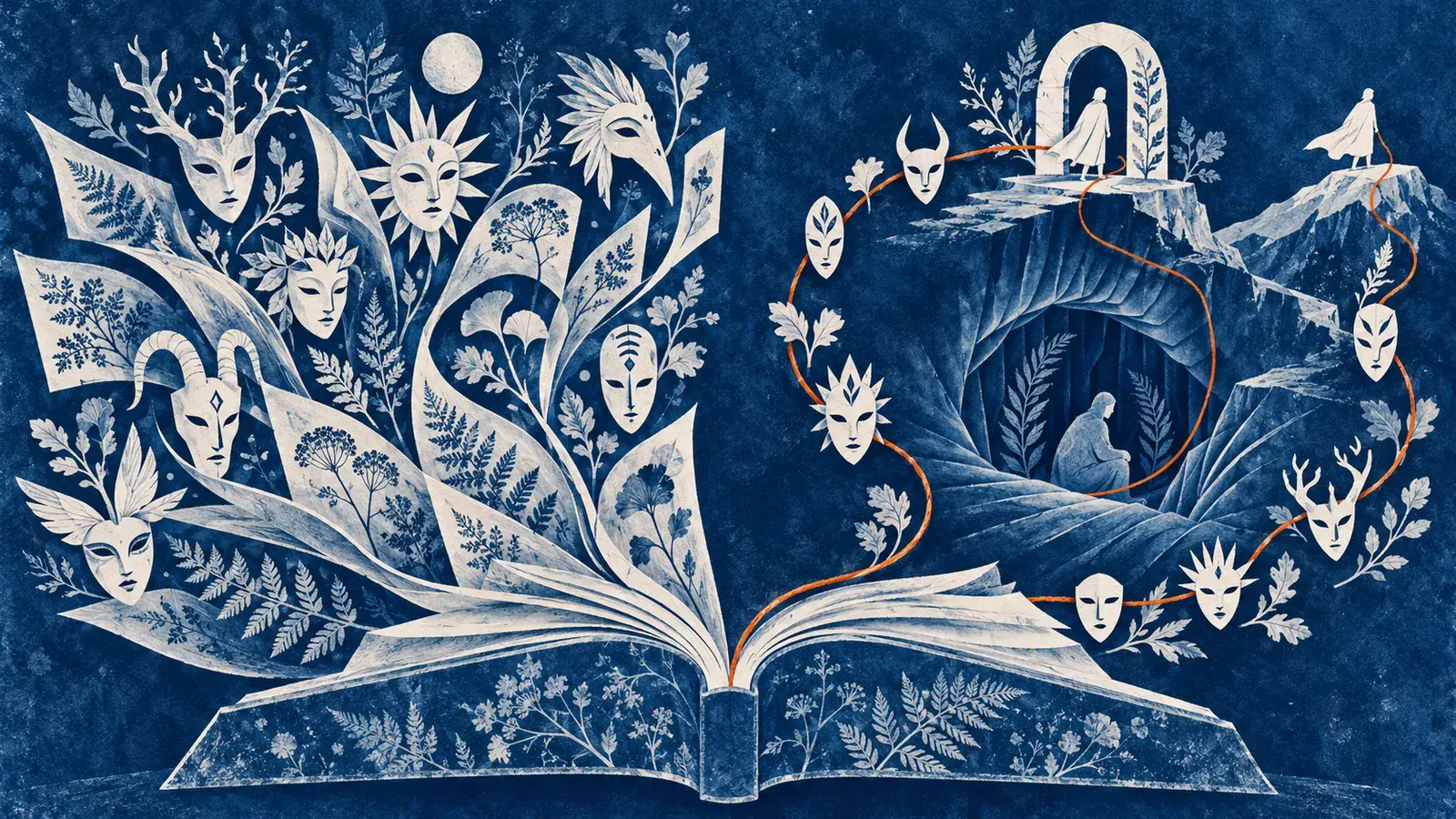
Joseph Campbell's The Hero with a Thousand Faces was first published in 1949 and is a work of comparative mythology. In it, the author develops his theory of the structure of the archetypal hero's journey, which he identifies in myths from around the world. The book's central concept is the “monomyth,” a term Campbell borrowed from James Joyce's Finnegans Wake. Campbell summarizes the pattern as follows: the hero leaves the ordinary world and enters a realm of supernatural wonder, where they encounter fantastic forces and win a decisive victory, returning from the mysterious adventure with the power to bestow gifts on their fellow human beings.
Campbell breaks the hero's journey down into stages. The adventure begins in the ordinary world with the “call to adventure”; with a mentor's help, the hero crosses a guarded threshold into a supernatural world where familiar laws do not apply. There, the hero follows a road of trials, faces the journey's greatest challenge and, upon overcoming it, receives a reward or gift. The theory also includes a metaphorical death and resurrection, the decision to return to the ordinary world, new trials on the way back and the use of the gift to improve the world. The stages are grouped into three broader phases: “Departure” (or Separation), “Initiation” and “Return.”
Campbell notes that many myths follow the general outline of the monomyth, although the presence and order of some stages vary. To establish his model, Campbell studied religious, spiritual, mythological and literary classics, including the stories of Osiris, Prometheus, the Buddha, Moses, Muhammad and Jesus. In the book, he sets out the similarities between these stories as he analyzes the structure of the monomyth. His theoretical framework combines Freudian concepts popular in the 1940s and 1950s, Jungian archetypes and Arnold van Gennep's theory of the stages of rites of passage, while also drawing on the work of psychoanalyst Otto Rank and ethnographers James George Frazer and Franz Boas.
The book's influence on art and pop culture was extensive. George Lucas acknowledged the influence of Campbell's theory on the creation of the Star Wars films; Stanley Kubrick recommended the book to Arthur Clarke during the writing of 2001: A Space Odyssey. Christopher Vogler, a Hollywood producer and screenwriter, wrote a memo for Disney studios using the book as a guide, influencing films such as Beauty and the Beast (1991), Aladdin (1992) and The Lion King (1994), and later expanded it into the book The Writer's Journey.
In literature, Richard Adams used passages from the work as chapter epigraphs in Watership Down, while scholars and critics have pointed out how closely J. K. Rowling's Harry Potter books follow the monomyth pattern.
In television, Dan Harmon, creator of Community and Rick and Morty, has used the monomyth as inspiration. In video games, Jenova Chen cites the hero's journey as a key inspiration for Journey (2012).
In Pathways to Bliss, a book drawn from Campbell's later lectures and workshops, he describes artists as “magical helpers” who can help us on the heroic journey of our lives through symbols and motifs that connect us with our deeper selves. “A good life is one heroic journey after another,” he said; each time, the same question arises—“do I dare?”—and each time there is danger, help, fulfillment or failure, as well as the possibility of bliss.
The book was originally published by the Bollingen Foundation through Pantheon Press as the seventeenth title in the Bollingen Series, which Princeton University Press later took over. Campbell revised it in 1968, and it has been reprinted many times; after the release of Star Wars in 1977, some reprints used an image of Mark Hamill as Luke Skywalker on the cover. In 2008, the Joseph Campbell Foundation and New World Library released a third edition as part of the author's Collected Works.
The work has been translated into more than twenty languages—including Greek—and has sold over a million copies worldwide, while in 2011 Time magazine included it among the 100 most influential books written in English since 1923.


Comments