East of Eden is a novel by American Nobel Prize-winning author John Steinbeck, first published in 1952. Many consider it his most ambitious work, and the author himself described it as his magnum opus. “It contains everything I have been able to learn about my art or craft over all these years,” he said, adding that everything else he had written was “in a sense, practice for this.”
Steinbeck initially addressed the book to his two then-young sons, Thom and John, wanting to describe life in the rural Salinas Valley of central California to them in every detail: the landscape, sounds, smells and colors. The novel follows the lives and intertwined stories of two families, the Trasks and the Hamiltons. The Hamilton family is based on the real family of Samuel Hamilton, the author's maternal grandfather, while Steinbeck himself makes a brief appearance as a young minor character.
The story takes place mainly in the Salinas Valley, from the beginning of the twentieth century to the end of World War I, with early chapters reaching back to the American Civil War and providing background for Adam Trask, his brother Charles, their father Cyrus and Cathy Ames. Adam Trask, newly married and having recently inherited a fortune, arrives in California and settles in the Salinas Valley with his pregnant wife Cathy, who—without his knowledge—had tried to end the pregnancy with a knitting needle.
Cathy gives birth to twin boys, shoots Adam in the shoulder after persuading him to unlock the bedroom door, and leaves. Adam survives and sinks into a deep depression. His Chinese American servant, Lee, and his neighbor, the inventive Irish immigrant Samuel Hamilton, bring him out of his depression enough for him to name his sons Aron and Caleb. Lee becomes a close friend and a member of the family, and has long philosophical discussions with Adam and Samuel, particularly about the story of Cain and Abel.
Lee recounts how his relatives in San Francisco, Chinese scholars, spent two years studying Hebrew to discover the moral lesson of the story of Cain and Abel. They discovered that the Hebrew word timshel means “thou mayest,” suggesting that people are neither compelled to be holy nor condemned to sin. Meanwhile, Cathy becomes a prostitute in a respectable brothel in the town of Salinas, renames herself “Kate Albey,” murders the madam and inherits the business, which she makes notorious as a place of sexual sadism and blackmail of the valley's wealthy residents.
Adam's sons, Caleb (“Cal”) and Aron, grow up unaware of their mother's circumstances. Echoing Cain and Abel, they are opposites: Aron is virtuous and obedient, Cal wild and rebellious. Aron falls in love with Abra Bacon, the daughter of a wealthy family. When Adam starts an unsuccessful business and loses almost the entire family fortune, the boys are horrified that their father has become the town's laughingstock. Cal, tormented by guilt over his very human flaws, discovers that his mother is alive and runs a brothel; she spitefully tells him that they are alike, and he replies that she is simply afraid.
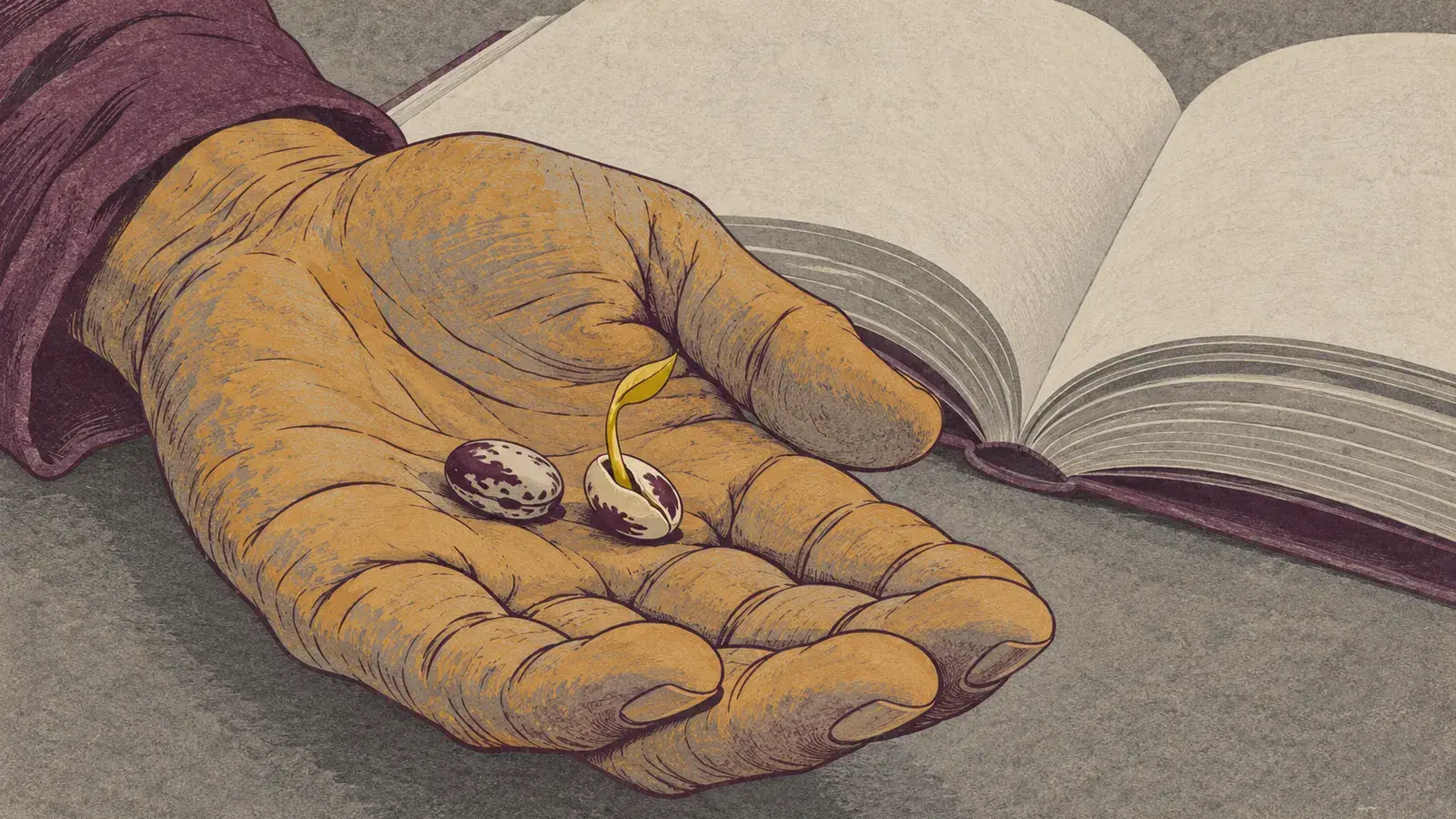
Cal goes into business with Samuel's son Will and plans to win his father's approval by selling beans from the Salinas Valley to European countries during World War I. He succeeds beyond all expectations and prepares a gift of $15,000 in cash for Adam. Adam, however, refuses to accept it and tells him to return it to the poor farmers he exploited. In a burst of anger and jealousy, Cal takes Aron to their mother. Aron sees her for what she is and recoils in disgust. Kate, filled with self-loathing, signs over her fortune to Aron and takes her own life.
Aron, his idealistic worldview shattered, enlists in the army and is killed in battle in the final year of the war; Adam suffers a stroke when Lee tells him the news. Abra persuades Cal to return home, and Lee begs the bedridden, dying Adam to forgive his only remaining son. Adam responds by saying “timshel,” giving Cal the choice to break the cycle and overcome sin. The book explores themes such as corruption, goodness, love, the struggle for acceptance, the capacity for self-destruction, guilt and freedom.
The title comes from the fourth chapter of Genesis: “And Cain went out from the presence of the Lord, and dwelt in the land of Nod, on the east of Eden.” In an important discussion, Adam, Samuel and Lee realize that, since Abel died before having children, they may be descendants of Cain. The linguistic issue is of interest: there is no word timshel in Hebrew, as Genesis 4:7 reads timshol, meaning “you will rule”; within the novel, Lee explains the word as “thou mayest,” and scholars have explored the nuances of this mistranslation.
Upon its release, readers embraced the book and quickly took it to the top of the fiction bestseller lists. Literary critics were much harsher: they called it ponderous and unconvincing, particularly in its use of biblical references, found Cathy implausible, its philosophy overbearing and its author moralistic, and criticized its lack of unity, intermittent first-person narration and obvious symbolism. Nevertheless, around 50,000 copies are sold each year, and its popularity surged again in 2003 when it was selected for Oprah Winfrey's book club, reaching the top of the New York Times bestseller list.
The novel has been adapted many times: into a 1955 film directed by Elia Kazan and starring James Dean (which covers only the fourth and final part of the book), an ABC television miniseries in 1981, a Takarazuka Revue musical in 1995, a stage production in Adelaide in 1998, and a seven-episode Netflix miniseries written and executive produced by Zoe Kazan and starring Florence Pugh, released on October 1, 2026.


Comments