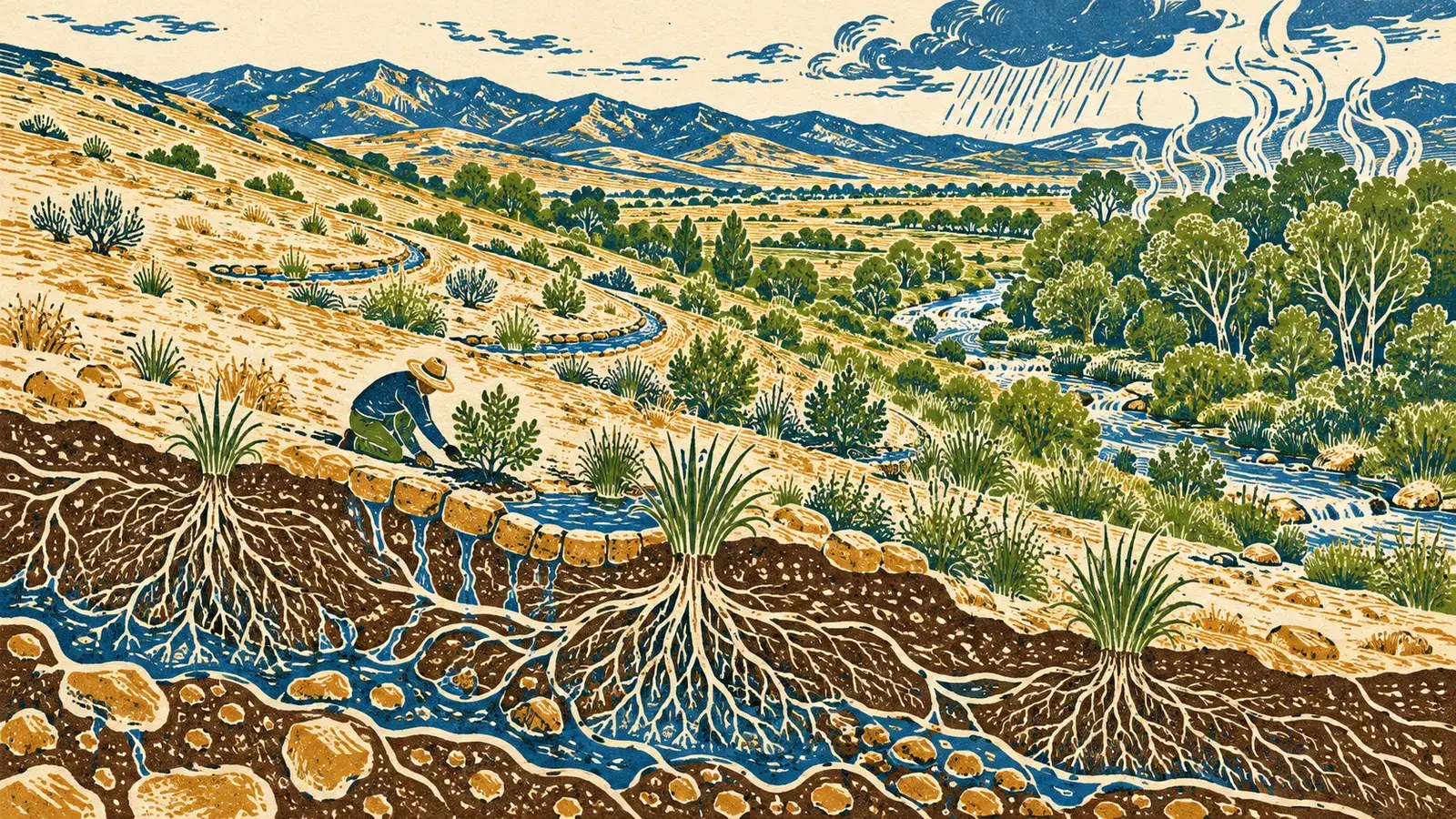
Brett KenCairn, founding director of the Center for Regenerative Solutions and senior climate resilience adviser to the city of Boulder, Colorado, discusses with Nate Hagens the idea that climate change has a neglected half: the degradation of living systems. KenCairn starts from the observation that we cannot stabilize the climate, reverse species loss and protect local cultures without a global movement to regenerate lost ecosystem function.
He explains that the planet is now operating at roughly 50% of its living productive capacity compared with the recent past. He cites the World Atlas of Desertification, according to which around 75% of the Earth's land is severely degraded. We have abandoned around two billion hectares of agricultural land, more than we currently cultivate. Global plant biomass has fallen by 50% since the beginning of agriculture, forests have shrunk by a third, 73% of species are in decline, ocean phytoplankton has fallen by 40%, and marine fish biomass by 60% to 80%. He adds that 10,000 years ago wild mammals accounted for 95% of animal biomass, whereas today humans and domestic animals account for 95%.
KenCairn argues that climate change was described from the outset as a problem with two components. In the 1971 MIT study that led to international discussions, one component was the burning of fossil fuels and the other was land degradation and the disruption of water cycles. He cites a 2017 analysis by Sanderman and colleagues, according to which around a third of the additional carbon in the atmosphere came not from fossil fuels but from the release of soil carbon through land degradation.
He explains that the focus on carbon ultimately prevailed because in 1971 there was not enough computing power to model water cycles. It was also easier to talk about technological change than land use. In Rio in 1992, three conventions were created: on climate, biodiversity and combating desertification, but the third went largely unnoticed. Later, “natural climate solutions” treated land primarily as a carbon sink and fueled carbon markets.
KenCairn distinguishes restoration from regeneration. Restoration aims to return to a historical baseline, while regeneration seeks to strengthen a system's capacities. He gives a yard as an example: rather than planting only the historical grassland with a few species, he wants more photosynthetic capture, soil carbon, habitats and shade. In a Boulder park, if tree cover increases from around 15% to 35%–40% and shrubs are added, photosynthetic capture could rise by 70%–80%, while the water required could fall by two to three million gallons a year.
KenCairn points out that there are historical examples of reversing degradation. During the Dust Bowl, the United States stabilized the Great Plains within roughly ten years by putting millions of people to work building terraces, windbreaks and plant nurseries. Similarly, on China's Loess Plateau, the World Bank and the Chinese government mobilized millions of people with hand tools to build terraces and embankments, turning a degraded region into an ecosystem that supports communities again.
In India, KenCairn describes the natural farming movement that grew out of women's microfinance networks during a period of collapse in the Green Revolution and farmer suicides. Smallholders developed local soil amendments and seed coatings, while participation in one state rose from 800,000 to 1.8 million within three years. In recent years, they have been using cover crops with 30, 40 or 50 species, drawing inspiration from Elaine Ingham.
In Boulder, KenCairn and his team analyzed 500 square miles between Boulder and Longmont using satellite data and water rights. In a semi-arid region where wheat is grown in rotation with fallow periods, the collapse of the Colorado River Compact could leave thousands of decares without irrigation water. If they do not switch in time to species that survive without irrigation, bare soil will remain, raising temperatures and accelerating desertification. KenCairn notes that no jurisdiction oversees the system as a whole.
He argues that forests should be treated as water infrastructure, not just carbon stores. He refers to Anastassia Makarieva's work on the biotic pump: local vegetation influences local climate phenomena. In the Boulder analysis, spring rainfall increased by an inch and a half over 20 years, while snowmelt in forests now comes three to four weeks earlier. Elizabeth Heilman of Wichita State described a county in northern Oklahoma where regenerative agriculture covers 60%–70% of the land and rainfall appears to have increased by 15%–20%, with a minimum scale of around five square miles.
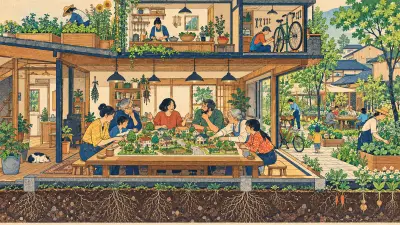
KenCairn stresses that citizen participation cannot rely solely on volunteering. In Boulder, he launched the Community Land Stewards program, which trains “neighborhood foresters” and “gardener-stewards” and pays them around $30 an hour for 10 to 15 hours a month, beginning with school grounds. The aim is to create the social infrastructure needed to maintain shared landscapes so that newly planted trees and biodiverse gardens do not die from a lack of care.
He insists that an economy supporting the care of living systems is needed. Local governments are essential because they manage shared resources, but they no longer have enough resources to do everything themselves. The model resembles the Civilian Conservation Corps, adapted to the present day. Nate Hagens comments that every city could have teams working 10 to 15 hours a week on the ecological regeneration of their area.
KenCairn highlights the connection between ecological regeneration and social cohesion. Neighborhoods that garden together begin sharing meals and developing mutual dependencies. This may sound quaint, but in times of crisis social cohesion is one of the strongest factors in survival. KenCairn suggests starting with a houseplant, then planters, then a garden. A connection with life can be found in a dragonfly, a bird or a squirrel.
His greatest concern is children. He would like every school to incorporate basic skills for caring for living systems into its curriculum, so that school landscapes become part of education. His hope, he says, lies in our ability to stabilize the places where we live, even if we cannot immediately stabilize the entire planet. Hagens closes by saying that the third act of the relationship between humans and the biosphere lies ahead.
Comments