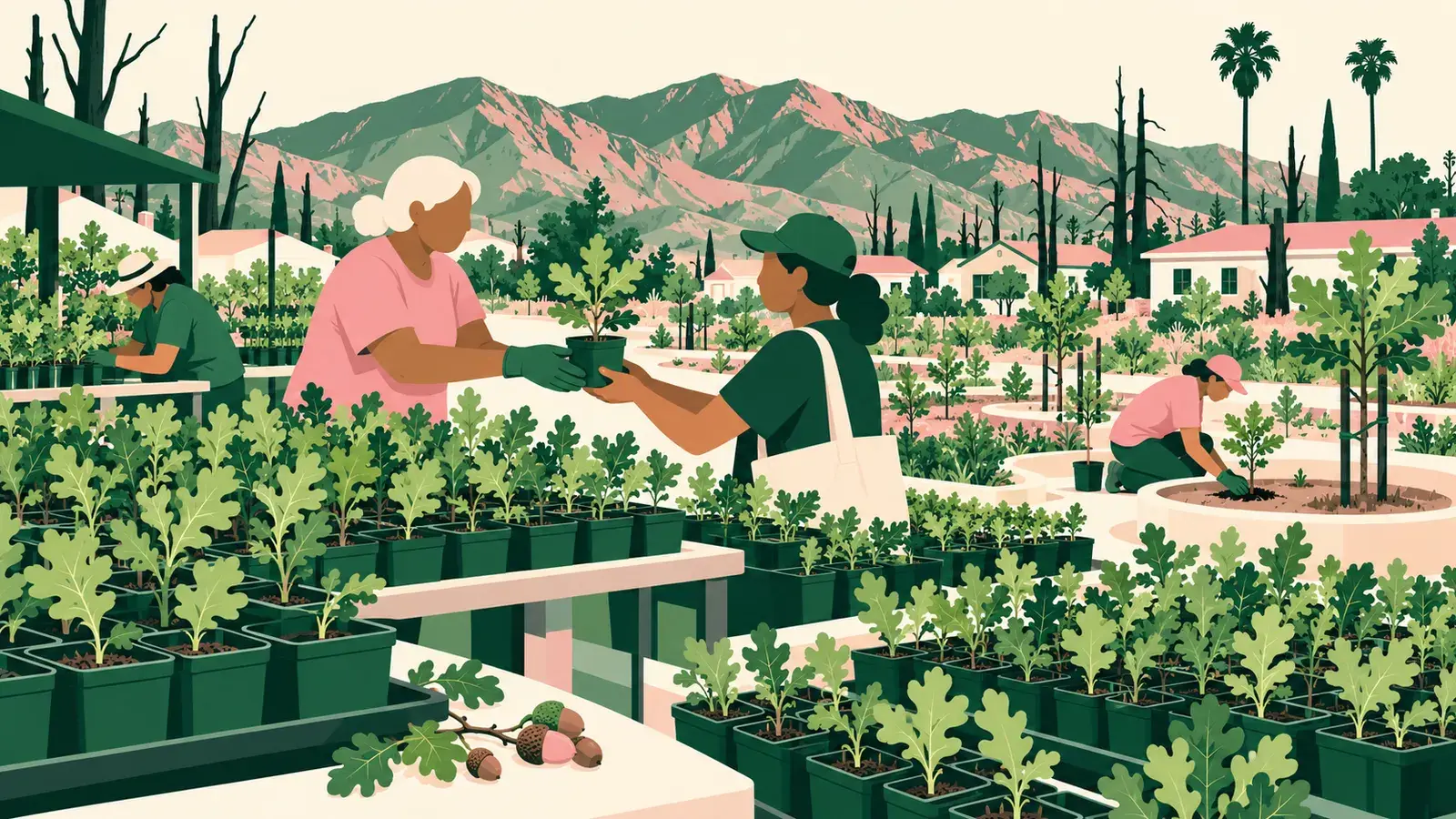
Jim Crouch, a retired science teacher from San Diego County, has repeated the same act ten thousand times: collecting an acorn, planting it and entrusting the seedling to people who commit to caring for it. He says oaks became his mission and his obsession after retirement.
For the first eight years, he worked alone in his backyard, planting acorns in deep pots. He then began handing seedlings to volunteers and opening small nurseries. He named his organisation Re-Oak California, inspired by a group with the same name in the San Francisco Bay Area. His motivation, he says, began with the climate, but he soon realised he could do nothing better for nature than protect a keystone species.
Oaks support a large number of organisms, anchoring entire ecosystems while storing carbon on a warming planet. Yet many parts of California have lost their almost legendary oak canopy: some trees died from insect damage after drought, others were cut down for construction, some were felled illegally, and others were removed after fires.
Crouch collects acorns mainly on private land. He uses an app for hunters to identify who owns each remote piece of land, then sends the owner a letter asking permission to collect them. As he is 75 and walks with a cane after a cycling accident, a growing number of volunteers help him with the harvest. One volunteer even built him a mapping app that combines ownership information, tree locations from iNaturalist and research by Victoria Sork.
Victoria Sork, a professor at UCLA and dean of life sciences, has studied oaks for more than 30 years. Her laboratory, together with the Nature Conservancy, is sequencing acorn DNA to identify which trees are best adapted to survive in a warmer, drier California. The aim is to plant acorns from resilient trees that have survived traumatic conditions. She sees Crouch as one of the links bringing university research to people doing practical work.
The organisation’s new nursery in the Los Angeles area is opening at La Cañada High School on Oak Grove Drive and is intended to serve stricken Altadena. It is Re-Oak California’s sixth nursery. The school provided a garden started three years ago by English teacher Daryl Bilandzija, a former student of Crouch’s. Bilandzija believes that if students plant a few acorns wherever they end up, a neighbourhood could fill with oaks again.
The need in Altadena is great. Some trees survived the 2025 fire, but they are more vulnerable because the collective protection provided by neighbouring trees has been lost. Altadena Green estimates that western Altadena lost around 70% of its tree canopy in the Eaton fire, while losses continue as contractors and owners remove what remains. Meanwhile, the mother-and-daughter team operating as the Los Angeles Humane Society has donated more than 1,000 coast live oaks to Altadena and Santa Monica, while the Los Angeles County Fire Department’s forestry service offers free oaks and other native plants.
Alongside La Cañada, Crouch is preparing a smaller nursery in Santa Clarita, led by 20-year-old Anderson Khalil. Khalil discovered him through Facebook while looking for a tangible way to help the environment and ease his anxiety about the planet’s future. ‘We need to care more about the environment if we want to keep living the way we do,’ he says. Re-Oak California is also planning an eighth nursery in Irvine, its first in Orange County.
The donated oaks are around 15 centimetres tall, with six leaves and a foot-long root. Anyone planting one today may have to wait more than a decade to sit in its shade, but supporters say the wait is worthwhile. Because he uses a cane, Crouch has shifted from manual work to recruitment: he coordinates volunteers to plant, locate trees, collect acorns and build nurseries. He is trying to turn the organisation into a formal nonprofit. The costs of pots, shelves and soil are individually small but add up quickly; for ten years, he has covered the shortfall himself, with donations and the $12,000 brought in by a television feature in 2025. His dream is to have 20,000 trees planted each year.
He says he has never been so ambitious, or worked on a project with so much love and so little selfishness. He is betting that the more people understand what is at stake, the more will keep showing up — even if they are planting trees for a future he will not live to see.
Comments