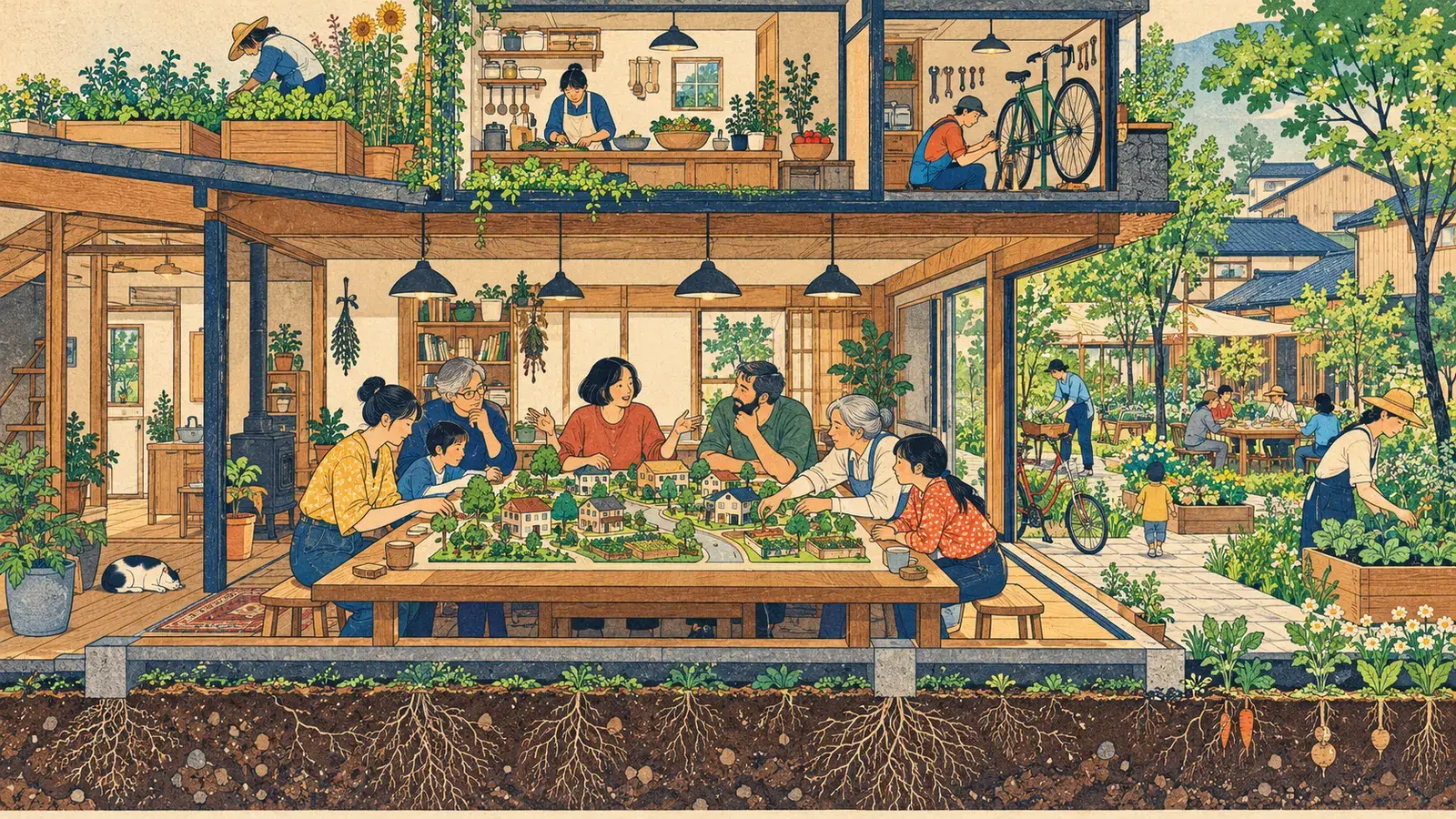
Nate Hagens hosts Rob Hopkins, co-founder of Transition Town Totnes and Transition Network, author of “How to Fall in Love with the Future” and former host of the podcast “From What If to What Next.” Hopkins argues that we face a crisis of imagination: our collective inability to vividly envision radically different and better futures can lead us down bleak or unrealistic paths. He explains that creative visions are not decorative but a force that causes change, and that we need a deep sense of what we are building toward, not just what we are running away from.
The Transition movement began in 2005–2006 in Totnes, a town of around 9,000 people in southwest England, as an experiment in what a community can do when it organizes locally. Their slogan was: if we try on our own, it will be too little; if we wait for governments, it will be too late; if we come together with the people around us, it may be enough and in time. The movement spread to around 50 countries and thousands of groups. After almost 20 years, Totnes has 39 energy-efficient affordable homes, a community energy company and the annual Local Entrepreneur Forum, which has created many businesses.
Hopkins acknowledges that around 30% of all human-caused CO2 emissions have been released since the movement began, but says it is unfair to beat ourselves up. If Transition groups had even a fraction of the money oil and gas companies spent on disinformation campaigns, they would have achieved far more with very few resources. The initiative began with climate change and peak oil as its drivers; today, he says, he would add the rise of fascism. He recalls that dependence on imported fossil fuels was a known vulnerability: between 2008 and 2022, the European Union was sending Russia €18 billion a month for natural gas, while throughout that period we were told there was no money for decarbonization.
On the crisis of imagination, Hopkins refers to articles by George Monbiot, Naomi Klein and Amitav Ghosh that described climate change as a failure of imagination. A study by Kyung Hee Kim using the Torrance Test shows that imagination and IQ rose together until the mid-1990s, but then IQ continued to rise while imagination began to decline. The causes she identifies are a reduction in free, unstructured play, screens and testing in schools. Hopkins adds less time in nature and chronic stress: cortisol shrinks the hippocampus by up to 20%, and because memory and imagination are triggered by the same region of the brain, the future starts to shrink.
His answer is “evidence-based daydreaming”: neither utopias nor dystopias, but stories that start in the present and show how a meeting leads to an action and that action to a larger change. He quotes William Gibson: “The future is already here—it's just not evenly distributed.” In Utrecht, 40,000 bicycles pass outside the station every day; in Germany, there are car-free neighborhoods with 3,000 residents; in Liège, Belgium, a food belt is being built that has transformed the city's economy. In Mouans-Sartoux, France, 80% of school meals are local and organic, at the same cost as the government allowance, and this change was linked to reduced consumption of ultra-processed foods and meat. Everything we need to know, he says, already exists somewhere; he simply brings it together into a coherent narrative.
Hopkins explains that when people remember the past or imagine the future, the same neural pathways are activated. This is why he tries to create “memories of the future”: experiential exercises with laughter, color and emotion that leave a vivid record in memory. He quotes Rilke: “The future must enter into you long before it happens.” When people imagine the world this way, their sense that they can create it grows. This is not toxic positivity: he stresses that he is not saying “the future will be like this,” but “it could be like this.” Awareness of the risks is essential, but it must be accompanied by schools, neighborhoods and institutions that serve as models of 2036.
In 2021, at a Black Lives Matter demonstration, he saw a young woman wearing a T-shirt that read “I've been to the future. We won.” Shortly afterward, he was invited to speak at an Extinction Rebellion event in London and appeared as a time traveler from 2030, describing cycling rush hours, urban agriculture and post-growth. He saw people crying and wanted to understand what was happening. He refers to Rashida Phillips and Black Quantum Futurism: linear Newtonian time is only one way of perceiving time, and colonialism imposed clocks and bells on much more complex local understandings of time. Hopkins talks about “temporal fluidity” and more bioregional senses of time.
His practices include Ruth Ben-Tovim's “Town Anywhere,” where participants build a future world with cardboard, string and tape, and the exercise “making scents of the future,” where they create cocktails of smells to give the future a sensory texture. Smell, he says, can connect memories and emotions with ten thousand scents. He also mentions the music project Field Recordings from the Future with Mr. Kit: recordings from Utrecht, areas with beavers and car-free neighborhoods become ambient music. Their goal is a tour and multisensory time portals that show the future is possible.
On the question of whether we can love a future with fewer material goods, he points to a 2024 study by Jason Hickel and Dylan Sullivan, according to which the world can provide a decent standard of living for 8.5 billion people while consuming just 30% of today's global resources and energy, leaving a surplus for public luxury, science and social investment. The problem is not technical feasibility but cultivating “longing on a large scale.” He quotes Don DeLillo: “Longing on a large scale is what makes history.” Capitalism, he notes, is excellent at cultivating longing, and that is why we need artists, poets and storytellers on the side of life.
On grief, Hopkins considers organizations such as Good Grief Network and the work of Joanna Macy important. He says we may need to grieve the idea that we can be in Bangkok, Singapore, Los Angeles and New Zealand within a few days. He stopped flying in 2013 and travels by train; he arrives calmer, watches the landscapes change and gets work done. He adds that he changed his mind about the importance of inner transition: women he worked with persuaded him that solar panels and organic carrots are not enough, and that a culture of support, meetings you enjoy and conflict management are needed. He also feels that the artistic and activist parts of himself are coming back together, which is liberating for him.
Asked whether fear or longing is more motivating, he replies that we are different: IPCC reports motivate some people, but Extinction Rebellion's message of collapse probably mobilized only 5% of the population. Solitaire Townsend, he says, described how the climate movement has done an excellent job with the first Shakespearean act, with its drama and villains, but is not doing the second act, where you meet allies, fall in love and discover skills. The civil rights movement had the Black Panthers with free school meals and mutual aid, but also Afrofuturist writers such as Octavia Butler. We need all these forms, he says: both those who warn and those who fill the future with possibilities.
As a personal practice, Hopkins reads writers such as Adrienne Maree Brown and Walidah Imarisha, photographs things that look like the future every day, does yoga every morning and is working on a comic about a time machine with Belgian cartoonist Thomas Liheira. He suggests that listeners subscribe to “The Time Traveler's Gazette” newsletter, seek out positive news and visit places that embody the future, as he did as a student in Denmark. He mentions the young Annaïg Plassard in France, who wore a time traveler's outfit to a demonstration with a sign reading “I've been to the future. We won” and went viral. Hopkins wants to act as a messenger from the future who tells today's activists: “Keep going, you're doing the right thing.”
Asked what he cares about most in the world, he answers, “Life and life's ability to create more life.” With a magic wand, he would immediately bring down oil and gas companies, calling them the most antisocial and anti-life institutions on the planet. When Hagens points out that this would mean billions of people dying in the short term, Hopkins replies that he would put a “thought worm” into executives' minds so they would plan to dismantle their companies at the most ambitious possible pace consistent with climate targets. He closes by saying that we live in a time when everything can be reimagined, something that happens only every few hundred years.


Comments