
In the third part of his series on how to think about the future, Nate Hagens argues that we are facing a very serious turning point in the global economy and our civilization. As he puts it, he wants more people to be able to imagine, discuss and engage with the unknown so that we move toward life and continuity and away from dystopia—although some dystopian elements are now inevitable or already happening.
Before presenting complex future scenarios in part four, he adds a conceptual tool from biology. In the 1950s, developmental biologist Conrad Waddington was trying to understand how a single fertilized cell becomes an entire organism. All cells have the same DNA and start from the same point, yet a heart cell, a liver cell and a neuron end up becoming completely different things.
Waddington imagined the problem as a landscape: a ball at the top of a series of hills and valleys. A stem cell has the potential to become many things, but as it develops, it rolls downhill, enters a valley, encounters forks and closes off possibilities. The valleys are not all equally deep: some are deep with steep sides, others shallow, while the ridges between them vary in height. Hagens believes this model maps directly onto the futures of human civilization.
Humanity, he notes, does not choose futures as though ordering from a Chinese restaurant menu, where everything is equally available. We are already moving through a changing landscape. Some futures are downhill: the path of least resistance, favored by existing momentum and incentives, requiring the least new energy or coordination. Others are uphill: they require continuous effort to reach and continuous effort to remain in once we get there. A farmer in Malawi and a software engineer in San Francisco stand at very different points in this landscape.
He uses a lake as an example. A young, clear lake teeming with life gradually accumulates sediment and nutrients and ages until it becomes a wetland. People can slow that aging through regenerative techniques that require intention, planning and energy, or accelerate it by adding fertilizers, sewage or phosphorus. An overload of nutrients can trigger an algal bloom: the water turns murky, light no longer reaches the bottom, plants die, oxygen levels fall and fish die. The lake shifts into a new stable state: a murky lake dominated by algae.
The crucial point is the asymmetry. The shift from a clear lake to a murky one can happen within a few years of excessive nutrient loading. The reverse transition, even if pollution stops completely, can take decades or longer because the entire ecosystem must be rebuilt: plants, oxygen, fish populations, nutrient cycles and ecological webs. The system has settled into a new valley, and getting out requires climbing a ridge that did not exist before.
According to Hagens, the same pattern appears in human societies. A transition from democracy to authoritarianism during a crisis can happen over years, decades or even months. Fear and uncertainty grow, people accept restrictions, a leader concentrates power, surveillance expands and opposition is suppressed. Hagens cites the slow erosion of the Roman Empire, Peru in the 1990s and Tunisia a few years ago.
The reverse journey is much harder. Rebuilding democracy requires independent courts and a free press, habits of dialogue and disagreement, institutional knowledge, a population that remembers what self-government means, and above all trust—which Hagens calls perhaps our most valuable resource. This transition can take at least a generation, often longer, and sometimes never happens. Hagens connects this asymmetry to what Ugo Bardi calls the Seneca effect: things grow slowly and collapse suddenly.
Organized systems with high levels of trust, such as democracy and civic discipline, require energy, effort and social participation. Degraded systems characterized by low trust and coercion are, in thermodynamic terms, lower-energy states: that is where the system rolls when we stop investing collective effort. This is the default valley.
The practical lesson is that the easiest futures are not necessarily the most desirable. The most desirable futures for humanity and the biosphere require persistent climbing—and persistent effort to stay there. If we stop climbing, gravity, both social and ecological, will pull us back into a valley we do not want. The landscape is not static: energy descent, climate change and biodiversity loss continually reshape the valleys.
In today's context, economic contraction with competitive geopolitics and concentrated power is a downhill path. It requires no conspiracies or villains; it is enough for people to be afraid and for leaders to respond as they have for thousands of years: with consolidation, control, surveillance and walls. By contrast, economic contraction with cooperative geopolitics and shared power is uphill: it requires trust precisely when trust is hardest, leaders who share power when incentives to concentrate it are strong, and communities that coordinate when coordination is costly and exhausting.
Uphill does not mean impossible. Every living cell has accomplished an uphill undertaking, salmon swim against the current to spawn, and redwoods draw water hundreds of feet upward against gravity. The landscape metaphor does not say the climb is impossible; it says there is a cost, and that if we stop before reaching a stable point, we will slide back. This applies at every scale: personal health, relationships, community, national and international governance, and the biosphere.
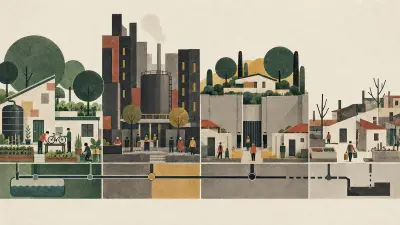
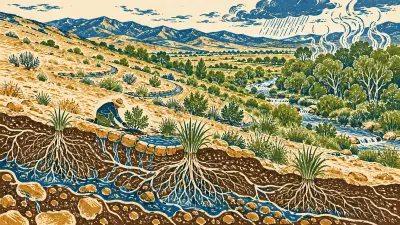
Hagens proposes four terms to keep in mind. Valleys are stable states where systems settle and reinforce themselves; ridges are the barriers between them. People can create winding uphill paths to cross ridges that would otherwise be impassable: social trust, soil restoration and cooperative institutions are such paths. They can also erode the path through action or neglect: depleted aquifers and soils, the loss of political norms, surveillance infrastructure that is never dismantled.
When part four arrives with its complex scenarios, Hagens asks us to consider where we see deep valleys and open terrain, which paths lead uphill and which downhill, where we ourselves stand, and whether the futures we want match those indicated by physics and the data. The same concepts, he concludes, apply to personal life: everyone has valleys and ridges and erodes or opens up their path every day, whether they realize it or not.

Comments