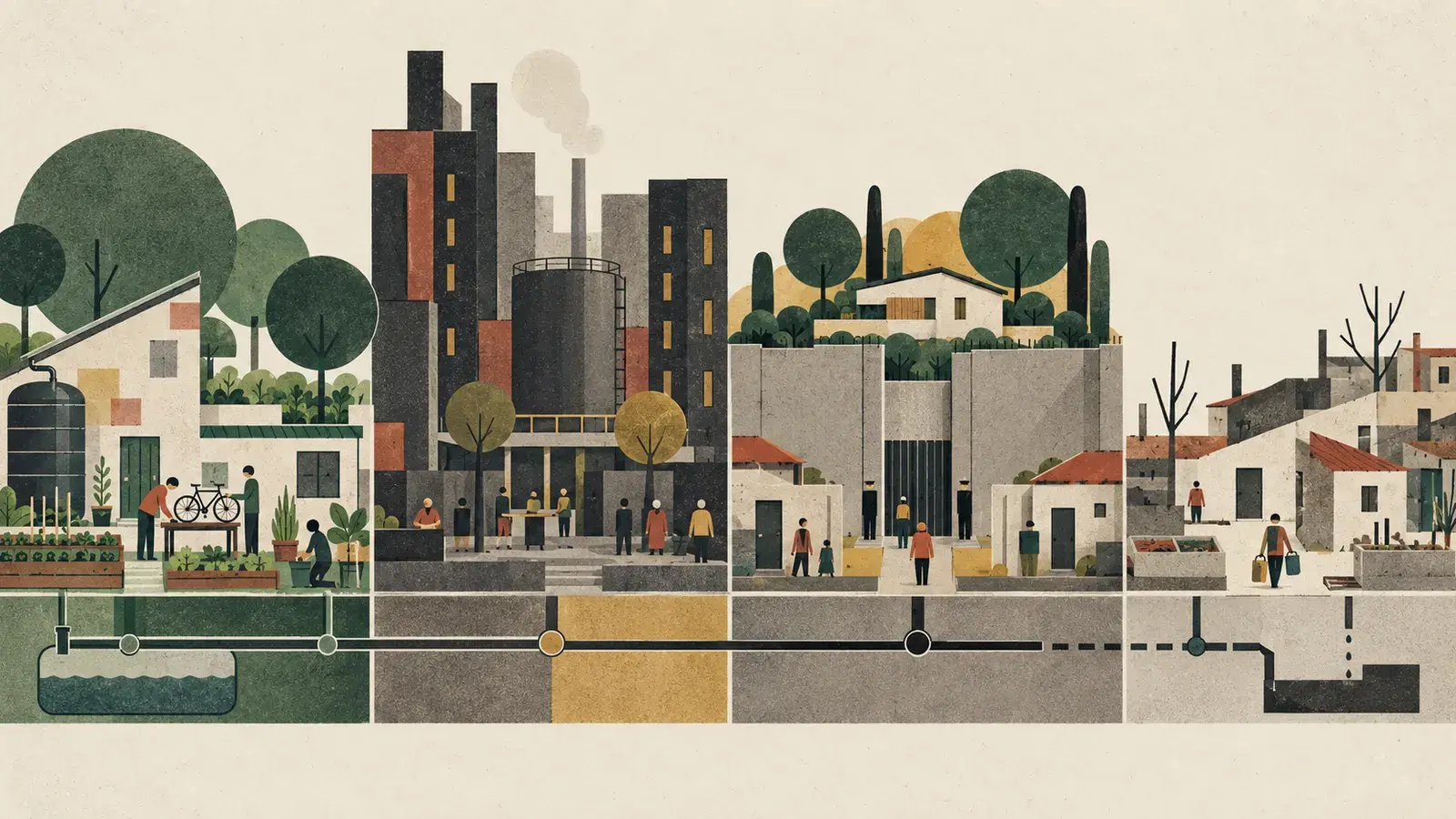
In the fourth part of the “How to Think About the Future” series, Nate Hagens recalls the foundations he laid in previous episodes: coupled systems, the risks of shortages and an image of the future as a landscape of ridgelines and valleys. Today, he says, he uses four frameworks—economic growth or contraction, power, geopolitics and the Earth system—to build four complete worlds, not for anyone to choose one, but to practice thinking about possible futures, risks and interventions.
Hagens makes clear that the four futures are not equally likely. Energy limits, resource depletion, excessive debt and ecological overshoot pull toward contraction; this is why he does not build a “green growth” scenario, because continued material expansion and healing the biosphere on a global scale pull very strongly in opposite directions. He adds that the frameworks are not independent: when resources become scarce, governments concentrate power, fear makes citizens accept it, and growth requires cooperative geopolitics.
The first scenario, the Long Repair, is what he considers the ambitious path: difficult but achievable and worth striving for. It combines contraction with ecological stewardship, widely shared power, cooperative geopolitics, regional self-sufficiency—not complete isolation, but shorter supply chains—and technology that makes people more capable, such as a culture of repair, regenerative technology and open designs.
In daily life, the Long Repair means fewer material goods, less travel and more local, seasonal food, but a richer social life: neighbors become practically important again, local decisions carry more weight, and competence becomes a stronger status signal than qualifications or fame. Hagens believes work becomes more hands-on, with more repair, caring for people and growing food, and fewer of what David Graeber called “bullshit jobs.”
This already exists in small forms, he points out: transition towns, regional food networks, community land trusts, energy cooperatives, makerspaces and repair cafés. But it is no utopia: people grieve the futures that contraction rules out, and there are conflicts and losses. This scenario is the hardest to achieve and the easiest to lose, because it depends on legitimacy and trust; once a large share of people become convinced that the pain is not being shared fairly, the glue holding this world together dissolves.
The second scenario, Mordor Persists, is growth that continues on paper while deepening biophysical and ecological overshoot. Hagens constructs it from a Mordor-style economy, a captured democracy where gains go to a small minority, a geopolitical danger zone, the quiet unraveling of the Earth system and technology geared toward consumption and dependence. He explains that liquidating the natural world concentrates profits, and that concentration tightens its grip on a hollowed-out democracy.
The experience of daily life in Mordor depends on one's position: for the top 10 to 20 percent, life feels busy, stimulating and comfortable, but comes with anxiety, harder work for less, bad news and managed information. For the bottom half to 70 percent, life is precarious and the system does not work for them, but the alternatives seem worse. Both groups experience a sense of unreality: official figures proclaim that everything is going well, lived experience says the opposite, and this fuels cynicism, conspiracy thinking and apathy.
Hagens reminds us that this is the experience of Mordor from rich countries. For the Global South—in cobalt mines, clothing factories, places where plastic is sent for recycling or forests are cleared for soy and pasture—Mordor is not a scenario but the reality of the past thirty or fifty years. Material comfort at the center of the system has always rested on physical insecurity at its edges.
Two things break this world: fragile interdependence, where one chokepoint can trigger a global domino effect, and slow ecological unraveling, which eventually pulls the rug out from under growth itself. As Hagens puts it, “the Earth hits last.” The real tragedy is not that Mordor continues forever, but that it burns through the ecological foundations, institutions and resources needed for a smooth transition; if we get out in time, we can move toward the Long Repair.
The third scenario, Fortress World, arrives when contraction comes and the powerful choose to hoard rather than share: contraction without ecological stewardship, coercive feudalism, Cold War geopolitics, triage of zones within the Earth system, and powerful technology for control, surveillance and rationing. The logic is old: contraction breeds fear, fear calls for a strong hand, external threats justify surveillance and military spending, and permanent emergencies seem to demand someone in charge who acts quickly.
In daily life, Hagens describes something like The Hunger Games: controlled lives, rationing, surveillance, hard borders and a gray order. Certain zones near critical infrastructure are protected, while peripheral zones and ecosystems are abandoned. Most people feel resignation and constant low-level fear; continuous surveillance creates hypervigilance that hardens into emotional numbness. Fortress World is fragile because control is expensive, and as energy and complexity decline, the regime must choose between spending to control people and spending to provide for them.
The fourth scenario, the Unraveling, is the dark one: the collapse of large-scale coordination, contraction without ecological stewardship, local strongmen, active conflicts, a collapsing Earth system and retreating technology. Days revolve around immediate needs: where the water is, which fields are producing, who has fuel and what they want for it. The institutions of previous generations seem like fairy tales, the threat of violence lingers in the background, and health deteriorates without pharmaceutical supply chains. Yet even there, community, love, care, stories and laughter exist; the worst part is not the absence of joy but the complete absence of reserves, as cheap fossil energy provided endless second chances.
Hagens connects the scenarios to the idea that “stable does not mean good”: Mordor is stable like cancer, self-sustaining and seemingly vital, while our main indicators measure blood flow to a tumor and call it healthy. By contrast, the Long Repair looks like failure by today's growth criteria, and this creates cultural fear; the human nervous system cannot easily distinguish whether a tumor is shrinking because the patient is dying or because they are healing.
The actual future, he says, will probably be a patchwork: some regions will approach the Long Repair, others will live under Fortress conditions, and others will be in various stages of Unraveling. We are in a transition zone and the ridgelines are not yet fixed; but every year of soil degradation, every loss of trust and every layer of surveillance makes those ridgelines steeper. No one is steering the whole system, but at the level of a household, a community and a small plot of land, choice is real: we build trust, protect a piece of the biosphere and put tools in people's hands. When the transition closes, those who dug paths beforehand will be able to climb toward better valleys.

Comments