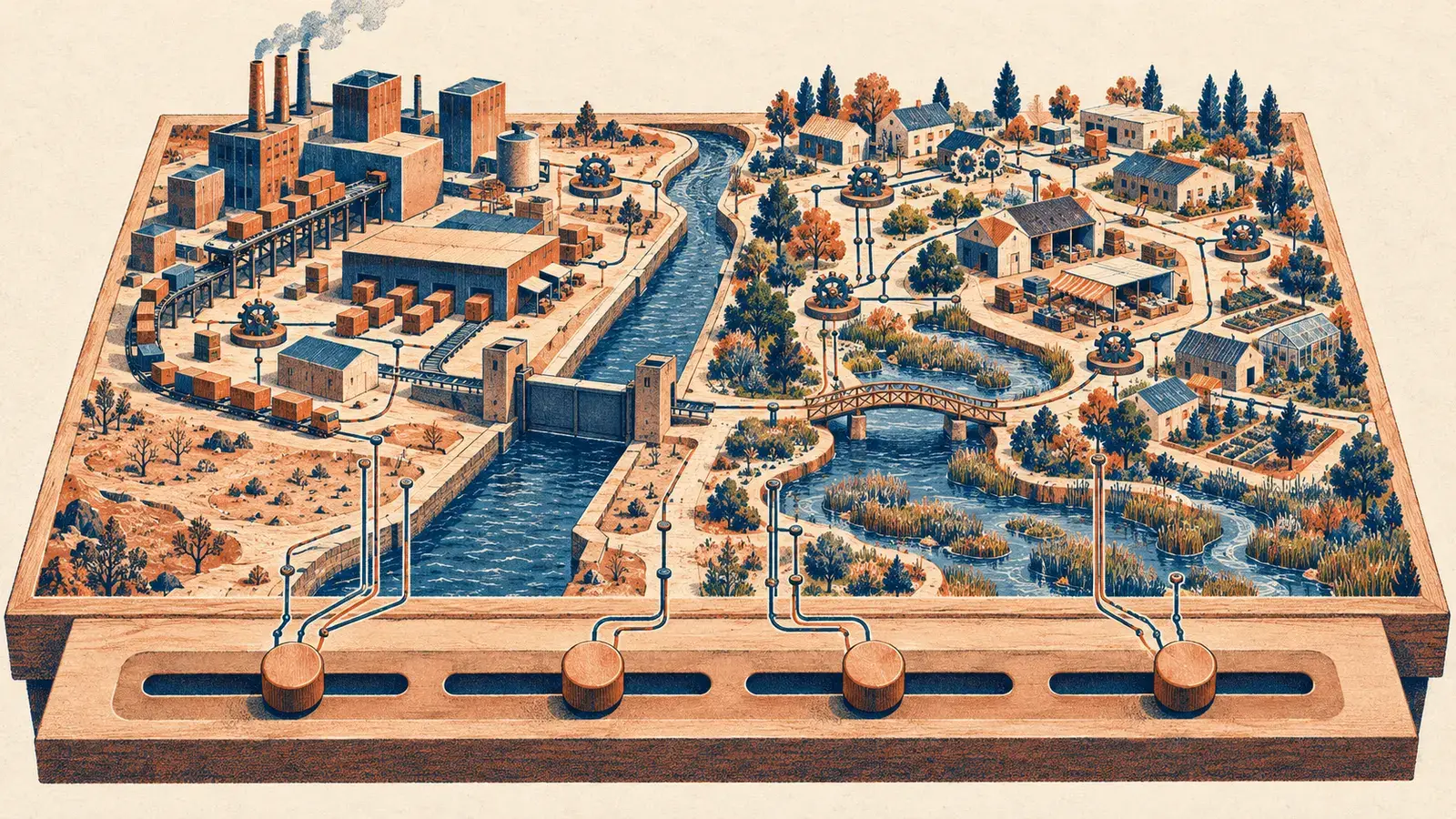
In the second part of the series “How to Think About the Future,” Nate Hagens starts from his central argument: the future is not a prediction but a landscape of possibilities. As he explains, when people settle on a single vision of the future, they begin to judge everything else against it. He considers it more honest and more useful to keep several possible futures in mind at once, even if no one knows which will come to pass.
He revisits four scenarios he has used for years. The first axis is whether the global economy continues to grow or begins to shrink; the second is whether this happens close to ecological limits or with further overshoot and liquidation of the living world. The four quadrants are green growth, moreor, The Great Simplification and Mad Max. He makes clear that the real world will not fit neatly into one quadrant, nor will every region be in the same one; the scenarios serve as guides.
At the same time, he points out that the future is not just an economic story. Two people may agree that contraction is coming but imagine completely different lives because they have different power structures, geopolitical settings and ecological conditions in mind. That is why he introduces a second grid, focused on power, and defines four sources: military, political, financial and technological power.
According to Hagens, military power is the oldest and ultimate backstop for the other three. Political power concerns who makes the laws and appoints judges. Financial power has grown enormous over the past fifty years and drives politics in many places, while technological power concerns platforms, data and algorithms. He notes that 26 people hold financial claims on biophysical reality equal to those of the poorest 4 billion people.
The power grid has two axes: how concentrated or distributed decision-making power is, and how widely or narrowly material benefits are shared. Hagens calls the first quadrant “civic ideal”: broad participation and broad benefits, as in functioning democracies with strong public goods. He calls the second, concentrated power but broad benefits, “stewardship deal,” citing Singapore and the developmental states of East Asia as examples; it is stable, but depends on the competence and goodwill of those at the top.
The third quadrant, broad power but narrow benefits, is “captured democracy”: everyone votes, but institutions are democratic in name only and the gains go to a few. Hagens believes much of the West is already there, and during contraction this becomes the most unstable quadrant. The fourth, concentrated power and narrow benefits, is a form of “forced feudalism,” meaning kleptocracy or colonial extraction; during contraction it is the most dangerous, with violent resistance or social collapse. He adds that during growth, the question of “who gets what” looks like a matter of fairness, while during contraction it becomes a question of whether there is enough for food and heating.
The third grid is geopolitics. The first axis is cooperation versus rivalry: can the major powers coordinate on shared problems? The second is interdependence versus relative self-sufficiency. Hagens notes that true self-sufficiency is almost impossible at today's level of complexity: even North Korea depends on China for fuel, while the US is nearly self-sufficient in energy but heavily dependent on others for semiconductors and medicines.
Within the geopolitical quadrants, he describes the cooperative and interdependent ideal of globalization; cooperation with relative self-sufficiency, which he calls “friendly neighbors with good fences” and considers perhaps the most stable over the long term under energy contraction; rivalry with interdependence, where every economic node becomes a potential weapon; and rivalry with self-sufficiency, a new Cold War scenario with a lower risk of cascading collapse but a higher risk of direct military conflict.
Hagens believes the world is now in the quadrant of rivalry and interdependence. He cites the consequences of the closure of the Strait of Hormuz as current examples: the Philippines declared an energy emergency, Bangladesh closed schools to save electricity, and Japan released oil reserves. Everywhere, the response is a move toward greater energy security and self-sufficiency; the question is whether this will happen cooperatively or competitively.
The fourth grid is different because it describes boundary conditions rather than human choices: the Earth system. The first axis concerns pressure from global warming, not just the average rise in temperature but variability and extreme events: heatwaves, droughts, floods, fires, shocks to crops and compound events. The second axis is the integrity of the biosphere: soils, freshwater, forests, fisheries, pollinators and food webs. He points out that seven of the nine planetary boundaries have already been crossed.
The Earth system quadrants begin with “strained but workable,” where the climate creates pressure but systems still function with some room to spare. Next comes “quiet unraveling,” the silent weakening of the biosphere: degraded soils, collapsing pollinator populations, declining fish catches and falling water tables. The two worst are “hothouse triage,” with continuous emergency management, and “cascading breakdown,” where severe climate stress and disruption of the biosphere occur at the same time. None includes a fully healthy climate or biosphere.
Hagens explains that some degradation is already locked in because we have burdened the atmosphere and oceans and significantly degraded soils. Yet he insists that choices still matter: regenerative agriculture can rebuild soil health, ecosystem restoration can recover functions of the biosphere, and many people are working on ideas for global cooling and regenerative solutions. The trajectory is largely set, but the destination remains flexible.
He does not give technology a separate grid because he sees it as an amplifier of the context in which it operates. The same artificial intelligence system can be a tool for liberation or authoritarian control, depending on the power structure. He quotes Dennis Meadows: if someone is coming at you with a hammer and swaps it for a screwdriver, they are still coming at you. He adds that AI data centers represent enormous new energy demand, with global electricity demand from data centers expected to double by 2030, mainly because of AI. Likewise, demographics do not have their own grid; fertility is falling faster than any forecast, with South Korea at 0.72 children per woman in 2023, and the effects will show up within the other grids.
He closes by saying that no grid on its own is a scenario; scenarios are combinations of layers. We will not live in a generic “Great Simplification,” but in a version of it with a specific power structure, geopolitical setting and ecological state. In the third part, he plans to put together a handful of scenarios to show the differences in everyday life and shift the discussion from predictions of a single outcome to robust choices under real uncertainty.



Comments