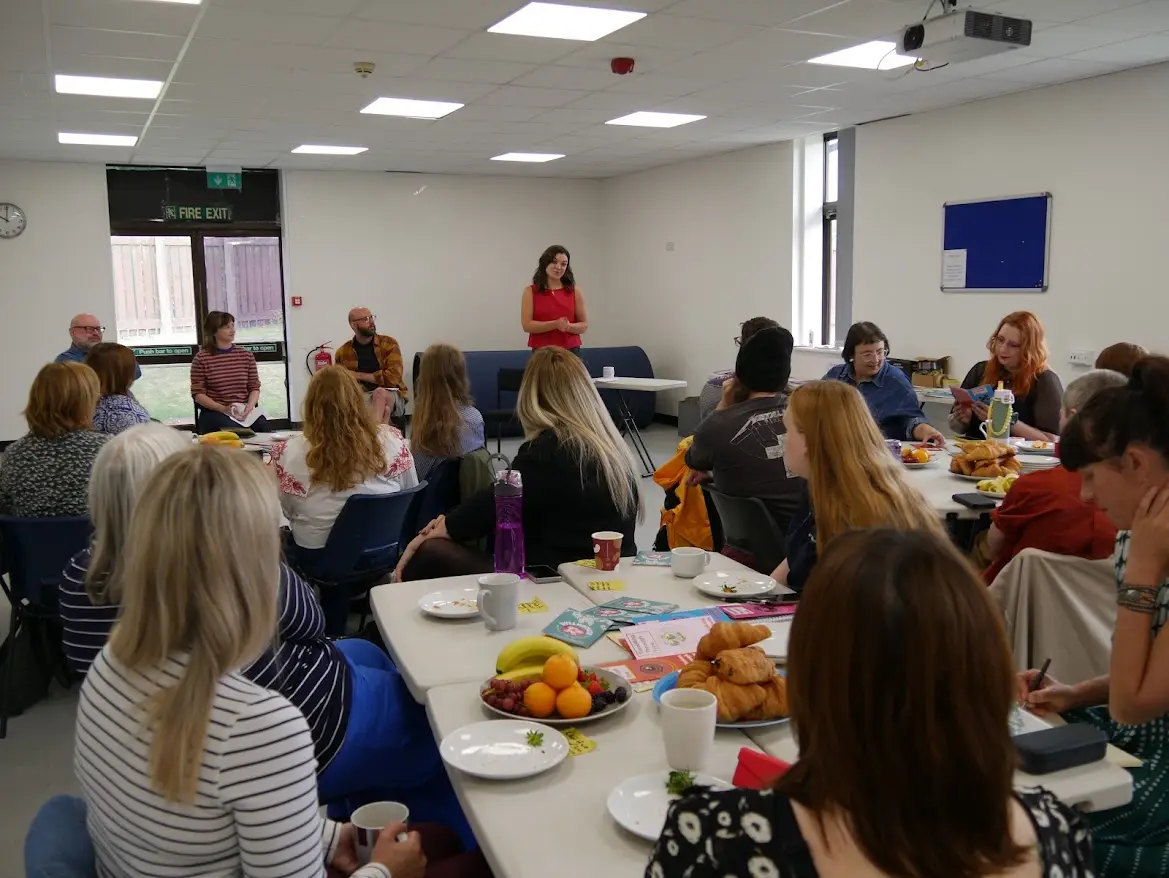
Dingy Butterflies CIC, a community arts organisation based in central Gateshead in northeast England, created a set of six activities and resources for residents, groups and schools to explore their area's past, present and future and consider how they can become good ancestors for future generations. The activities were presented at a community event in early July 2026.
The starting point is Tyne Derwent Way, a project exploring the route from central Gateshead, along the rivers Tyne and Derwent, to the Derwent Valley. The area was once a major centre for coal mining and shipbuilding and retains many historic buildings and landmarks. The best known is Dunston Staiths, a large wooden structure once used to load coal onto ships, which now stands in the river as a reminder of the area's industrial past.
Dingy Butterflies CIC has been working with Tyne Derwent Way since January 2025. As part of the ongoing Traveling through Tyne project, visual artist Chris Folwell and theatre-maker Liv Hunt invited residents and groups who had taken part in earlier workshops to discuss what they would like to see in their local community. The groups included a primary school, a secondary school, a youth group, a care home, an arts and wellbeing group for retired people and a heritage site along the route.
During the project, the artists met regularly with Justine Boussard, founder of the Amateur Ancestor Project, a heritage engagement initiative that helps people view today's problems in the context of deep time. They discussed concepts such as deep-time thinking, active hope and imagination activism. They asked “What if?” questions and built time machines to explore the past and future with optimism.
The aim was to help residents think about their community's future and actively become good ancestors. As author Amitav Ghosh says, the climate crisis is also a crisis of culture and, therefore, a crisis of imagination. If that is true, supporting more people to reflect on their culture and imagine how things could be better is a powerful act. The creators note that approaching the planetary emergency through belonging, hope and connection with nature can better equip communities for our times.
The discussions and creative workshops resulted in six activities and accompanying resources. Although designed for Tyne Derwent Way, they can be used by anyone in different communities as imaginative activities exploring the past, present and future. They were presented in early July 2026 at a community event whose guests included participants, community and youth workers, teachers, academics and residents. The resources are available as six printed leaflets at local locations and along the route, as well as PDFs on the Dingy Butterflies and Tyne Derwent Way websites.
Jack Burton, heritage officer for Land of Oak and Iron, said the project moved him and resonated with thoughts he had been having since becoming a father four years ago. He cited a Native American proverb: “We do not inherit the Earth from our ancestors; we borrow it from our descendants.” He said the resources made him think about the future he is borrowing from his sons' generation and how easy it is to feel powerless in the face of change. But change begins with imagination, and it was good to see that ethos embedded throughout the resources: “Everything around you was once imagined by someone.”
The activities are designed as a starting point for exploring your own community. Users can draw on their imagination, develop their own “What if?” questions and build a personal time machine for their local area. Traveling through Tyne, the creators conclude, is about looking closely, thinking deeply and imagining boldly alongside the people and places that make up where you live.


Comments