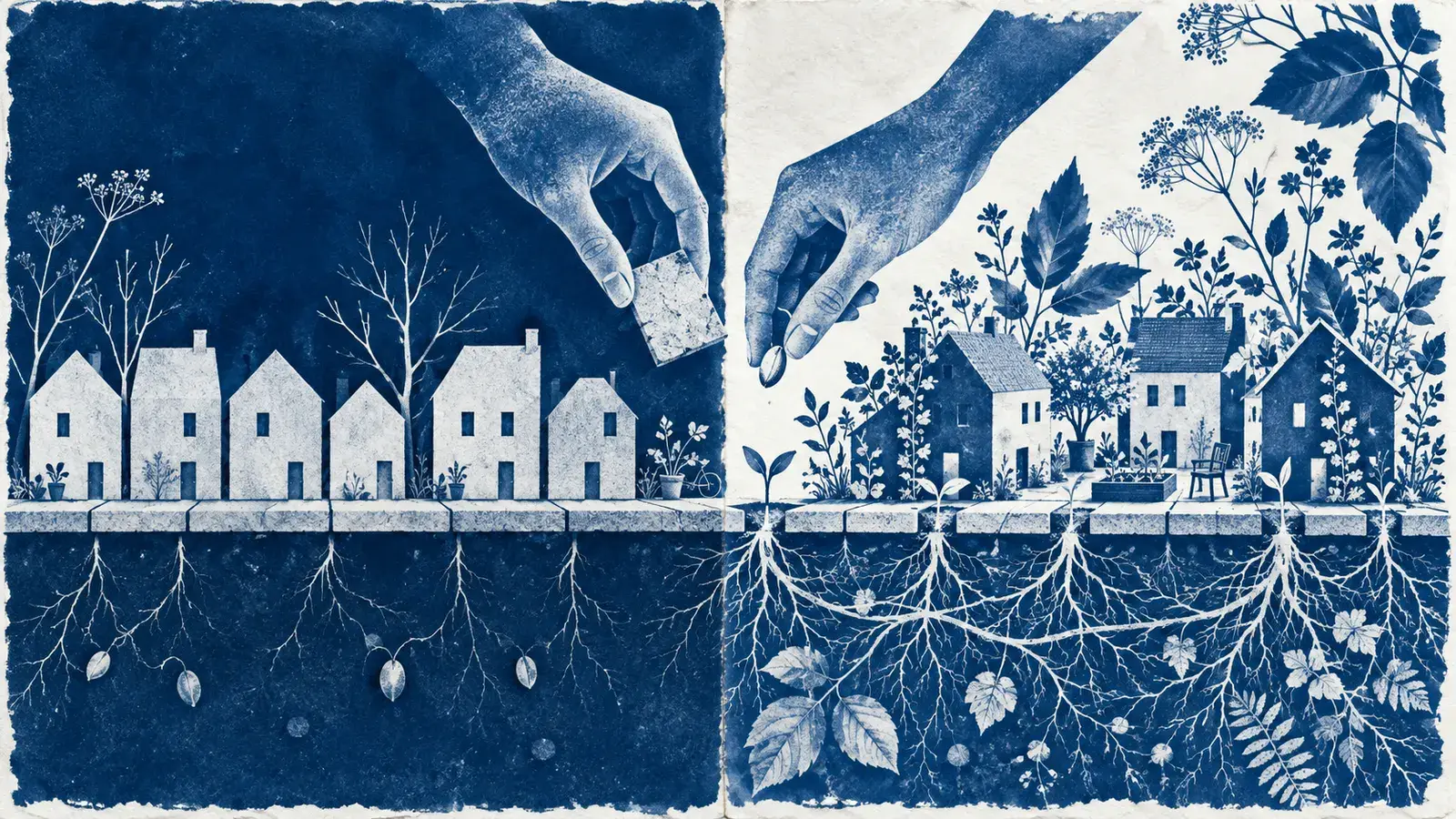
In this episode, host Nate Hagens does not repeat the broad policy directions he set out the previous November. Instead, he tries something more practical: a set of small, specific and slightly unusual things people can do in their lives to respond to what he calls the “metacrisis”.
First, he sets the context. The metacrisis, he says, is not a collection of separate problems but the symptoms of one large interconnected system. We have crossed seven of the nine planetary boundaries. The cheap, high-quality energy that built everything around us is running out, and we are filling the gap with ever more debt. Monitored wildlife populations have declined by roughly three quarters within his lifetime, while many people, especially young people, are anxious, lonely or dependent on stimuli they carry in their pockets.
Politics has hardened into tribal displays, artificial intelligence is accelerating risks, trust in institutions and the media is eroding, and beneath it all lies a crisis of meaning. The painful point, he explains, is that this is not going to be “fixed”. The metacrisis is a predicament, not a problem with a solution. But it can be softened a little, a lot or not at all, depending on what we do individually and collectively over the coming decades.
Drawing on his experience in complexity science, Hagens believes that small differences in initial conditions can lead to very different outcomes. That is why he talks about “seeding” the future rather than choosing it. He also makes an important distinction: things that simply help us and our families weather the storm are different from things that change the storm itself. All his suggestions belong to the second category; if enough people act on them, something may shift in the world.
His first suggestion is to measure our returns in something other than money. When we invest time, energy or money, he suggests asking what we actually got back: better health, a friendship, an ecosystem we helped recover, an animal that exists because of us, or something beautiful that was not there before. Money, he says, creates a recursive loop in which more money chases more money, and we have almost completely financialised the human experience.
The second intervention is to rehearse loss before it arrives. Research on loss aversion shows that we feel losses about twice as intensely as equivalent gains, and the coming decades will bring real losses. His practical suggestion is to spend a few weeks cutting spending or driving by 30%, and see what we actually miss. He also asks us to write down our own “enough” in terms of income, housing, possessions and recognition, and reduce our fixed expenses towards that level. Someone who needs less, he explains, is harder to manipulate.
Next, he recommends taking on a younger person as an apprentice. Knowledge and skills with a broad outlook reside in scattered individuals and are lost unless they are deliberately passed on. Human cultures, he stresses, do not change by decree but through transmission from person to person. He therefore calls on older people to share a skill, a way of seeing or some wisdom with someone younger.
The next suggestion concerns dopamine. Our brains respond not to how good something is, but to how good it is compared with what we expected. A phone, for example, provides small bursts of neurotransmitters many times a day and raises our threshold, making a walk in the woods or a meal with a loved one seem flat. He mentions a study in which people were left alone in a room, and many preferred to press a button that gave them a mild electric shock rather than sit with their thoughts. His advice is not to stop the habit, but to add friction: charge the phone in another room, set the screen to greyscale, or have a beer on Friday instead of a martini every night.
He also suggests curating our status environment. Our brains evolved to gauge status among roughly 150 people, whereas the media now expose us to billions. He advises spending time with people who admire the right things: kindness, patience, a well-stocked cellar, the ability to play music or to reflect before answering. We should say it aloud when we admire people who make, grow and care for things. He says he learned this when he left Wall Street and spent time among farmers.
He also recommends coordinating with a small group of close friends. At its core, the metacrisis is a failure of coordination, and manipulative people thrive when everyone else is scattered and alone, just as predators isolate their prey. He suggests finding three to eight people and regularly doing something tangible together: a food-buying group, a tool lending library or a monthly work session. From time to time, we should do something physically demanding together, because deep trust is built when we are tired and share hard work, not over coffee or an online chat.
Hagens asks us to break the chain of negativity. Moods are contagious, and pessimism spreads like a virus. We should act as a circuit breaker: bring lightness, smile at strangers, be the first to perform a small act of kindness. He does not mean ignoring constraints, but avoiding adding despair to what we pass on. A related suggestion is to be wrong in public. The cost of changing our minds fuels polarisation. When we admit “I was wrong” in front of others, we lower the price of reconsidering for everyone. He has done this himself on the show, including with his November 2018 prediction about peak oil, and the response was almost always the opposite of what he had feared.
The intervention “treat today as the tomorrow you keep promising” targets procrastination. As animals, he says, we discount the future and put off costs. But any real response to the metacrisis requires us to start now. He suggests choosing one thing we have been putting off and doing a little of it today. In the same spirit, he suggests taking off our shoes and standing on the soil. We have placed layers between our bodies and the earth, and we do not protect something we do not feel connected to.
He asks us to learn a pre-industrial skill, even badly. Grow a food crop, learn a musical instrument or learn to repair one type of broken object. We do not need to become good at it; we need to be the one person who knows or is learning. In a world with less energy, millions of people who make, repair and grow things will be needed, and this knowledge survives only if we start now.
When it comes to species, he distinguishes saving one animal from changing the odds for an entire lineage. He suggests keeping cats indoors, putting stickers on windows that birds fly into, and turning off outdoor lights at night during migration. He also suggests supporting local land trusts and attending land-use planning meetings. Relatedly, he calls on us to regenerate something living. He mentions Brett kenCairn and the estimate that Earth is operating at roughly half its biological productive capacity, but that changing land use can bring much of it back, as happened on the southern plains about a hundred years ago.
Finally, he urges us to train as though we will be needed. Comfort has become the default, so he asks us to push ourselves physically, intellectually and spiritually, to become capable nodes when the time comes. He concludes that none of these actions solves the metacrisis, because nothing will solve it. The aim is to influence it, soften it and change the initial conditions. If one person does these things, he says, they gain a healthier life; if thousands do them, a subculture emerges; if millions do them, the mechanisms of the problem itself may begin to shift.

Comments