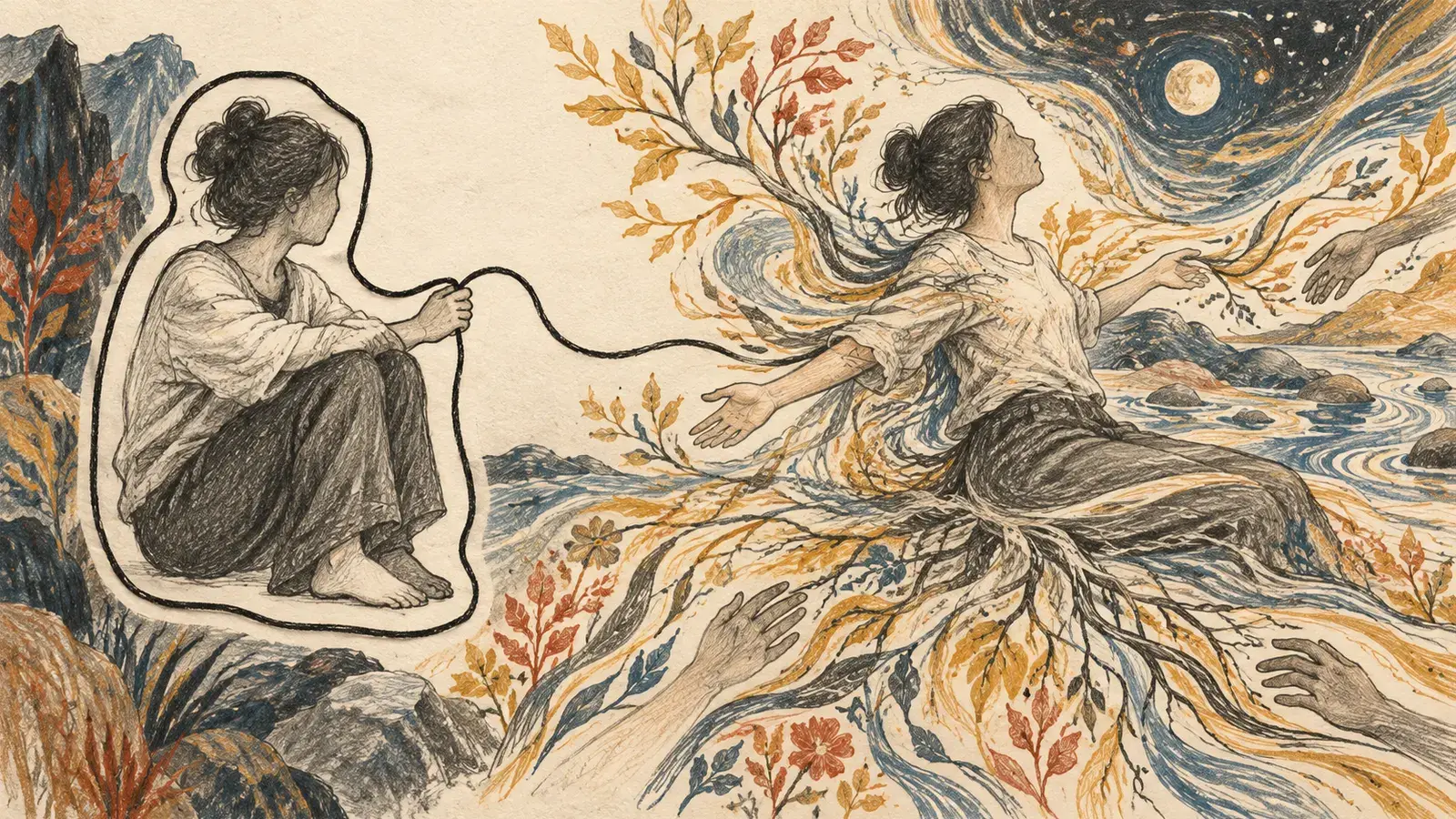
The British philosopher Alan Watts helped popularize Eastern philosophy in the West during the 1950s and 1960s, and his influence is widely felt in today's mainstream adoption of practices such as yoga and meditation. In his 1966 book The Book: On the Taboo Against Knowing Who You Are, he makes a central claim: the prevalent sensation of oneself as a separate ego enclosed in a bag of skin is a hallucination, one that accords neither with Western science nor with the experimental philosophy-religions of the East.
Watts begins with traditional religions, which he describes as exhausted mines. Their ideas about humanity and the world, their imagery and their notions of the good life, he argues, no longer fit the universe as we now know it or a human world changing so rapidly that much of what one learns in school is already obsolete on graduation day. He also names a growing apprehension: existence feels like a rat-race in a trap, with living organisms reduced to tubes putting things in at one end and letting them out at the other.
For Watts, many philosophical problems are solved by getting rid of them. Questions such as 'Why this universe?' are, he says, a kind of intellectual neurosis, a misuse of words: the question sounds sensible but is as meaningless as asking 'Where is this universe?' Yet wonder is not a disease. Wonder, and its expression in poetry and the arts, is among the most important things distinguishing human beings from other animals, and intelligent people from morons.
The core illusion is that 'I myself' is a separate center of feeling and action, living inside the physical body and confronting an external world. Everyday language reflects this: 'I came into this world,' 'You must face reality,' 'The conquest of nature.' But Watts insists we do not come into the world; we come out of it, as leaves from a tree. As the ocean waves, the universe peoples. Every individual is an expression of the whole realm of nature, a unique action of the total universe, though few people experience this directly.
Religion, Watts suggests, often reinforces separateness rather than liberating us from it because it depends on dividing the saved from the damned, true believers from heretics, the in-group from the out-group. All belief is fervent hope, and thus a cover-up for doubt and uncertainty. Real faith, he argues, is openness and trust in the unknown. Books are not life, just as money is not real consumable wealth; to idolize scriptures is like eating paper currency. Instead of a new Bible, Watts proposes a new domain of experience and feeling, a new feeling of what it is to be an 'I.' The most strongly enforced taboo, he says, is the taboo against knowing who or what you really are behind the mask of the apparently separate ego.
Watts traces the illusion partly to attention and language. Attention is narrowed perception, like a scanning flashlight that looks at life bit by bit, and this persuades us that the world is a great collection of separate things. But solids and spaces go together as inseparably as insides and outsides. The word 'individual' is the Latin form of the Greek 'atom' — that which cannot be cut further — but the only true atom, he writes, is the universe. Head, neck, heart, brain and lungs are separate names but not separate events; they grow into being simultaneously and interdependently.
The separate ego is also tied to anxiety about death and the inability to embrace uncertainty. The hallucination of separateness prevents one from seeing that to cherish the ego is to cherish misery. Even 'unselfishness' can be a highly refined egotism, while genuine love comes from knowledge, not from duty or guilt. Watts warns that trying to get rid of the ego by willpower or by spiritual exercises aimed at gaining enlightenment only strengthens the fallacy, because getting rid of one's ego is the last resort of invincible egoism.
The cure, he suggests, is to accept the feeling of separateness as a passing sensation; approached and accepted like any other sensation, it evaporates like the mirage it is. When the line between self and what happens dissolves, one finds oneself not in a world but as a world. The world outside the skin is as much you as the world inside; air breathes itself, light and sound come on their own, and time flows through the present. From this recognition, Watts says, one can return to practical affairs with a new spirit: the only real 'you' is the universe looking at itself from billions of points of view.

Comments