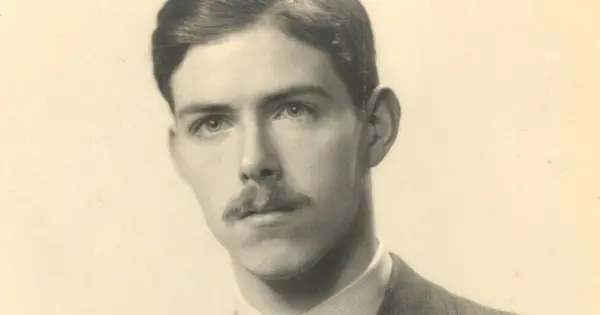
On the first day of 1941, John Steinbeck wrote to a friend that goodness and heroism rise, are cut down, and rise again, and that the evil thing never wins but never dies. A few months later, as the Second World War spread across Europe, a young Englishman in New York was reaching for a similar long view. Alan Watts, then twenty-five, wrote a letter to his parents that tried to hold onto what The Marginalian calls the telescopic perspective—the ability to see any single terrifying event inside a much wider frame.
The letter appears in the Collected Letters of Alan Watts, described as a revealing selection lovingly edited by his daughters Joan and Anne. It is a personal document, but it speaks directly to a public question: how a person can keep some inner sanity while the world around him is falling into violence and uncertainty.
Watts had left his native England for New York City at age twenty-three to begin Zen training. He had made that decision two years earlier after meeting the great Zen teacher D.T. Suzuki in London. In New York he was working hard to publish his American debut, The Meaning of Happiness, a book that bridged modern Western psychology and ancient Eastern philosophy. He was also establishing himself as a public speaker, giving talks on Zen to adults and children at Riverside Church in Harlem.
Addressing his parents as 'Dear Mummy & Daddy,' Watts wrote in the spring of 1941 that he had faith something good would come out of the crisis 'like the phoenix out of the fire.' At the same time, he admitted that it was almost impossible to plan for the future. 'Things here are as good as can be expected,' he told them, 'but under such strains you never know when people are going to go crazy!'
The letter's most distinctive idea arrives in a passage about the relationship between inner and outer experience. Watts wrote that he sometimes had 'the queerest feeling' that what was going on in the world around him was in some odd way a reflection of things happening in the depths of his own mind. It seemed to him, he said, that the world gets calm as one keeps calm oneself, and vice versa.
He was careful not to turn that feeling into a claim of magical control. To imagine that one could actually control the course of events in that way would be absurd, he wrote, because it would imply that the self alone is real and everything else is a figment of thought. But the feeling did convince him that there is a universe inside a person—a universe that contains what he called 'Hitler and all forms of human madness as well as love and beauty.'
That sentence is at the heart of the piece. Watts does not soften the reality of war or human cruelty; he says those forces are present in the inner world just as much as love and beauty are. His hope lies not in denying the darkness but in widening the frame. Decades before he would formulate his ideas about how learning not to think in terms of gain or loss enlarges life, this early letter already shows him searching for a perspective that makes the human struggle more bearable.
The Marginalian frames the letter as a companion for difficult times, alongside Watts's later reflections on presence, the antidote to loneliness, and what makes us who we are. It also places it in a lineage of writers—from Steinbeck to Albert Camus and Rebecca Solnit—who have wrestled with strength of character and hope in the dark. What Watts offers is not a prediction that everything will quickly improve, but a way of seeing that keeps beauty and madness in the same field of awareness.




Comments