China Heritage republished Mike Brock’s essay “An Argument in Three Costumes” as part of its Seeds of Fire at Forty series. The piece first appeared on Brock’s Substack, Notes from the Circus, and follows an earlier essay, The Longest Relay, which the publication published for the anniversary of June 4. Editor Geremie Barmé introduces the piece as the second essay in the series and notes that it responds to China Heritage’s work and develops the author’s metaphysical position. The editors also place Brock’s work in a line running from the 1986 Seeds of Fire to its sequel, New Ghosts, Old Dreams, after June 4, 1989.
Brock writes that his metaphysics is nondualist and, in his view, resembles Taoism more than the dualist accounts of the Western canon. The Western tradition, he argues, insists that the world consists of two substances—mind and matter—while he sees a single process appearing in different aspects. Referring to Chapter 42 of Lao Tzu’s Tao Te Ching, he says that the Tao that gives birth to the myriad beings does not make them an illusion; they belong to the one, but the one does not flatten everything into gray sameness. A unity that abolishes the differences it unites is, as he describes it, erasure rather than unity.
He extends this reasoning to persons and collective consciousness. Brock says he recently wrote a short piece about a television show dealing with collective consciousness precisely to argue that a world without the other is a world without anyone to love. Nonduality, as he defines it, is not the claim that we are all secretly the same person; it is the claim that no one is a sealed jurisdiction. This, he writes, is what makes persons precious rather than interchangeable.
Brock also argues that the West is not as dualist as its official facade claims. He refers to Spinoza’s Deus sive Natura, which he treats as one thing with two aspects; to Whitehead’s Process and Reality, built from events rather than substances; and to John Wheeler’s participatory universe, in which the substrate looks at itself through embodied observers. These, he suggests, are not anomalies but repeated arrivals at the same door under different names.
Discussing his intellectual development, Brock says he began as a declared atheist who had read the arguments and found them inadequate. What atheism never gave him was an explanation of why a world without God had to be a world without depth. As he puts it, reading the Gospels closely as an outsider, he realized that depth had never been the problem; only the furniture had. He now firmly believes that materialism cannot be true, citing the binding problem and the fact that the combination problem remains unresolved as the sharpest empirical difficulty. In a metaphysics of a single process, he argues, the unity of experience is exactly what one would predict.
His moral philosophy, Brock says, is classical liberalism, and he insists that the connection is not loose. If the other is irreducible—if no collective entity, party, movement or market can absorb a person’s being—then politics must be built around the refusal to merge. He invokes Hume’s statement that reason is, and ought only to be, the slave of the passions, and argues that no calculation can deduce what one ought to care about. The formalists’ repeated attempt to banish this idea fails, he writes, because the premises still enter wearing their author’s gratitude and horror.
On language, Brock places himself in conversation with the continental tradition. He credits the poststructuralists with recognizing that a sentence is an instrument of power and meaning, and that meanings arise through differences. He admits that part of this subculture produced an anti-intellectual fog, but says that rejecting a tradition’s worst flaws does not answer its best observations. The sign does indeed carry its exclusions, he writes, and the analytic tradition arrived at meaning as use in respectable clothing and was praised for its rigor.
He describes Alan Watts as the hero of this method. Watts, Brock writes, is remembered today mainly as atmosphere—wallpaper for meditation apps, a pleasant voice over images of water. His essence, however, was translation: he read Zen in the American idiom, returned to the West its own mystics, whom it had shelved alongside fairy tales, and treated the boundaries between categories as administrative artifacts rather than ontological ones. Watts read the Fall not as an inherited crime but as the mythology of self-consciousness—the dreamer who forgets he is dreaming. His description of himself as a spiritual entertainer, Brock argues, was not modesty; it was a metaphysical stance on what philosophy is for when its discoveries keep arriving in costumes.
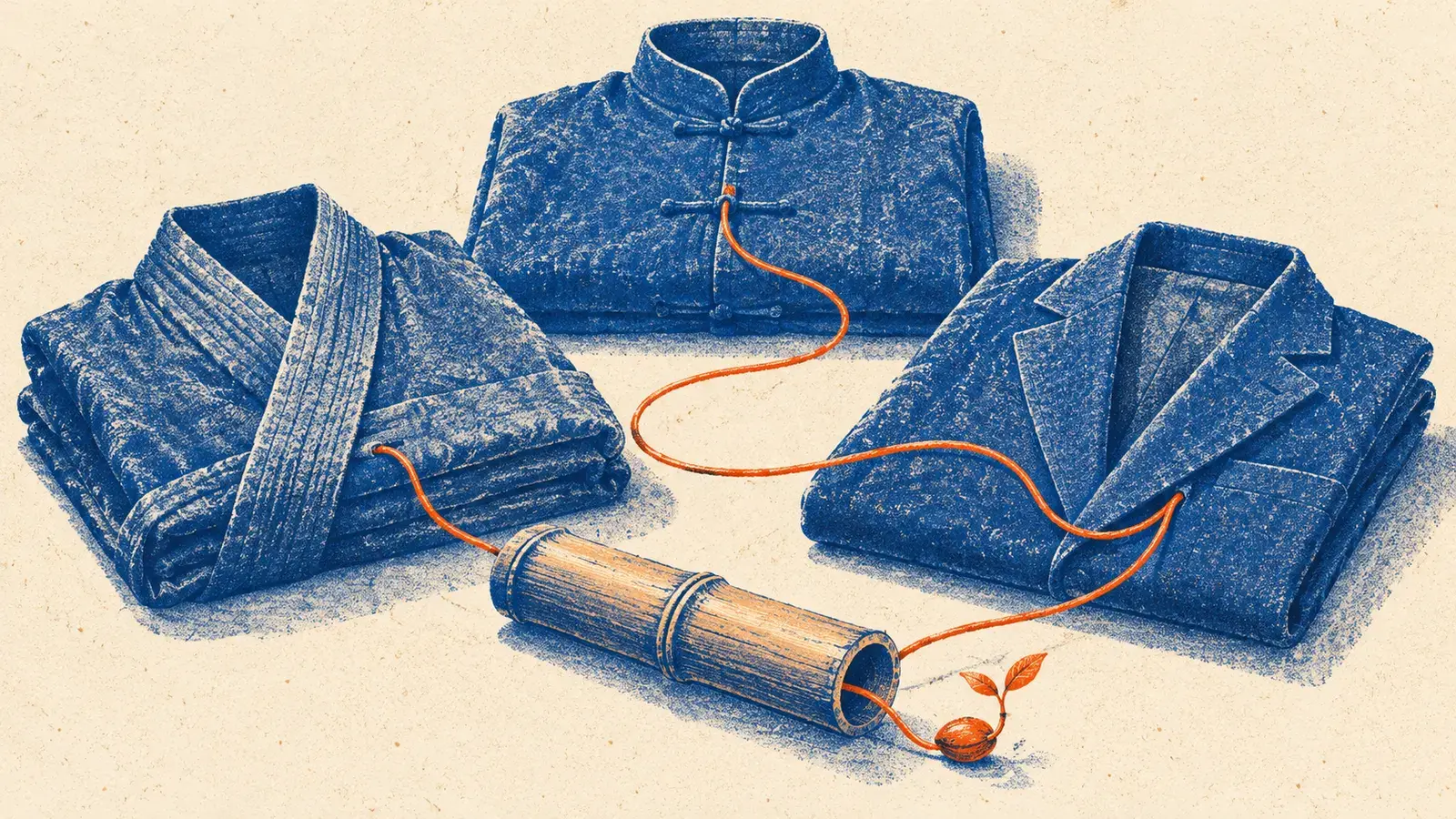
Brock concludes that his nondualist metaphysics, classical liberalism and continental suspicion are not three commitments that negotiated a coexistence. They are one argument worn on three occasions. Returning to China Heritage’s baton metaphor, he says it is a baton of conscience—voices passing on refusal to a generation that was supposed to forget—and that it recently passed through a museum of remembrance in Los Angeles that someone tried to desecrate three days before the anniversary. What holds the texts together, he writes, is not nationality, school or era, but what can be handed on without distortion—and that turns out to be the only test all these traditions were applying.


Comments