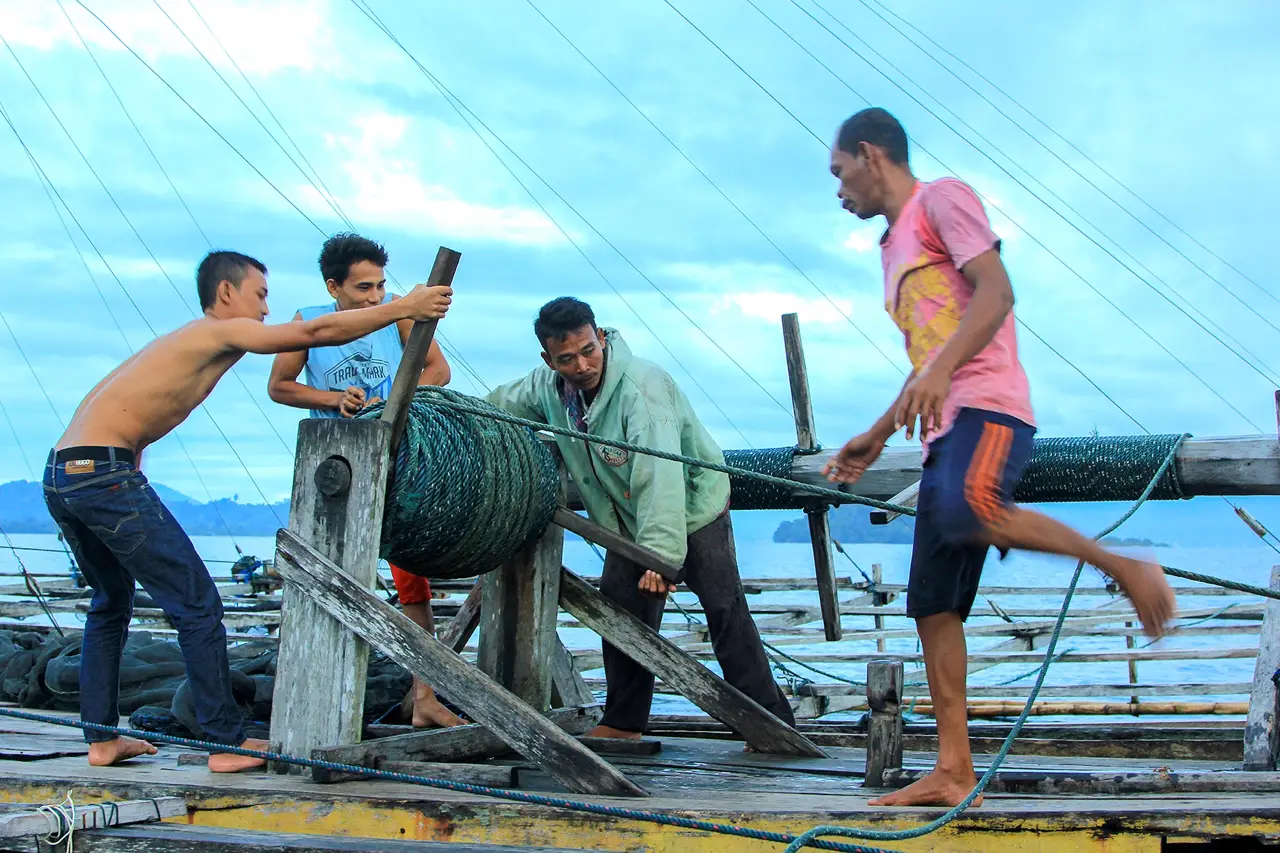
On September 2, South Korea’s Ministry of Gender Equality and Family and Ministry of Oceans and Fisheries announced that they had revised the national human trafficking guidelines to make it easier for authorities to identify and stop forced labor and other abuses in the fishing industry.
The new guidelines describe specific situations in which human rights violations are highly likely: workers with physical injuries that go untreated, workers whose mobile phones have been confiscated, or those living in environments with limited internet access.
The guidelines are not law, but they provide thresholds for authorities to act when they encounter situations that suggest human trafficking. Kim Hye-jeong, a director at the Ministry of Oceans and Fisheries, said the new guidelines would significantly help prevent labor exploitation and protect human rights because they contain provisions tailored to the fishing sector.
According to activists, an incident in Busan was one of the final straws. On the night of July 21, two Indonesian fishers were hanging from a makeshift rope made of tied bedsheets, suspended from an eighth-floor motel window. The men had been locked in the room for nearly 24 hours and were trying to escape.
The rope came undone: one fell to his death, while the other survived with a broken leg, according to Lee Han-sook, director of the Institute for Migration and Human Rights. In August, before the revision, the government officially recognized the surviving Indonesian fisher as a human trafficking victim, the first to have worked on a fishing vessel, giving him access to subsidies for medical, housing and legal assistance.
South Korea has one of the world’s largest distant-water fishing fleets and relies heavily on migrant fishers. According to government figures from July, about 80.5% of fishers on South Korean distant-water fishing vessels are migrants, with most coming from Indonesia, followed by Vietnam and the Philippines.
After years of criticism from human rights organizations, activists say migrant fishers frequently face confinement, debt bondage, pay below the minimum wage and working days of 14 to 18 hours. The isolated nature of the work, often without communication devices, makes them even more vulnerable.
Companies that recruit foreign workers often resort to extreme measures to prevent migrants from “escaping” their jobs: locking them up outside working hours, confiscating their passports and phones, or withholding pay until their contracts end.
Companies have an incentive to use these practices because the Ministry of Fisheries holds them responsible if their workers escape and become undocumented migrants, as the investigative news outlet Newstapa reported. Recruitment companies, usually small and with limited cash reserves, can face fines deducted from deposits of tens of thousands of dollars or be barred from future government contracts.
Although authorities have arrested people accused of crimes such as kidnapping or assault against migrant fishers, these cases remain the exception.
In its annual human trafficking report, the U.S. Department of State placed South Korea in Tier 1, recognizing that it has generally adopted and enforced anti-trafficking laws in a serious and sustained manner.
However, the report identified shortcomings in prosecuting and convicting traffickers as a weakness, especially in the fishing fleet: the government has never prosecuted human trafficking in the distant-water fishing sector and did not report identifying any confirmed victims of forced labor among migrant fishers.
South Korean authorities specifically cited one of the report’s 16 recommendations, which called for developing a specialized victim identification indicator in coordination with civil society, as a reason for revising the guidelines.
Activists argue that the government’s latest moves are not enough. Wi So-hyun, a lawyer at the nonprofit Lawyers for Public Interest, said he agreed with the spirit of the new guidelines, but that they “do not really mean much” and that nothing would change in practice because the guidelines were not the main problem. The bigger problem, he added, is enforcing existing labor and anti-trafficking laws. He also said more broadly worded guidelines would be better because they would lower the threshold for authorities to act, and that he would like a provision requiring authorities to take action.
Lee Han-sook noted that South Korea’s anti-trafficking laws are still relatively new: the law on preventing human trafficking and protecting victims took effect on January 1, 2023, later than in other Asian countries such as Japan in 2005, Taiwan in 2009 and Singapore in 2015. This means legal precedents are lacking, as are measures to protect victims who report trafficking from retaliation. “Ultimately, what matters is how we implement the anti-trafficking guidelines,” Lee concluded.



Comments