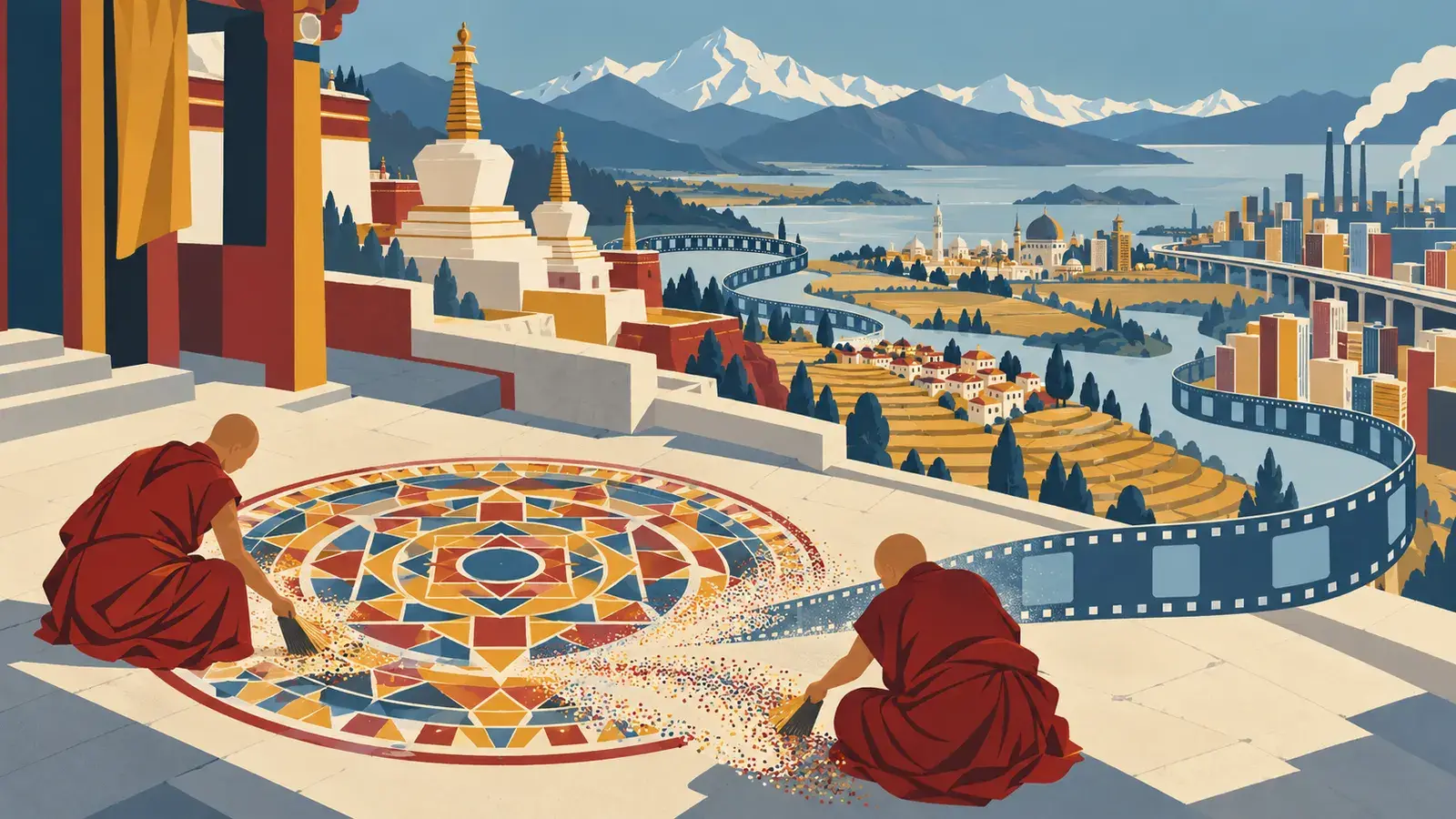
Samsara is a 2011 American non-narrative documentary film directed by Ron Fricke and produced by Mark Magidson. The two filmmakers had previously collaborated on Baraka (1992) and Chronos (1985), films in the same spirit. Samsara was filmed over five years in 25 countries—around a hundred locations in total—with 70 mm cameras and finished digitally. It premiered at the Toronto International Film Festival in 2011 and received a limited release in August 2012.
The film's title refers to the Buddhist concept of “samsara,” which, for the filmmakers, means “birth, death and rebirth” or “impermanence.” According to the official website, the film explores the wonders of our world, from the everyday to the extraordinary, looking into the unexplored depths of humanity's spirituality and the human experience. It is neither a traditional documentary nor a travelogue: it takes the form of a non-verbal, guided meditation.
For the production, Fricke and Magidson researched locations that would fit the conceptual imagery of samsara. They gathered material from photography books, the internet and YouTube—the latter two sources had not been available when Baraka was being planned. Although they considered using digital cameras, they decided to shoot in 70 mm, believing the quality to be superior. The crew used three 70 mm cameras: two from Panavision and a specialized time-lapse camera designed by Fricke himself.
As Magidson explained, the 65 mm negative was scanned and then processed digitally, allowing the filmmakers to salvage shots they would otherwise have discarded. They used telecine to convert the footage to ProRes for editing, which was done in Final Cut. The crew also filmed pilgrims around the Kaaba in Mecca, Saudi Arabia, from above: a 40-story building had just been erected beside the mosque, and the filmmakers were able to shoot the scene with the owner's permission.
The film's music was composed by Michael Stearns, Lisa Gerrard and Marcello De Francisci. Unlike Baraka, Samsara was initially edited without music, and the composers worked on many sequences as separate pieces before linking them together. The composition process took six to seven months.
The film was shot on five continents. Locations include the Kawah Ijen sulfur mine in Java, the Cebu Provincial Detention and Rehabilitation Center in the Philippines—known for its dancing inmates—the Pyramids of Giza in Egypt, Versailles in France, Monument Valley in Arizona, the Kilauea volcano in Hawaii, New Orleans' Ninth Ward after Hurricane Katrina, and the Burj Khalifa and artificial islands in the United Arab Emirates.
Fricke and Magidson stressed that they deliberately avoided adopting a specific political position. “We're just trying to keep it in the middle,” Fricke said, explaining that they assembled small sections of material without music or sound effects and let the images guide the flow. Nicolas Rapold of The New York Times pointed out that the absence of a specific message distinguishes Samsara from similar social documentaries of the period, such as Michael Glawogger's Workingman's Death, which depicts the same sulfur mines with a sociologically critical perspective.
Commercially, the film performed well for its genre. After its Toronto premiere, Oscilloscope Laboratories acquired the US distribution rights. The film opened in two theaters in August 2012, expanded to 60 theaters by its fifth weekend and became the highest-grossing documentary of 2012. With $1.8 million in revenue, it also became the most commercially successful film in Oscilloscope's history.
Reviews were generally positive, though opinions were divided. On Rotten Tomatoes, the film has a score of 76% based on 79 reviews, and on Metacritic, 65 out of 100. Roger Ebert of the Chicago Sun-Times awarded it four stars, writing that it offers “an invigorating experience” through powerful images. However, Kenneth Turan of the Los Angeles Times described it as “as frustrating as it is beautiful,” expressing annoyance that the filmmakers did not identify the less familiar locations and finding some connections overly obvious—such as images of ammunition followed by a portrait of a severely wounded veteran.
For its supporters, however, Samsara's strength lies precisely in the freedom it gives the viewer. Katie Walsh of IndieWire wrote that the film uses the technique of “intellectual montage” and compared it to Man with a Movie Camera, taking “the idea to new global and spiritual heights.” As she noted, discussing its technical excellence does not do justice to the work's “spiritual cinematic power.” In this way, Samsara remains an invitation to personal reflection on the endless passage from birth to death and rebirth.




Comments