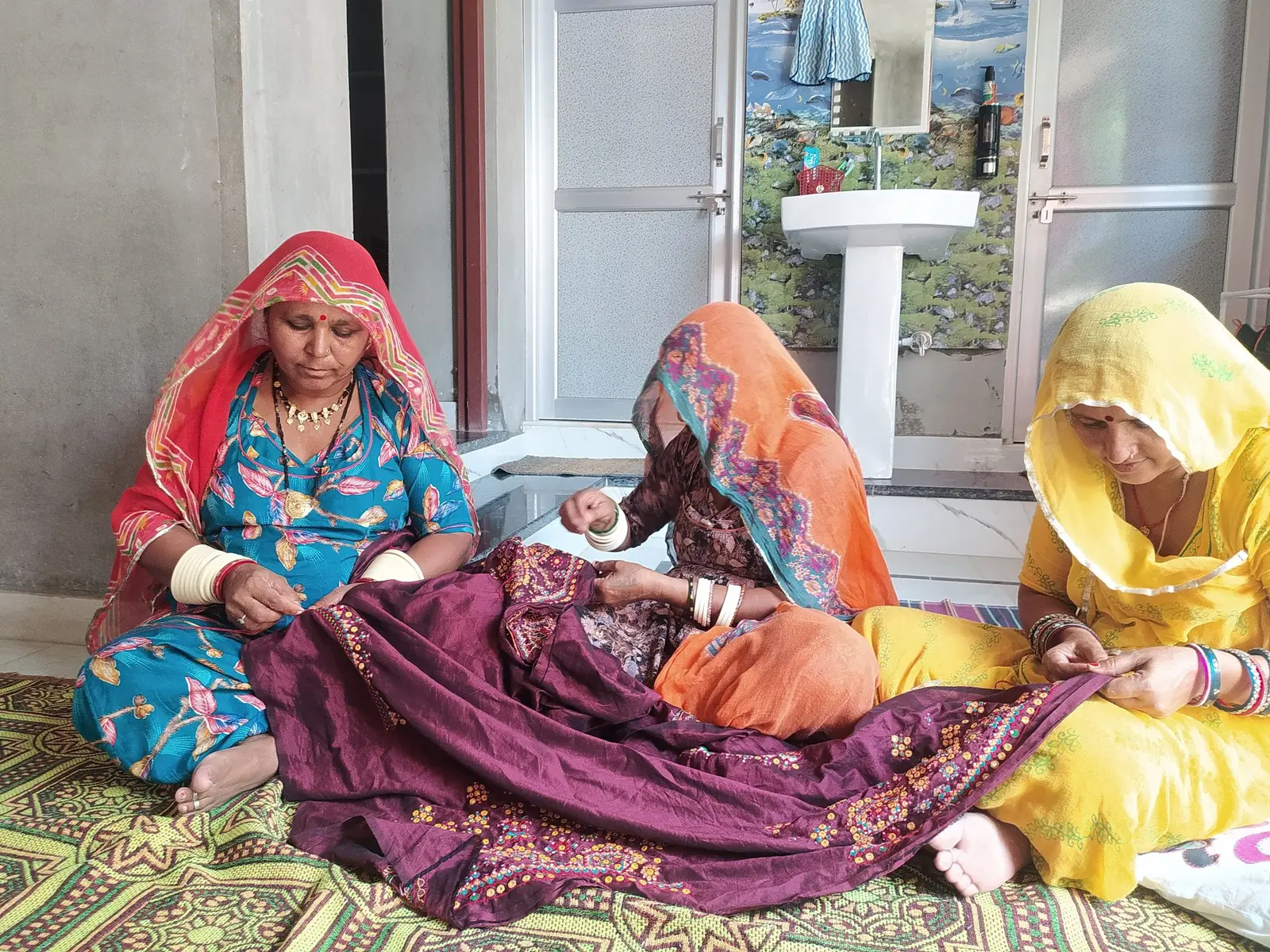
In Barmer in western Rajasthan, at a house in the Indira Nagar neighbourhood, women gather with needles and thread to work on traditional Sindhi embroidery. The intricate designs have been passed from mother to daughter for generations. These women are among thousands of Pakistani Hindu women artisans who fled Sindh, many to escape religious persecution. Their craft contributes to the state's handicraft exports; for decades, however, they remained trapped on pitiful wages.
Between 20,000 and 25,000 Pakistani migrants have settled in the state, the report says. Their craft contributes to exports worth 750 crore rupees, about $100 million, between April and August of 2023–24 alone, within a broader Indian handicraft sector worth $1.8 billion for the 2024 financial year. Yet most embroiderers earned just 150 rupees a day, about $1.67, far below the minimum wage of 285 rupees for unskilled workers.
Neeta Devi Meghwal, whose family has practised the craft for three generations, recalls how they left the village of Jhande Ka Tala in Pakistan's Sindh during the 1971 war. In the sand dunes, she says, even drinking water was hard to come by; her father worked as a day labourer whenever work was available. Her mother had only embroidery, which she had learned from her grandmother. When they arrived in India, she began selling embroidery to local traders. “The middlemen made us work but paid us peanuts. It wasn't just us; almost every woman faced this kind of exploitation,” Meghwal says.
The gap between pay and final prices is large. According to Achal Singh Bhati of Rangsutra, a social enterprise owned by the women artisans themselves, a cushion cover retails abroad for 800 to 900 rupees and curtains for 2,000 to 2,500 rupees. Yet the women see very little of this money, as middlemen and exporters control prices, materials and access to the market.
The Barmer-based organisation SURE, Society to Uplift Rural Economy, has been training women artisans since the early 1990s and helping them set up their own companies. One is the Thar Artisans Producer Company, founded in 2020 and run by the embroiderers themselves. All 700 women artisans are equal shareholders: each contributed 500 rupees by buying 50 shares at 10 rupees each, acquiring exactly the same stake. They elected ten women directors and vote on business decisions, while SURE provides only administrative support.
The artisans are paid per order and, as shareholders, are entitled to dividends. None have yet been distributed because the first two years coincided with the COVID-19 pandemic, but the company is preparing its first distribution. Rangsutra follows the same model with more than 2,000 women artisans in Rajasthan and other states, giving them direct access to national and international buyers. The cooperatives also teach digital marketing so that the women can bypass exploitative middlemen.
Incomes are changing significantly. Neeta Devi Meghwal now makes about 4,000 rupees a month, sometimes more, whereas previously she earned only 400 to 1,000 rupees through middlemen. Badli Devi earns 4,000 to 5,000 rupees and Hariya Devi, one of the most experienced, earns 7,000 to 8,000 rupees. Moomal Meghwal, whose family also came from Sindh in 1971, says her own daughter now earns around 4,000 rupees a month. “Previously, the effort was enormous but the earnings were very low. After working with SURE, for the first time we felt we were getting the true value of our work.”
Lata Kachhawa, joint secretary of SURE, explains that this embroidery once adorned the clothes of royal and wealthy feudal families in Sindh. After migration to India, it became a means of survival, but the artisans lacked market access and traders bought cheaply to resell at high prices. With help from experts at fashion design schools, traditional designs were adapted for bedding, pillowcases, bags, dupattas, kurtas, sarees and decorative items. To date, SURE has trained about 15,000 women and has operated a Craft Development Center since 1994, offering classes in quality control, time management, colour coordination and contemporary design. Rangsutra has trained around 350 women in Barmer and exports products to Japan, Germany and Singapore.
However, the obstacles have not disappeared. Chhagni Devi says many artisans in her area have received training, but she has not; if she were trained, she could earn more and take part in exhibitions. A SURE representative told her she would join the collective, but enrolment is gradual. Dinesh Sain, district manager of the Rajivika council, acknowledges that many artisans still lack strong links to the market and says the district administration is now emphasising quality, design, branding, packaging and added value. SURE itself faces fewer orders since the COVID-19 pandemic. “We are trying to bring in more orders and sell more products; only then will we be able to provide work for more women,” Kachhawa says. Hariya Devi hopes organisations such as SURE will continue to create opportunities. “Working through SURE helped my family meet basic needs. Life is difficult in this desert region. Thousands of women here know embroidery; if more receive training and steady work, their lives could change.”

Comments