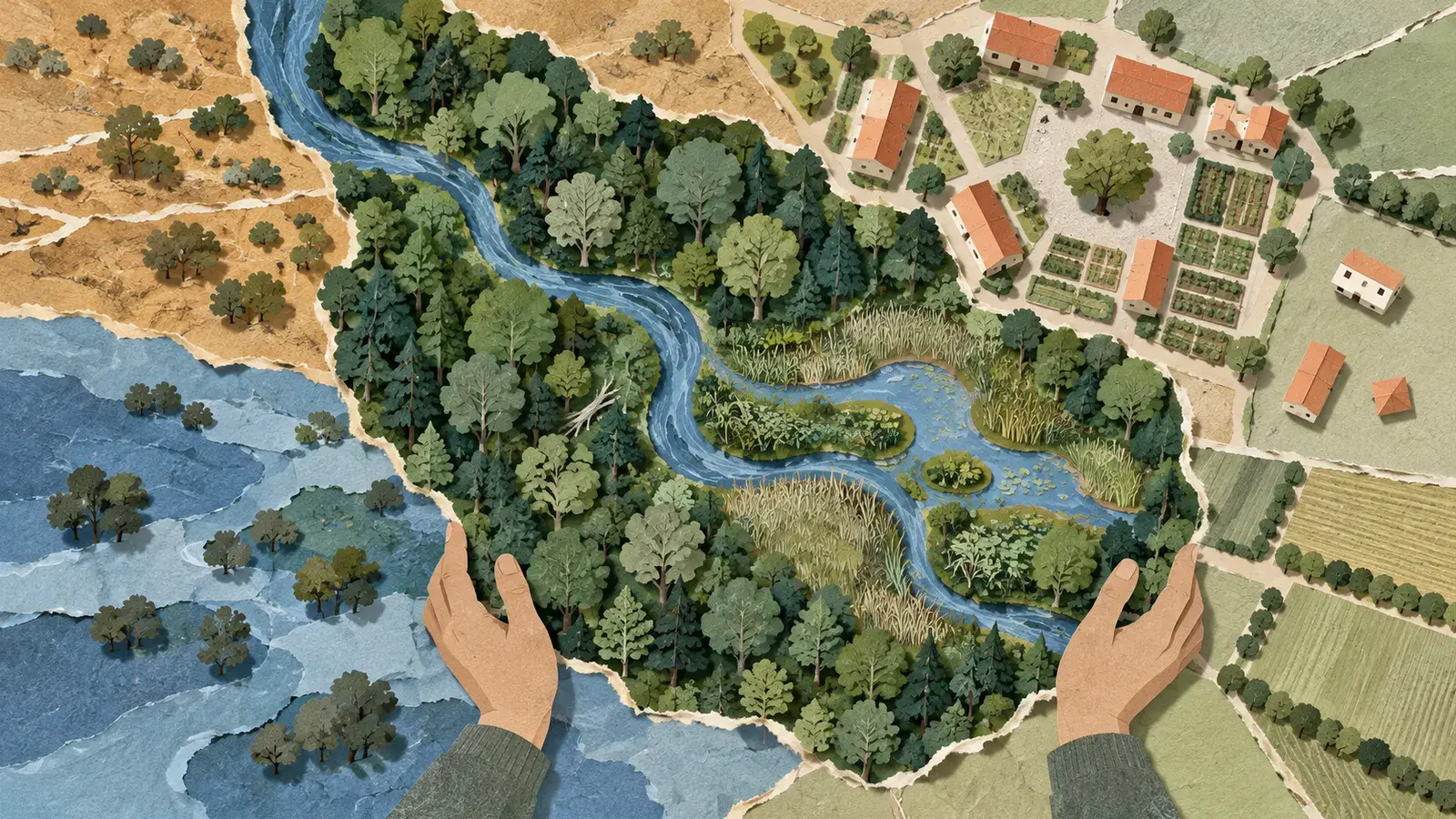
In the sixth part of the “How to Think About the Future” series, Nate Hagens offers a method for finding one’s own plan rather than a ready-made list of actions. As he explains, specific actions depend on what each person loves, where they live and what they want from the future; without such a framework, even well-intentioned efforts may be useless or counterproductive. His starting point is that the future is not a single scenario but a landscape of possibilities, and that planning must hold up across multiple futures.
He begins with how we think about what we should not do, using the statistical concepts of Type I and Type II errors. A Type I error is a false positive: you hear a noise at night, think it is a burglar, call the police, and it turns out to be the cat. A Type II error is a false negative: you assume the noise is the cat and roll over, but this time it really was a burglar. Both are dangerous, and, as Hagens says, the challenge of planning for an unclear future involves both risks.
Type II errors, he explains, are omissions: we do not protect topsoil or biodiversity because GDP does not measure them, we do not build community resilience because there is no financial or institutional incentive, and we do not transform energy systems because today’s technically work. But by the time these shortcomings become visible, it is often too late to reverse them. In the landscape language of previous episodes, these are instances of erosion and missed turns that disappear through neglect.
Type I errors are failures caused by taking the wrong action. We may act with an incomplete map, such as shutting down fossil fuels overnight when 80% of the world depends on them. We may fight the wrong war, investing in carbon offsets that offset nothing or in ESG metrics that do not change the behaviour of the economic superorganism. As he puts it, the burglar is real, but we called the fire brigade instead of the police.
The deepest Type I error, according to Hagens, is the assumption of permanent growth. Almost every institution, government budget, pension fund, corporate strategy and international agreement rests on the assumption that the future economy will be larger than today’s. When contraction comes, many clever, well-designed plans will prove to be an enormous Type I error because they answer a question that presupposes growth. Infrastructure built for expansion becomes a maintenance burden, financial instruments that assume compounding become traps, and institutions that know how to distribute growing surpluses do not know how to distribute shrinking ones. He believes that the greatest false positive in human history may be the cultural certainty that growth is permanent, on which investments in artificial intelligence and energy are now also being built.
The challenge, he says, is to navigate between the two types of error: to act, but not so shortsightedly that we trigger cascading failures; to protect what matters without freezing while we wait for perfect information. Hagens believes that his project, The Great Simplification, tries to avoid both.
The distinction that changes things is simple: some losses can be rebuilt and others cannot. If we had to choose between losing $100,000 and our left hand, the answer would be obvious. At the cultural level, however, Hagens says planning frameworks lose sight of this distinction: a dollar of lost GDP is given the same weight as an inch of lost topsoil. The first can be recovered; the second takes centuries.
The list of irreversible or practically irreversible losses is longer than we usually think. It includes topsoil, the Ogallala aquifer with water from the last ice age, species that become permanently extinct, pollinators, social trust, institutional knowledge, the nuclear taboo, children’s developmental windows and health beyond a certain point. Hagens notes that today’s culture optimises for quarterly profits and GDP, which are reversible, while allowing what is irreversible to erode. The required reversal is difficult: accepting losses of money, efficiency or comfort to protect what cannot be rebuilt.
If protecting what is irreversible is the priority, the next question is which actions help across all possible futures. Hagens calls these robust actions: they build soil health, strengthen community relationships, teach practical skills such as food production, repairs, basic medical knowledge and water management, reduce dependence on fragile overseas supply chains, and protect local ecosystems. These have value in every complex future, because the people around us will become more important as conditions grow harder. This logic, he explains, resembles resilience in ecology: organisms that do well in many environments survive change, even if they are not optimal in any single one. In times of genuine uncertainty, robustness beats optimisation.
However, Hagens recognises exceptions: some people have a “unicorn” mission, such as protecting the oceans, nuclear disarmament or saving an Indigenous language. These focused commitments make sense because people are not interchangeable planning units, but beings with loves and callings. For most people, he suggests a mix: a foundation of robust actions and one or two focused commitments.
In response to the despair that systems are too large, Hagens suggests a mental framework: agency becomes real at the scale where you can see results. In the household, the garden, personal relationships and the neighbourhood, action is visible. In the bioregion and at work, it is slower but present. At the cultural level, it is harder to feel, but systemic changes are the sum of individual choices. We do not need to save the world on our own; we can act where we see results.
He closes with the distinction between constrained and predetermined futures: civilisation’s trajectory is constrained by physics, ecology and the deep patterns of Homo sapiens, but within those constraints the difference between the best and worst scenarios is enormous — from the long repair to unravelling. That difference, he says, is determined mainly by what people do at the scale where their actions become visible. His closing questions are: what are you protecting, what are you building, what are you willing to let go of, where are you creating turns towards recovery, and where are you allowing something to erode without realising it?

Comments