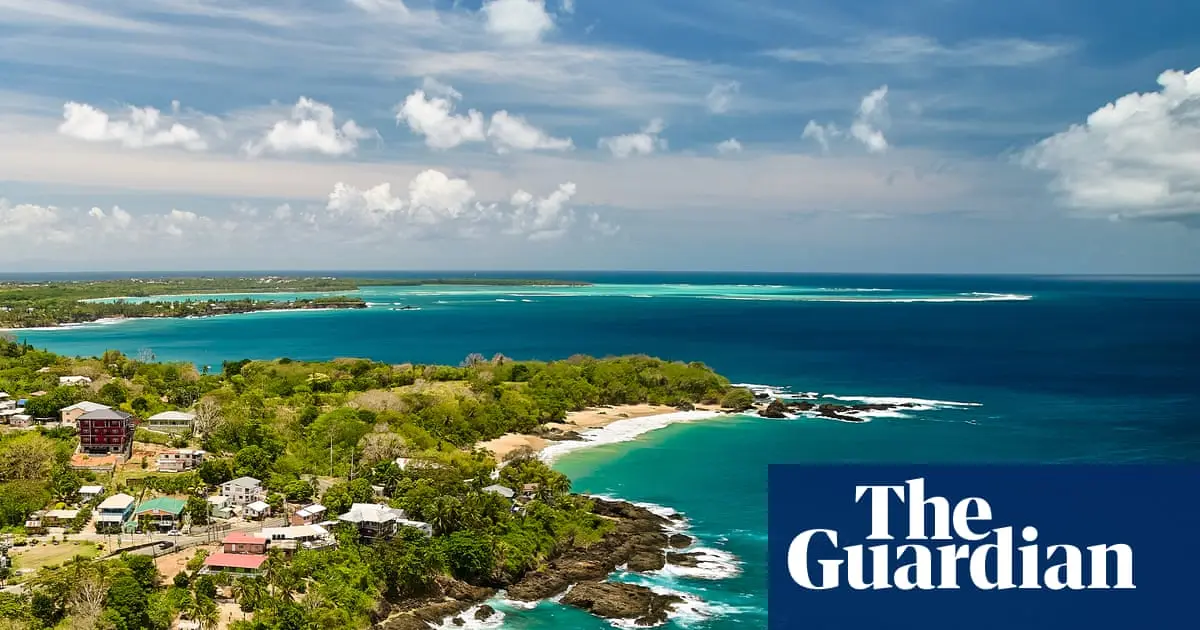
Rocky Point beach in southwestern Tobago attracts visitors with its sand, coral reefs and dark rock formations, while its vegetation of manchineel, sea grape, almond and coconut trees evokes a tropical forest. This coastline forms part of Back Bay, a stretch of about 500 meters, and remains relatively untouched. This almost pristine place is now at the center of a clash between those who see large-scale development as the most profitable path and those who favor smaller, gradual, community-based projects.
As elsewhere in the Caribbean, the need for economic development is fueling interest in tourism investment. Rene Seepersadsingh, first vice-president of the Tobago Hotel and Tourism Association, says the island is seeking partnerships with private investors to improve its tourism offering. As part of this effort, the government agency Eteck invited expressions of interest in 2021 for the 12 hectares at Rocky Point. The local company Superior Hotels won the bid and received a 99-year lease for a $500 million project with a 200-room hotel and private villas.
The plan has faced four years of opposition. Duane Kenny, a founding member of the Rocky Point Foundation, a former hotel manager and a surfer at Back Bay, is calling for greater accountability. He and his colleagues had submitted a proposal for a small eco-resort with nature trails, turtle watching and a museum displaying Indigenous artifacts found in the area, also showcasing the ruins of Fort Monk. Kenny says the winning project's initial design seemed to ignore many archaeological and ecological features, and that subsequent changes have not adequately addressed the concerns.
Environmental biologist Michelle Cazabon-Mannette, director of SpeSeas, says more than 100 people submitted written objections to the Environmental Management Authority (EMA) as part of the environmental impact assessment. Following opposition at public meetings and in written submissions, the developer made only minor design adjustments. The EMA eventually granted Superior Hotels a certificate of environmental clearance, accompanied by about 20 pages of mitigation measures.
Cazabon-Mannette considers the measures inadequate, although she acknowledges that the plans on which approval was based were conceptual rather than final. She and Kenny believe that a 200-room hotel and numerous villas will probably require the removal of many trees. The vegetation provides shade and protects the beach from erosion, while the shade keeps the sand cool where hawksbill and leatherback turtles nest. In addition, sediment runoff from construction could threaten the coral reef that makes the area a paradise for surfers; Kenny notes that sediment barriers “fail all the time.”
When asked about environmentalists' concerns, Superior Hotels T&T chairman John Aboud referred the Guardian to the certificate of environmental clearance without further comment. Final approvals from Tobago's Town and Country Planning Division and the Assembly, the island's legislature, are pending. Marriott International, which has reportedly been in talks to manage the resort, says it is not involved in the project and has not signed an agreement with Superior Hotels.
Kirkland Brathwaite, head of the environmental management company Katalyst Solutions, explains that a certificate of environmental clearance often includes mitigation measures and that a quality assurance plan for monitoring is mandatory. He considers it unrealistic to expect an investor to make significant changes after the environmental impact assessment has been completed, because a great deal of money has already been spent. He adds that the approval terms formalize the conditions and that monitoring requirements become stricter in environmentally sensitive areas.
Many residents, however, believe that a project requiring so many mitigation measures, with such extensive risks, is not the way forward for Tobago. The Caribbean Natural Resources Institute (Canari) promotes a different approach, community tourism, in places such as Speyside, about an hour north of Rocky Point. Dylis McDonald, a senior technical adviser at Canari, says such projects are usually small in scale and based on the vision of community members themselves; protection, restoration and conservation are often at their heart, with a strong sense of ownership and connection to the place.
Supporters and experts acknowledge that small ecological ventures may not always provide a steady income. Turtle protection patrols, for example, employ people to protect hatchlings and eggs, but this is seasonal work with little pay when funding is available. However, Kenny insists that development in harmony with nature and a sustainable business model are possible: “You can have it all.”


Comments