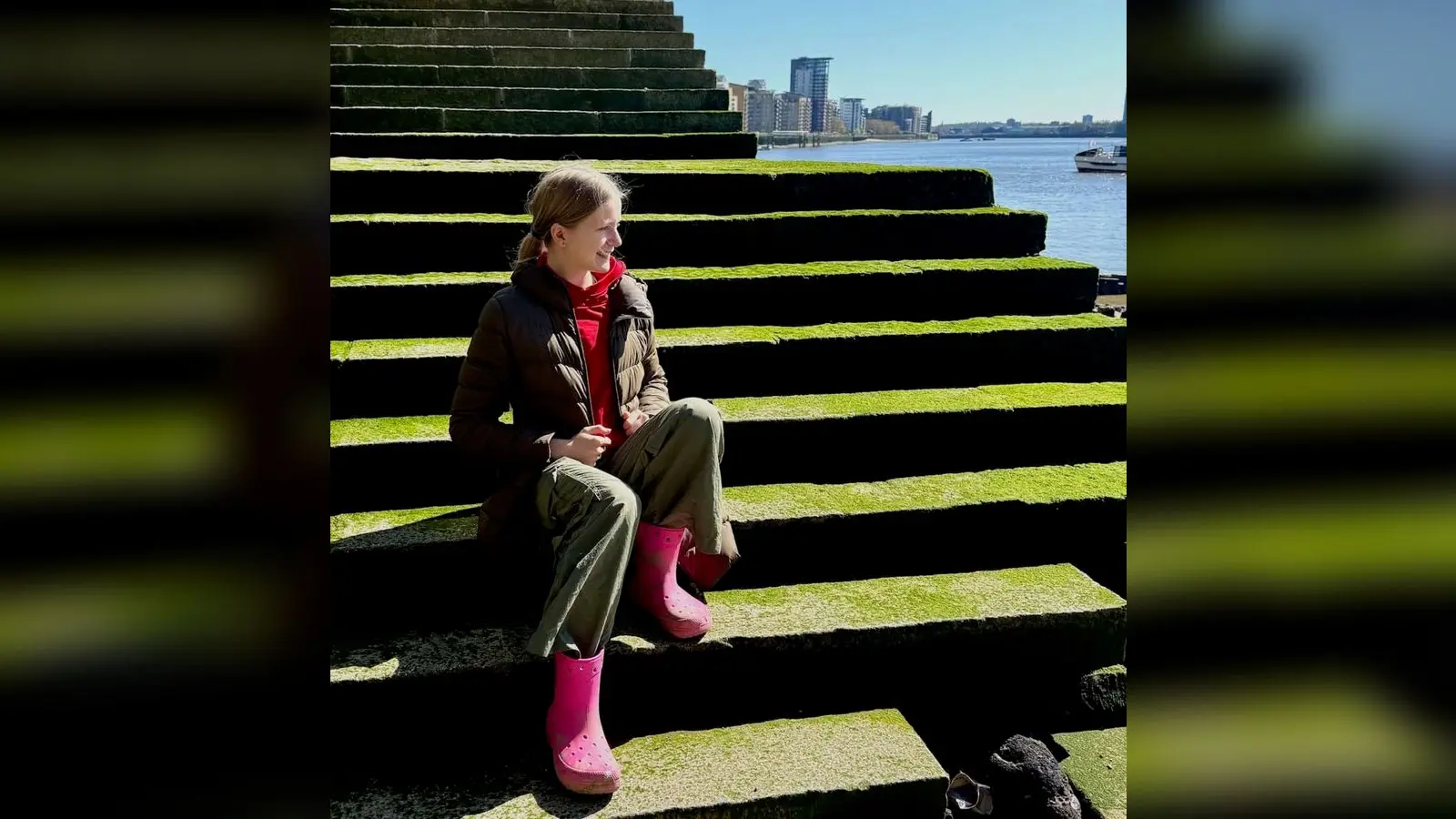
On a mild Sunday morning in late September, on the north bank of the Thames near Wapping, 14-year-old Emmylou Vaxby walks slowly over the mud and stones exposed by the low tide. She is a schoolgirl, author and experienced mudlark — someone who searches for objects on a riverbank — and has been exploring the Thames foreshore for fragments of London’s history for nearly a decade.
She explains how to “train my eye” for treasure: you need to bend down close to the ground, scan left and right, and look for “something that is a different colour”. Soon we find a muddy brown bone. Emmylou says it could have belonged to a sheep, dog, horse or cow. Perhaps a butcher threw it away after removing the meat, or an animal died and was dumped in the river. Its age is hard to estimate, but it has certainly been there for many years. She connects it to the “Great Stink”, the hot, dry summer of 1858, when the Thames — full of raw sewage, rubbish and rotting flesh — became a foul-smelling health hazard.
Emmylou has gained remarkable knowledge of the Thames, the science of tides and a very human version of history, inspired by our ancestors’ everyday objects and the things she has collected for nearly a decade. All mudlarkers are required to have a permit from the Port of London Authority, which currently has a waiting list.
Her unusual hobby began at the age of five or six, when a friend’s mother took them down to the east London foreshore to look for pottery and glass. During lockdown it became a passion: her parents, both musicians, and her brother spent their daily hour outdoors on the banks of the Thames. Her finds include blue-glazed chinoiserie pottery, possibly from the Georgian or Victorian era, clay tobacco pipes dating from the 16th century to the 1930s, and oyster, whelk and scallop shells. She documents her experiences and research on her blog and on YouTube, where she appears as Emmylou the Mudlark.
A publisher approached her about writing a book. After signing the contract, she spent the summer holidays of 2025 writing between 1,000 and 2,800 words a day — an unusual achievement for a writer of any age. In 2021, she also founded the Wapping Plastic-Free Community through Surfers Against Sewage, after being upset by the sight of a swan mistaking a piece of plastic for food. With 60 people on her contact list, she organises riverbank cleanups twice a year and takes part in cleanups by the WaSh Wombles.
For Emmylou, mudlarking is restorative. “It’s an hour when I’m not doing something stressful like schoolwork. I just walk,” she says. Mudlarking is necessarily slow — a meditative pastime based on careful observation — and she calls it her “happy place”. There is also the thrill and satisfaction of discovery. One of her favourite finds is the bowl of a pipe made by the renowned 18th-century tobacco pipe maker William Manby, “who lived down the road”. Mudlarkers are required to record and report their finds through the Portable Antiquities Scheme. She adds that she is not disappointed if she finds nothing, and feels grateful: “I do it for fun, whereas Victorian children were forced to do it to earn a living. It was much more dangerous then.”
Pursuing this specialist interest and learning about it on her own seems to have given Emmylou a natural confidence. She maintains eye contact, gives thoughtful answers and speaks comfortably about her subject. The freedom she had to pursue an unusual interest allowed her to become a real expert. A Guide to Mudlarking on the River Thames is published by Fonthill, priced at £16.99.




Comments