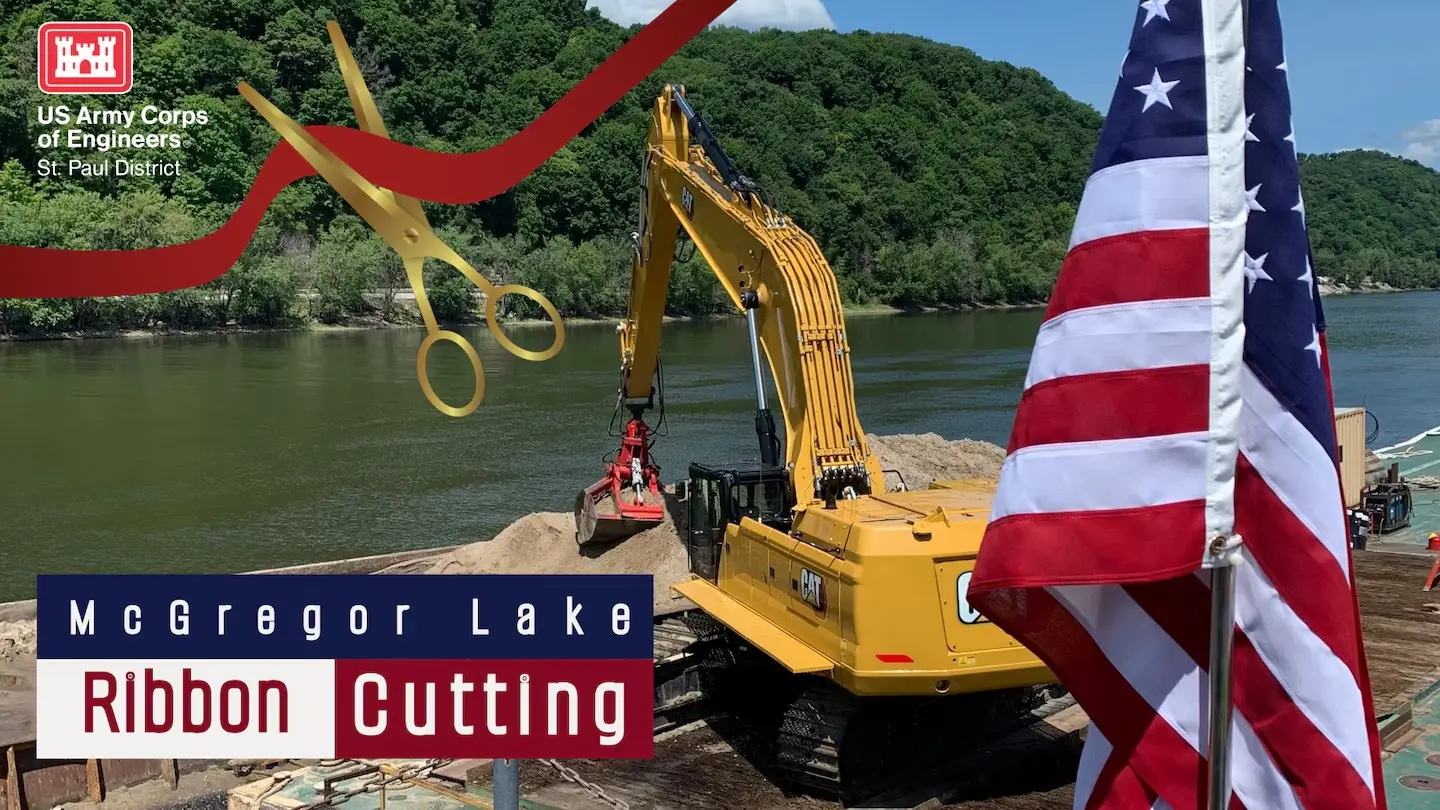
The US Army Corps of Engineers’ St. Paul District announced that it will celebrate the completion of the McGregor Lake habitat restoration and enhancement project with a ribbon-cutting ceremony on September 22. The event is open to the public and will take place at the Marquette Marina Pavilion in Marquette, Iowa. The project cost $25 million.
McGregor Lake is a 200-acre backwater lake in Pool 10 of the Mississippi River, near Prairie du Chien, Wisconsin. It lies within the Upper Mississippi River National Wildlife and Fish Refuge.
According to the engineers, the project improved the lake’s habitat for backwater fish species, increased the growth of emergent and submerged vegetation, enhanced the age and species diversity of the self-sustaining floodplain forest, and protected aquatic and terrestrial habitats by reducing erosion. Forests along the Mississippi corridor provide critical habitat for migratory songbirds, nesting bald eagles, herons, kingfishers and other birds.
Construction began in 2020. The Corps of Engineers used 500,000 cubic yards of clean river sand dredged from the Mississippi to build seven islands. Dredging the main channel ensures that navigation on the Mississippi continues. Another 35 acres of backwater fish habitat were dredged, creating overwintering sites for fish, while the material was used on the islands’ surfaces to support vegetation growth.
Beyond creating the islands, the Corps of Engineers built five rock structures and stabilized more than a mile of shoreline. The project improved more than 270 acres of aquatic habitat, enhanced over 45 acres of floodplain forest and protected 22 acres of wetlands.
The project is part of the Upper Mississippi River Restoration Program. The program ensures the coordinated development and enhancement of the Upper Mississippi River system, with a primary focus on habitat restoration projects and resource monitoring. In the program’s 40-year history, more than 62 habitat projects have been completed, benefiting approximately 120,000 acres from Minneapolis to St. Louis.
The completed project combines ecological restoration with maintaining navigation, as sand dredged from the channel was used to create the islands. For the area, this means more stable shorelines, more vegetation and better conditions for fish, birds and wetlands.
Comments