
Man's Search for Meaning was published in 1946 by Viktor Frankl, who records his experience as a prisoner in Nazi concentration camps. The original German title was Ein Psychologe erlebt das Konzentrationslager, and the first English translation appeared under a different title. The prefix Trotzdem Ja zum Leben sagen was added in later German editions. In Greek, it initially appeared as In Search of Meaning in Life and Freedom in a Concentration Camp.
In the first part, Frankl describes three psychological reactions that all prisoners experience to some degree: shock during the initial phase of admission to the camp, apathy after adjusting to camp life and, if they survive and are liberated, depersonalization, moral distortion, bitterness and disappointment. Frankl concludes that meaning in life can be found in every moment; life never ceases to have meaning, even amid suffering and death.
One of his key observations was that those who survived were connected to a purpose in life and immersed themselves in imagining that purpose, for example by talking to a loved one, even if only in their minds. The way a prisoner imagined their future affected how long they lived. In a group therapy session during widespread food deprivation, Frankl said that everyone in dire circumstances has someone watching them—a friend, a relative or even God—and would not want to disappoint them.
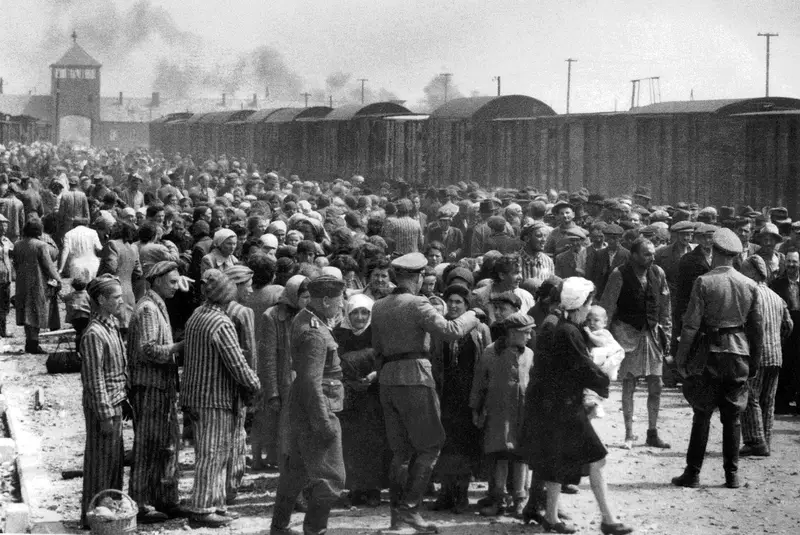
Frankl argued that a person's psychological reactions are not solely the result of their living conditions, however harsh, but also depend on the freedom to choose, which is never lost. He observed the paradox of prisoners in relatively poor physical health surviving while others who seemed strong did not make it; the difference was having a sense of meaning in life. That meaning can be found through three paths: completing work, caring for another person or facing suffering with dignity.
Frankl also concluded that there are only two kinds of people, the decent and the indecent, and that no society is free of either. Thus, there were decent guards and indecent prisoners, the most characteristic example being the kapos, who tortured and exploited their fellow prisoners for personal gain.
At the end of the first part, he describes the stages of liberation. The first is depersonalization: former prisoners are so numb that they cannot grasp what freedom means, and part of them thinks it is an illusion or a dream. The body is the first to respond, with a strong appetite for food and sleep; only afterward do emotions begin to respond. This is followed by the risk of distortion as psychological pressure is suddenly released, like a diver emerging abruptly from a decompression chamber.
On returning home, survivors struggle with bitterness and disappointment. Disappointment is the most difficult stage: discovering that the suffering has not ended and that the happiness they longed for will not come. This happened to those who, like Frankl, returned home to find no one waiting for them. Over time, however, the camp experience became a nightmare of the past.
In the second part, Frankl introduces logotherapy, his theory of the relationship between a person's health and their sense of meaning in life. According to him, success and happiness cannot be pursued directly; they are “side effects” of dedication to a higher purpose or another person. Today, there are many logotherapy institutes around the world.
The book had an enormous impact. In a 1991 survey by the Library of Congress and the Book-of-the-Month Club, it ranked among the ten most influential books in the United States. By Frankl's death in 1997, it had sold more than ten million copies and been translated into 24 languages; by 2022, it had reached sixteen million copies and 52 languages.
Gordon Allport called it “a gem of dramatic narrative,” Sarah Bakewell described it as a powerful example of what existentialist thinking can do in real life, and Mary Fulbrook praised its exploration of the importance of meaning as a key to survival.
However, the book has also faced criticism. Richard Middleton-Kaplan argued that its emphasis on a positive attitude as a factor in survival implies, however unintentionally, that those who died had given up, supporting the narrative that Jews went “like sheep to the slaughter.” Lawrence Langer criticized the promotion of logotherapy, the self-promotional tone and a cold, scholarly distance from Holocaust victims. Thomas Szasz accused Frankl of attempting a cover-up and collaborating with the Nazis, while Raul Hilberg spoke of distortions similar to those in Binjamin Wilkomirski's memoirs.
These criticisms were not universally accepted. Hilberg's claims were rebutted by several critics, and the comparison with Wilkomirski could justifiably be dismissed as misplaced, since whether he had ever been a prisoner was disputed, while there is no doubt that Frankl was a survivor.
The book remains an important document of memory under extreme conditions, while also highlighting the cognitive and psychological limits of representing Nazi extermination through an “impartial” first-person narrative.
Inspired by a proposal in the book, a “Statue of Responsibility” was designed by the sculptor Gary Lee Price, and its construction was supported by the governor of Utah. Frankl wrote that freedom is not the last word; it is only the negative half of the truth, while the positive half is responsibility. He therefore proposed complementing the Statue of Liberty on the East Coast with a Statue of Responsibility on the West Coast.
For today's readers, the book offers a proposition that is not an escape from suffering but the freedom to choose how to face it.




Comments