Jane Goodall, the British primatologist and anthropologist whom many publications call “the world's leading expert on chimpanzees”, died on October 1, 2025, aged 91. She died of cardiac arrest in her sleep while staying at a friend's home in Beverly Hills, California, during a speaking tour of the United States.
Born on April 3, 1934, in Hampstead, London, she devoted more than six decades to studying the social and family lives of wild chimpanzees in Tanzania's Gombe Stream National Park. Her love of animals began in childhood, when her father gave her a stuffed chimpanzee named Jubilee instead of a teddy bear; she said her mother's friends were horrified, but the toy sparked her interest.
In 1957, she travelled to Kenya, where she worked as a secretary and met palaeontologist Louis Leakey. Leakey, who was looking for a female researcher to study great apes, initially sent her to Olduvai Gorge and, in 1960, secured funding to establish her at Gombe. Goodall thus became the first of the so-called “Trimates” and was accompanied by her mother, as the chief warden was concerned about their safety. She credited her mother with encouraging her to pursue a career in what was then a male-dominated field.
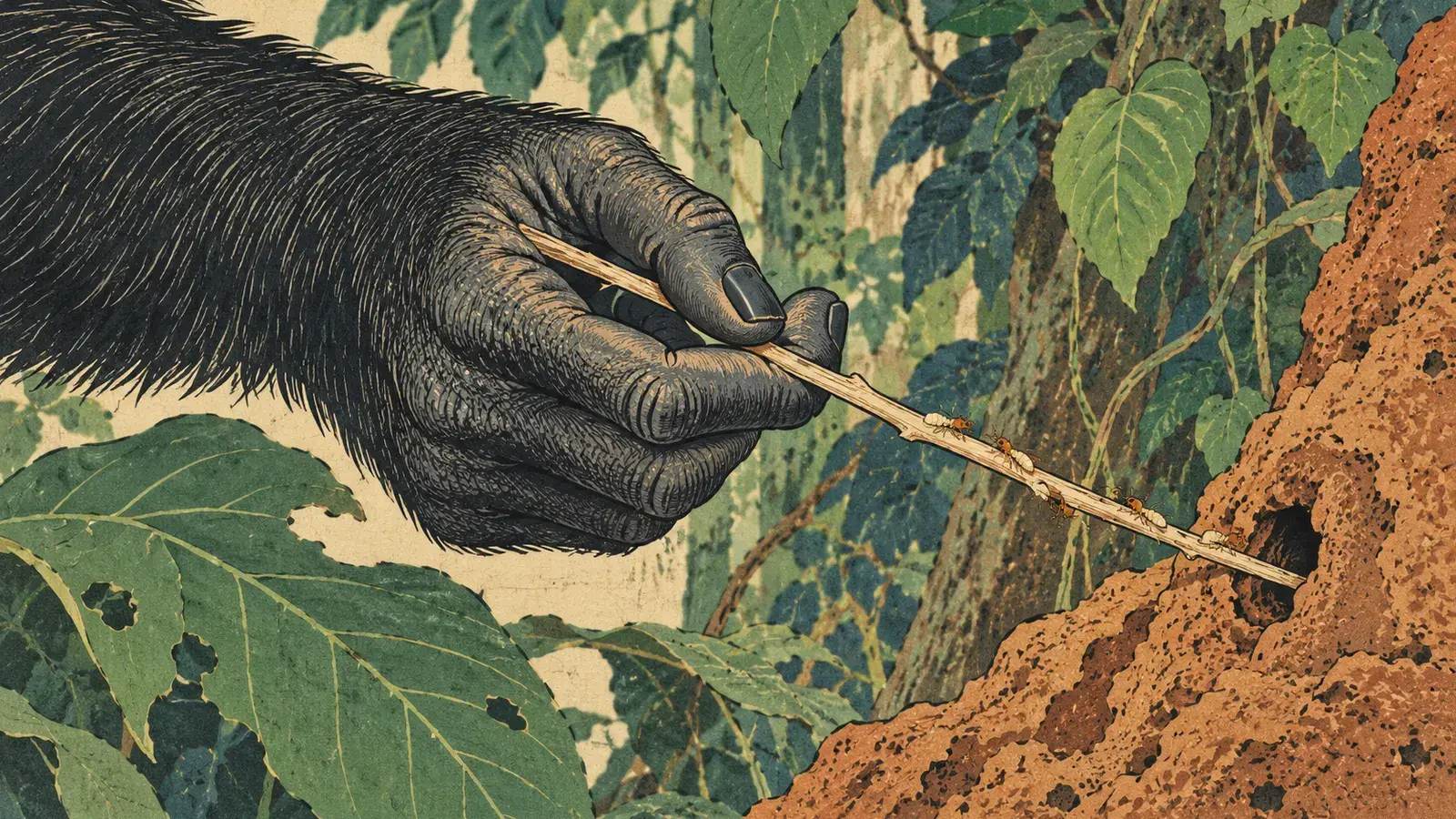
Goodall's observations overturned two deeply rooted beliefs of the time: that only humans make and use tools, and that chimpanzees are vegetarians. At Gombe, she saw a chimpanzee insert grass stems into termite holes and pull them out covered in insects, “fishing” for termites; she also observed chimpanzees stripping leaves from branches to make them more effective, a form of object modification that marks the beginnings of toolmaking. Leakey responded: “We must now redefine man, redefine tool, or accept chimpanzees as humans!”
Goodall also recorded that chimpanzees regularly hunt and eat smaller primates, such as colobus monkeys, and that they hug, kiss, pat one another on the back and even tickle—behaviours once considered exclusively human. But she did not see only their affectionate side. For the first ten years, she believed the Gombe chimpanzees were “better than humans”, as she put it, but later discovered that they could be brutal: she recorded dominant females deliberately killing other females' young, even resorting to cannibalism. She described the “Gombe Chimpanzee War” of 1974–1978 in her memoir Through a Window, documenting organised violence between groups. These findings provided further evidence of social similarities between humans and chimpanzees and radically changed modern understanding of their behaviour.
Goodall also stood out for her methods: she named the animals she studied instead of assigning them numbers, as was almost universally done at the time to avoid emotional attachment. She used words such as “childhood”, “motivation” and “personality” for chimpanzees and was accused of anthropomorphism, the worst “crime” in ethology, as she wrote. She defended her choice, saying that chimpanzees do indeed have personalities and emotions such as joy and sadness. This approach allowed her to develop a close bond with the chimpanzees and become, according to sources, the only human ever accepted into their society.
Later, some researchers argued that the artificial feeding stations used to attract the chimpanzees altered their natural behaviour and may have caused the “wars” between groups. Goodall acknowledged that feeding contributed to aggression within and between groups but insisted that its effect concerned the intensity rather than the nature of the conflicts. In a 2017 interview, she said that today she would no longer use feeding stations because of the risk of transmitting human infectious diseases.
In 1977, Goodall founded the Jane Goodall Institute to protect chimpanzees and their habitats, and in 1991 she established the Roots & Shoots youth programme, which began with 12 teenagers in Tanzania and grew into a network of more than 10,000 groups in over 100 countries. She also founded the Tchimpounga Chimpanzee Rehabilitation Center in Congo and the TACARE pilot reforestation programme around Gombe, which combined tree planting with training for neighbouring communities in sustainable practices and scholarships for girls. By 2004, she was devoting almost all her time to advocating for chimpanzees and the environment, travelling nearly 300 days a year.
She was a vegetarian for ethical, environmental and health reasons, and in 2021 she became vegan, also writing a cookbook titled Eat Meat Less. She campaigned against intensive livestock farming, animal experimentation and captivity, and for the recognition of ecocide as an international crime.
Goodall received dozens of honours. She earned a PhD in ethology from the University of Cambridge in 1965, although she was only the eighth person admitted to a doctoral programme without an undergraduate degree. She wrote 32 books, 15 of them for children, and was the subject of more than 40 films. Her honours included National Geographic's Hubbard Medal, the Kyoto Prize, the Templeton Prize, France's Legion of Honour and, in January 2025, the Presidential Medal of Freedom from President Joe Biden. In 2003, she was appointed Dame Commander of the Order of the British Empire by Queen Elizabeth II, and she had been a UN Messenger of Peace since 2002.
After her death, PETA posthumously named her “Person of the Year” for her legacy of kindness.
In her personal life, she married twice: first to Dutch baron and wildlife photographer Hugo van Lawick, with whom she had a son, and then to Derek Bryceson, a former member of Tanzania's parliament and director of its national parks, who protected her research programme and imposed a ban on tourism at Gombe. Goodall had said that her favourite animal was the dog, rather than chimpanzees, and that she had prosopagnosia, which made it difficult for her to recognise familiar faces. Spiritually, she grew up in a Christian family and described a mystical experience at Notre-Dame in Paris in 1977 that led her to believe in a “guiding force” in the universe. She said she saw no contradiction between evolution and belief in God, and openly expressed her interest in the possible existence of unknown primates such as Bigfoot.
Her death prompted tributes from figures including Prince Harry and Meghan, former US Vice President Al Gore, former Canadian Prime Minister Justin Trudeau and UN Secretary-General António Guterres, while her work continues through the Institute and the Roots & Shoots programme.
Comments