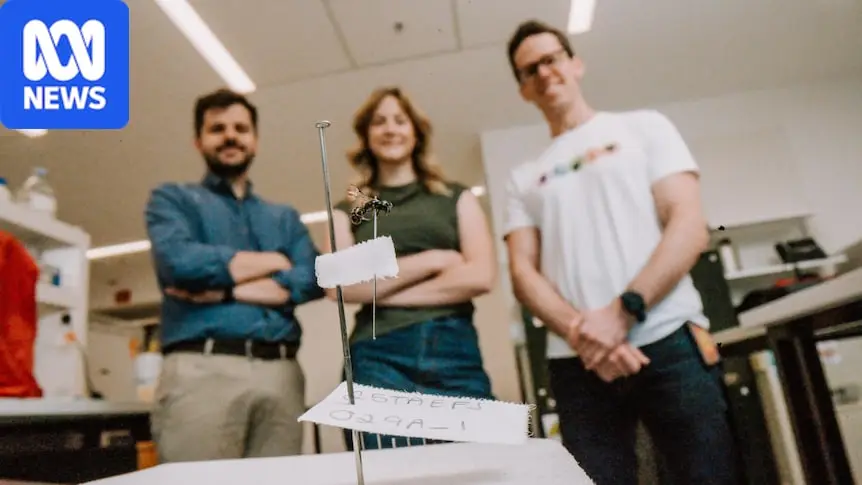
A tiny bee in Fiji is estimated to have suffered a 99% population decline over the past 150 years, according to research published in the peer-reviewed scientific journal Ecology and Evolution. Scientists believe the species Hylaeus navai should be classified as critically endangered. Its formal scientific description came only in 2024. Its case shows how an insect can approach extinction before its very existence is known.
Researcher Tegan Edwards, from the University of Wollongong, spent a month in Fiji searching for the bee, which is smaller than a grain of rice. In heat, humidity and rain, she wielded a nine-metre pole fitted with a net to collect the insects. Her colleague, evolutionary biologist James Dorey, also took part in the research. The difficulty of collecting specimens is an obstacle both to studying the species and to monitoring it systematically.
Dorey first found an individual Hylaeus navai on a trip to Fiji in 2016. During two visits in 2019, he found more individuals, ahead of the species' formal description in 2024. He spoke about the challenges of collecting specimens, but also about the difficulty of killing such an insect in order to properly record and describe it.
The estimate of the population's historical decline came from an analysis of the bee's genome. As Dorey explained, researchers examine mutations and their frequency to learn when they arose. This information also allows estimates of a population's past size and changes over time. According to him, the genetic analysis indicates that the species is critically endangered.
Dorey said the population collapse coincides with the colonisation of Fiji, which brought habitat destruction and possibly pesticide use. Potential threats also include natural events such as cyclones that damage habitats. Another possible threat is linked to the bees' attraction to plants with red flowers, such as the African tulip tree. This plant is toxic to various bee species, though the report does not establish that it caused the decline of Hylaeus navai.
For Edwards, the risk of a species disappearing before it is recorded is common in the insect world. Their enormous diversity makes cataloguing them difficult, especially in areas where research remains limited. She pointed out that Europe's insects have been extensively studied, while much remains unknown about those of the Pacific islands near Australia. These gaps in knowledge were one of the reasons that led the two researchers to Fiji.
Bees' importance goes beyond their small size: they pollinate plants that make up a large part of the diets of humans and animals. They also contribute to the health, reproduction and survival of entire ecosystems. Edwards argues that more research is needed on the pollinators that support systems providing food and medicine. As she stresses, when we are unaware of a species' presence, we cannot identify the threats it faces and try to protect it.
The research team has not returned to Fiji to check the bee's populations since 2024. Dorey explained that monitoring requires skill and strength to handle the nets and catch the insects. He also stressed the need for people in Fiji itself to take on this work. The lack of a more recent visit means the team has not carried out a recent field check.
The University of Wollongong research was funded by a federal government grant, which enabled collaboration with the University of the South Pacific. Dorey hopes this collaboration will help train students from Fiji to study the rare bee throughout the year. This prospect links protecting the species with strengthening local research capacity. The team wants more students in the South Pacific to take part in documenting life in the region.


Comments