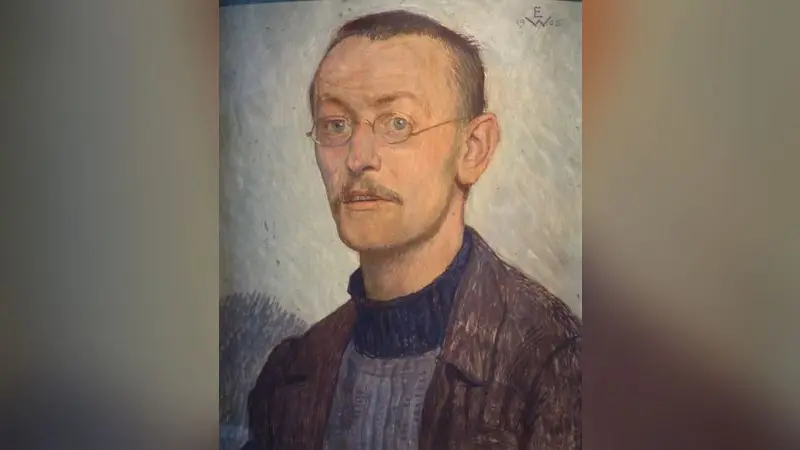
Hermann Karl Hesse was born on 2 July 1877 in Calw in the Black Forest, in the German Empire, and died on 9 August 1962 in Montagnola, Switzerland. He was a German-Swiss poet and novelist and received the Nobel Prize in Literature in 1946. His interest in Eastern religious and philosophical traditions, combined with his involvement in Jungian analysis, shaped his work. His best-known novels—Demian, Steppenwolf, Siddhartha, Narcissus and Goldmund, and The Glass Bead Game—explore the individual's search for authenticity, self-knowledge and spirituality.
He grew up in a Swabian Pietist environment, with a family involved in missionary work in India. His grandfather, Hermann Gundert, compiled a grammar and dictionary of the Malayalam language and contributed to the translation of the Bible. His father, Johannes Hesse, had been born in Estonia, then part of the Russian Empire, and the young Hesse felt alienated from Swabian petty-bourgeois society. From childhood, he displayed a strong will and early signs of depression, while access to his grandfather's library made him feel like a citizen of the world, opposed to all nationalism.
His education was marked by a crisis: in 1891 he entered the Protestant theological seminary at Maulbronn Abbey, but in March 1892 he ran away and was found in a field a day later. After a suicide attempt, he spent time in institutions and a psychiatric clinic, and continued his education at various schools. He later drew on this experience in his novel Under the Wheel.
From 1895 he worked as a bookseller in Tübingen, where he studied theology, Goethe, Nietzsche and the German Romantics. His first poetry collection and his first collection of prose were not commercially successful; his mother disapproved of Romantic Songs as too worldly.
Success came in 1904 with the novel Peter Camenzind, which made him financially independent and became popular throughout Germany. Sigmund Freud described it as one of his favourite books. That same year, Hesse married Maria Bernoulli, with whom he had three sons.
At Lake Constance, his interest in Buddhism was rekindled, and he was influenced by Schopenhauer and theosophy, influences that later gave rise to the novella Siddhartha. In 1911 he travelled to Sri Lanka, Indonesia, Borneo and Burma; the experience disappointed him spiritually but left a deep mark on his literary work.
During the First World War he volunteered for military service, but was deemed unfit for combat and served in the care of prisoners of war. His essay “O friends, not these tones”, published in November 1914, called on intellectuals not to be swept up in nationalist madness. He came under attack from the German press and lost friends, but found support from Romain Rolland and Theodor Heuss.
Personal blows came together: his father's death, his son's illness and his wife's schizophrenia led him to psychotherapy and to meeting Carl Jung. Demian was written in 1917 and published in 1919 under a pseudonym.
After the war, his marriage broke down, and Hesse settled alone in Ticino, at Casa Camuzzi near Montagnola, where he began painting. There he wrote Siddhartha and obtained Swiss citizenship in 1923.
Steppenwolf followed in 1927 and Narcissus and Goldmund in 1930, as did his relationship and marriage with the art historian Ninon Dolbin. In 1931 they moved to a larger house built for him by his friend and patron Hans C. Bodmer.
Hesse watched the rise of Nazism with concern. He helped Bertolt Brecht and Thomas Mann in exile and publicised the work of banned Jewish authors such as Franz Kafka. He did not openly condemn the Nazi Party, but his aversion was clear; in a letter in 1933, he wrote that intellectuals should stand by the spirit and not sing patriotic songs on demand. The regime treated him as an “undesirable” writer, although his books were never officially banned.
His last major novel, The Glass Bead Game, was printed in Switzerland in 1943 after eleven years of work, and he said that it had helped him survive the Hitler years. In 1946 he was awarded the Nobel Prize in Literature.
During the last twenty years of his life, he wrote short stories and poems, mainly recalling his childhood and exploring themes of nature, while painting watercolours and corresponding daily with readers. He died on 9 August 1962 and was buried in the cemetery of Sant'Abbondio in Gentilino.
International recognition came after his death: in the mid-1960s, his works became bestsellers in the United States, linked to counterculture themes such as the search for enlightenment. Some interpreted the “magic theatre” in Steppenwolf as psychedelic, although there is no evidence that Hesse ever took psychedelics. Colin Wilson and Timothy Leary played a significant role in the surge. From the United States, the revival spread to Germany; more than 800,000 copies were sold in the German-speaking world in 1972–73. Overall, his books have sold more than 100 million copies, placing him among the hundred bestselling fiction writers of all time.
For Hesse, “there are different paths to God for different people”, although he regarded the Christianity his parents lived by as the strongest formative influence.
Comments