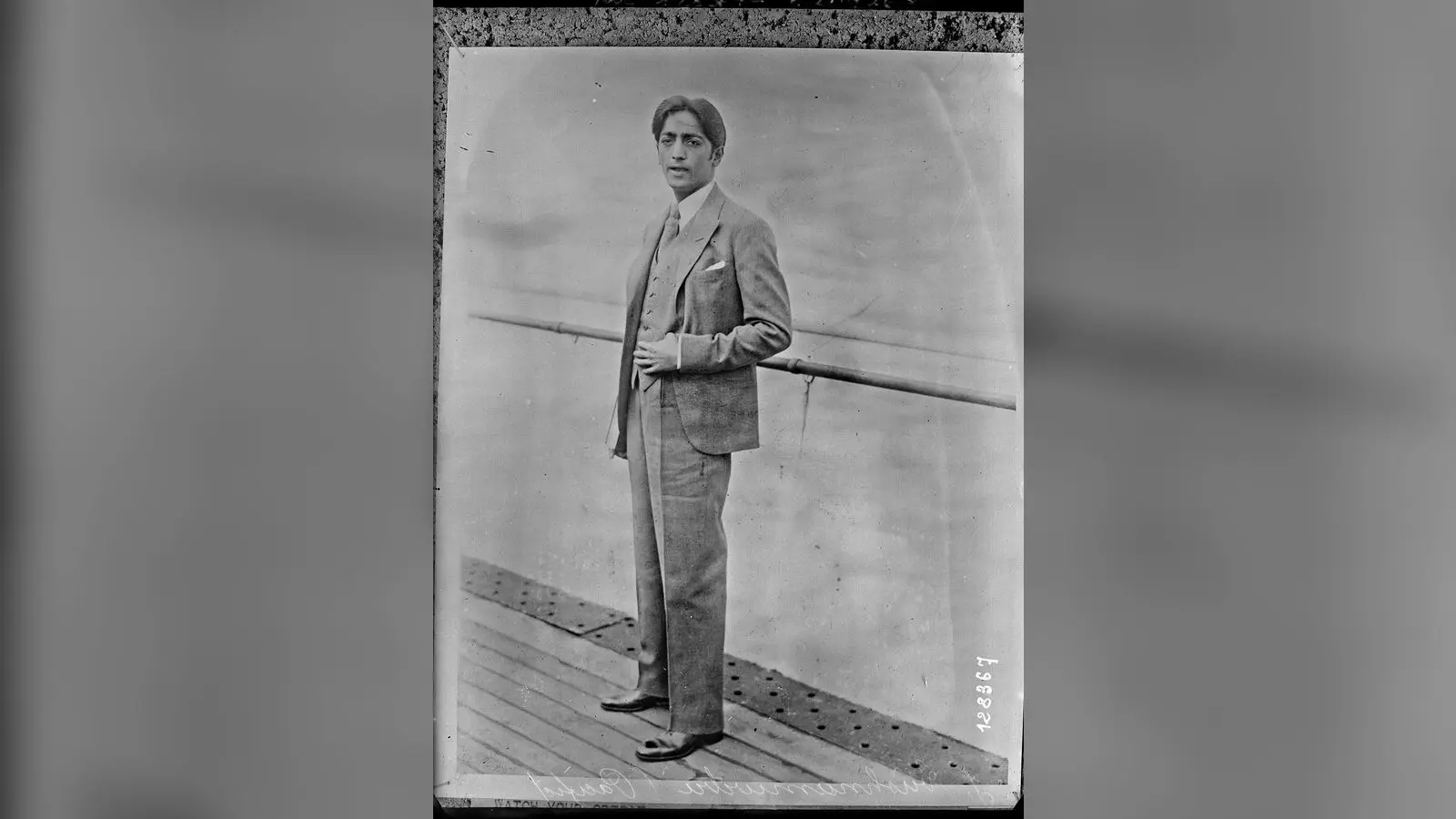
Jiddu Krishnamurti was born on 11 May 1895 in Madanapalle, in what was then the Madras Presidency, into a Telugu-speaking Brahmin family. As a child, he was sickly, “absent-minded and dreamy,” often considered intellectually deficient and beaten by teachers and his father; yet from an early age he felt an unusual closeness to nature.
In April 1909, Charles Webster Leadbeater, a member of the Theosophical Society, spotted him on the beach at Adyar and claimed to have seen “the most wonderful aura” he had ever encountered. The Society effectively adopted him and prepared him for the role of “vehicle” for the expected World Teacher. Despite doubts about his abilities — Ernest Wood considered him “particularly slow-witted” — within six months the 14-year-old could speak and write English. In 1911, the Order of the Star in the East was founded to prepare the world for the coming of the World Teacher, with Krishnamurti as its head.
After a legal dispute, Annie Besant became his guardian, taking him away from his father. Krishnamurti and his brother Nitya grew even closer and traveled together. His education included a strict schedule of physical exercise, Theosophical lessons, yoga, meditation and rules of British social etiquette; he struggled with formal education, however, and abandoned his attempts to attend university.
In 1921, Krishnamurti fell in love with 17-year-old American Helen Knothe, but the relationship went no further because he felt his work ruled out a “normal” personal life. She later said he was incapable of forming normal personal relationships because of the privileged way his followers had brought him up.
In 1922, in Ojai, California, he began experiencing the painful mystical episodes known as “the process”: sharp neck pain, loss of appetite, delirium and states resembling fainting, which he described as deep awareness and union with his surroundings. This was followed by “otherness,” a state that accompanied him almost continuously and gave him “a sense of being protected”; he wrote of an intense sensitivity to beauty and a force that filled the room during meetings.
His brother Nitya’s death in 1925 from complications of influenza and tuberculosis profoundly shook his faith in Theosophy and its leaders. He had believed that Nitya was essential to his mission and that they would not let him die. Twelve days after the death, witnesses said he appeared “immensely calm, radiant and free of all emotion.”
On 3 August 1929, at the annual Star Camp in Ommen, the Netherlands, he dissolved the Order of the Star. He declared that “truth is a pathless land” and that no religion, sect or organization could lead to it; he rejected followers and said his aim was to free people from every fear and cage. After the dissolution, he returned money and property to donors, including a castle in the Netherlands and around 20,230 stremmas of land.
From 1930 to 1944, he gave talks and published works through the Star Publishing Trust, based at Arya Vihara in Ojai, where he lived with his business associate Desikacharya Rajagopal and Rajagopal’s wife, Rosalind. According to the couple’s daughter, Radha Sloss, Krishnamurti had an affair with Rosalind for around 25 years, which was kept secret to preserve his image as a celibate guru. She also maintained that he depended on his followers to sustain his lifestyle.
During the Second World War, Krishnamurti did not speak publicly for around four years. Arya Vihara operated as an almost self-sufficient farm, and its surplus was donated to relief efforts in Europe. His position on the war was often seen as pacifist, even subversive, and for a time he was under FBI surveillance.
In 1938, he met Aldous Huxley, who became a close friend; Huxley encouraged him to write and introduced him to the publisher Harper. This led to the publication of The First and Last Freedom in 1954, which significantly expanded his audience and established him as an author in commercial publishing.
Krishnamurti subsequently traveled around the world, giving public talks and taking part in dialogues. In the early 1960s, he met physicist David Bohm; their philosophical and scientific concerns found common ground, and they began a dialogue that lasted almost two decades. Some of these dialogues were published, bringing Krishnamurti’s ideas to a wider scientific audience. Their friendship went through a difficult period, but they remained friends until his death, although it never regained its earlier intensity.
Krishnamurti maintained that meditation is not a technique but “choiceless awareness,” and that truth cannot be organized.
A few days before his death on 17 February 1986, he said that no one had understood what spirit or intelligence had passed through his body, and that after his death no other such body or intelligence would be found “for many hundreds of years.”
Through nonprofit foundations in India, Britain and the United States, his supporters oversee independent schools based on his educational philosophy and continue to distribute his extensive work in various formats and languages.



Comments