
Joseph Campbell (1904–1987) was an American writer and professor of literature at Sarah Lawrence College whose work covered comparative mythology and comparative religion. His best-known book, The Hero with a Thousand Faces (1949), set out the theory of the “monomyth”: the idea that all major mythological narratives are variations of a single story, the journey of the archetypal hero. His work profoundly influenced cinema, literature and the way many people see myth as a guide to life.
He was born on 26 March 1904 in White Plains, New York, into a middle-class Irish Catholic family. In 1919, a fire destroyed the family home in New Rochelle, killing his grandmother. He studied biology and mathematics at Dartmouth College, but soon turned to the humanities and transferred to Columbia University, where he earned a degree in English literature in 1925 and a master’s degree in medieval literature in 1927.
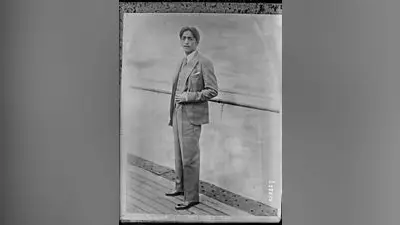
In 1924, on a voyage by ship, he met Jiddu Krishnamurti, an encounter that opened up the world of Indian philosophy to him. With a Columbia scholarship, he studied Old French, Provençal and Sanskrit in Paris and Munich, and learned to speak French and German. There he was influenced by the writers James Joyce and Thomas Mann, Picasso’s art and the thinking of Freud and Carl Jung. When he returned to Columbia in 1929 and asked to broaden his studies to include Sanskrit and modern art, his professors refused, so he abandoned his graduate studies.
With the onset of the Great Depression, he spent five years (1929–1934) in a rented cabin in Woodstock, New York, studying intensively: he divided the day into four three-hour periods, reading for nine hours a day, as he described it. In 1931–1932, he travelled to California, where he became close friends with the young writer John Steinbeck and the marine biologist Ed Ricketts, who inspired an unfinished novel. In 1933, he taught for a year at Canterbury School and sold his first short story, titled “Strictly Platonic”.
In 1934, he was hired as a professor of literature at Sarah Lawrence College, where he remained for 38 years until his retirement in 1972. In 1938, he married a former student, the dancer and choreographer Jean Erdman; they lived together for 49 years and had no children. At the beginning of the Second World War, he met the Indologist Heinrich Zimmer and, after Zimmer’s death, took on the task of editing and publishing his remaining writings. In 1955–1956, he travelled to Asia for the first time, spending six months in South Asia, mainly India, and six in East Asia, mainly Japan, an experience that profoundly influenced his thinking about Asian religion and myth.
In The Hero with a Thousand Faces, Campbell described the hero’s journey in broad stages: the hero receives the “call to adventure”, receives supernatural help, meets the goddess or reconciles with the father, and returns to the human world with the “gift” that can benefit the community. The theory drew on Carl Jung’s ideas about archetypes and Freud’s psychoanalytic concepts. The term “monomyth” comes from Joyce’s Finnegans Wake.
Campbell described myth as having four functions in human society: the mystical or metaphysical, which awakens awe and gratitude before the mystery of existence; the cosmological, which explains the shape of the universe; the sociological, which validates and supports the existing social order; and the psychological or pedagogical, which guides the individual through the stages of life. He also identified a progression of myth through history, from the “way of the animal powers” of hunting societies, to the “way of the seeded earth” of agricultural societies, to the “way of the celestial lights” of the first great civilisations and finally to the “way of man”. He believed that all the world’s religions are culturally influenced “masks” of the same fundamental, transcendent truths.
One of his best-known and most misunderstood phrases was “Follow your bliss”. He drew it from the Upanishads and the Sanskrit terms Sat-Chit-Ananda (being, consciousness, bliss), saying that, since he was not sure whether his consciousness or his being was “right”, he knew where his joy lay and held on to it. In his later years, when some students took him to be encouraging hedonism, he reportedly grumbled: “I should have said: follow your blisters.” In the documentary Joseph Campbell: A Hero's Journey, he explained that God is a metaphor for a mystery that transcends all human categories of thought, adding that theists regard their metaphors as facts, while atheists regard them as lies.
Campbell’s influence on contemporary culture was considerable. George Lucas acknowledged that Star Wars was shaped in part by the ideas in The Hero with a Thousand Faces, and later invited Campbell to Skywalker Ranch to watch the entire trilogy, which Campbell called “real art”. Screenwriter Christopher Vogler wrote a memo based on Campbell’s work that led to the development of Disney’s The Lion King, while films such as The Matrix and Indiana Jones have been recognised as following the monomyth structure. Creator Dan Harmon cites Campbell as a major influence and uses a “story circle” based on his work. In 1991, Campbell’s widow, Jean Erdman, and his publisher, Robert Walter, established the Joseph Campbell Foundation. However, his emphasis on the psychological reading of myths brought him both a large audience and substantial criticism: some of his colleagues believed that the primary purpose of mythical texts was sociological.
Campbell died at his home in Honolulu, Hawaii, on 30 October 1987, from complications of oesophageal cancer. Shortly before his death, he had completed filming a series of interviews with journalist Bill Moyers, which aired the following spring as The Power of Myth and brought his ideas to a wider audience.



Comments