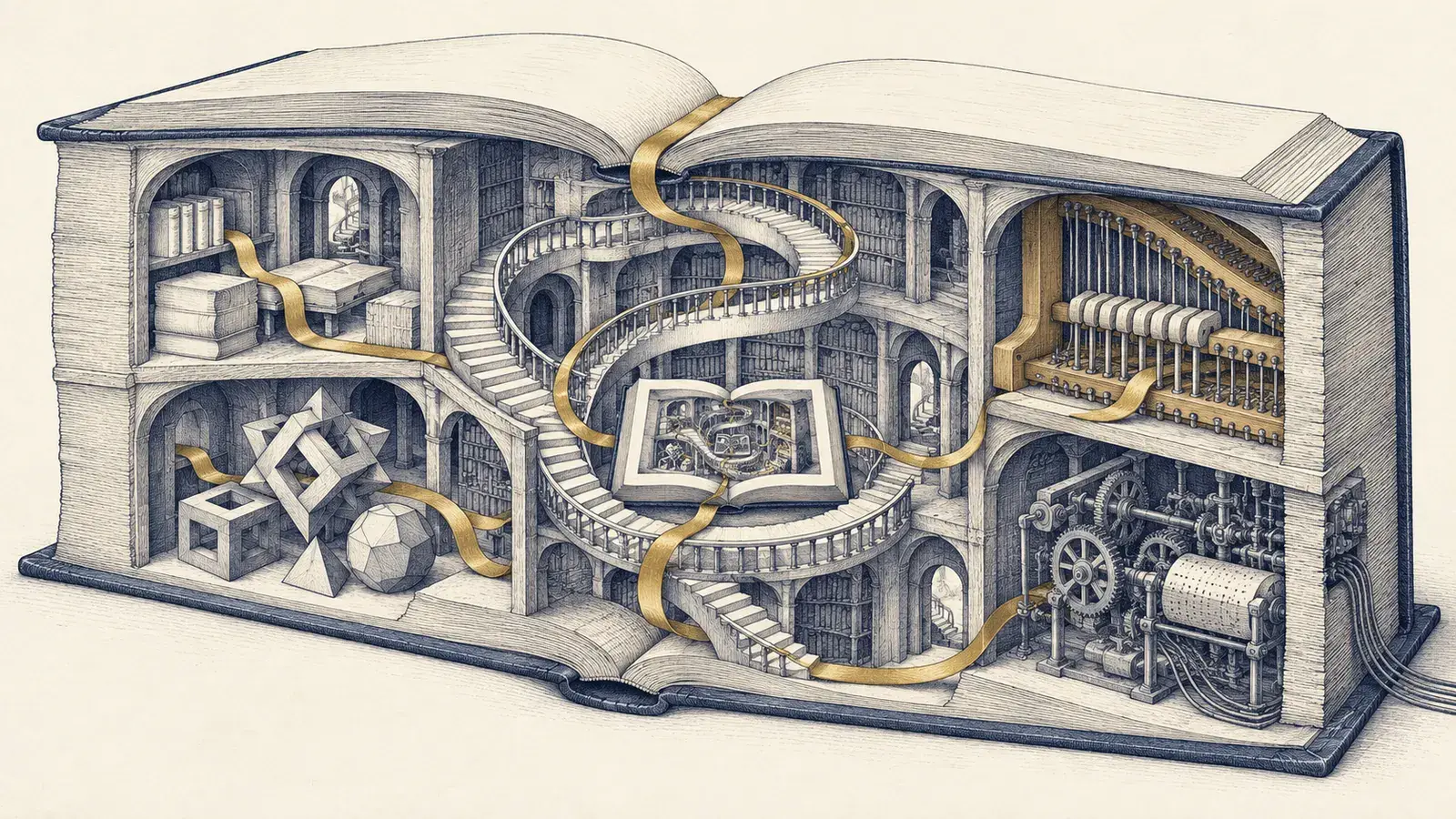
Douglas Richard Hofstadter was born on 15 February 1945 in New York City and is a cognitive scientist and computer scientist whose research covers concepts such as the sense of self in relation to the outside world, consciousness, analogy-making, “strange loops”, ambigrams, artificial intelligence and discovery in mathematics and physics. His 1979 book Gödel, Escher, Bach: An Eternal Golden Braid earned him the Pulitzer Prize for General Nonfiction and a National Book Award for Science, while his 2007 book I Am a Strange Loop won the Los Angeles Times Book Prize for Science and Technology.
Hofstadter was born in New York City to Robert Hofstadter, who later won the Nobel Prize in Physics, and Nancy Givan Hofstadter. He grew up on the Stanford campus, where his father was a professor, and attended the International School of Geneva in 1958–59. He graduated with distinction in mathematics from Stanford University in 1965 and began graduate studies in mathematics, but abandoned them because he felt unable to keep up — something he described as “a huge, bitter wound to my ego” and “traumatic”. He received his PhD in physics from the University of Oregon in 1975; his graduate studies of the energy levels of Bloch electrons in a magnetic field led him to discover the fractal known as “Hofstadter’s butterfly”.
In 1977, he was initially appointed to Indiana University’s computer science faculty, where he began his research programme on computational modelling of mental processes — a programme he initially called “artificial intelligence research”, a label he has since abandoned in favour of “cognitive science research”. In 1984, he moved to the University of Michigan in Ann Arbor as a professor of psychology and holder of the Walgreen chair for the study of human understanding. In 1988, he returned to Indiana as a distinguished professor of cognitive science and comparative literature, directing the Center for Research on Concepts and Cognition, where he formed the “Fluid Analogies Research Group” (FARG). In 1988, he received the In Praise of Reason Award, the highest honour of the Committee for Skeptical Inquiry, and in 2009 he was elected a member of the American Academy of Arts and Sciences, while in 2010 he became a member of the Royal Society of Sciences in Uppsala.
Hofstadter’s central position on consciousness, first set out in Gödel, Escher, Bach, is that it is “an emergent consequence of intense lower-level activity in the brain”. In the same book, he draws an analogy between the social organisation of an ant colony and the mind as a coherent “colony” of neurons. According to Hofstadter, the feeling that we have — or are — an “I” comes from the abstract pattern he calls a “strange loop”, which he defines as “a feedback loop that crosses levels”. The model example of a strange loop is the self-referential structure at the heart of Gödel’s incompleteness theorems. His book I Am a Strange Loop takes this idea further, arguing that each human “I” is distributed across many brains rather than confined to one.
At the University of Michigan and at Indiana, Hofstadter worked with Melanie Mitchell to create Copycat, a computational model of high-level perception, as well as other models of analogy and cognition, such as Tabletop with Robert French. The Letter Spirit project, implemented by Gary McGraw and John Rehling, aims to model artistic creativity by designing stylistically consistent “grid fonts”. More recent models include Phaeaco and SeqSee, which model high-level perception and analogy-making in microdomains, as well as George, which models processes of perception and discovery in triangle geometry.
Hofstadter’s work extends far beyond cognitive science. In 1999, on the 200th anniversary of Alexander Pushkin’s birth, he published a verse translation of the classic verse novel Eugene Onegin, and he has also translated other poems and two novels: Françoise Sagan’s La Chamade and Walter Veltroni’s La Scoperta dell'Alba. His book Le Ton beau de Marot is devoted to language and translation, centring on 88 translations of “Ma Mignonne”, a highly constrained 16th-century poem by Clément Marot; there he jokingly calls himself “π-lingual” (because the sum of his levels of proficiency in all the languages he has studied comes to 3.14159...) and “oligoglot”. Gödel, Escher, Bach also sets out “Hofstadter’s law”: “It always takes longer than you expect, even when you take into account Hofstadter’s law.”
In 1983–84, Hofstadter coined the term “ambigram” to describe a calligraphic composition of glyphs that conveys different meanings depending on the orientation from which it is viewed. In 1987, a book containing 200 of his ambigrams and a long dialogue with his alter ego, Egbert G. Gebstadter, was published in Italy. John Langdon popularised ambigrams with his book Wordplay, acknowledging Hofstadter’s “seemingly inexhaustible” creativity, while Hofstadter’s Ambigrammia Between Creation and Discovery (2025) presents hundreds of his handmade ambigrams alongside reflections on this art form.
Hofstadter has said that he feels “uncomfortable with the geek culture that revolves around computers” and that he is “not interested in computers”, although his work inspired many people to pursue careers in computing and artificial intelligence. After Garry Kasparov’s defeat by Deep Blue, he commented: “It was a watershed event, but it has nothing to do with computers becoming intelligent.” However, in his book Metamagical Themas he writes that “today, how can anyone fascinated by creativity and beauty fail to see computers as the ultimate tool for exploring their essence?” In response to predictions of a technological singularity, he organised and participated in public discussions — including the “Spiritual Robots” symposium at Stanford in 2000, where he moderated a panel with Ray Kurzweil, Hans Moravec and others — and expressed doubt that the singularity would occur in the foreseeable future. In a 2023 interview, he said that rapid progress in AI had caused some of his “core beliefs” about AI’s limits to “collapse”, and suggested that humans might soon be overshadowed by “something else, far more intelligent, that will become incomprehensible to us”.
From 1981 to 1983, Hofstadter succeeded Martin Gardner’s “Mathematical Games” column in Scientific American with his “Metamagical Themas” column, in which he introduced, among other things, the concept of “Reviews of This Book” and wrote about the harmful effects of sexist language. He published the satire “A Person Paper on Purity in Language” under the pseudonym William Satire only in the book Metamagical Themas. Other columns covered Robert Axelrod’s tournament of prisoner’s dilemma strategies, the concept of superrationality, patterns in Chopin’s music and the self-modifying game Nomic. His doctoral students included David Chalmers, Robert French, Gary McGraw and Melanie Mitchell.
Hofstadter was married to Carol Ann Brush, whom he met in Bloomington and married in Ann Arbor in 1985, and they had two children. Carol died of glioblastoma in 1993, when their children were young, and a scholarship was established in her memory for Indiana University students heading to Bologna; the dedication of Le Ton beau de Marot to their children reads “To M. & D., living sparks of their Mommy’s soul”. In 2010, he met his second wife, Baofeng Lin, at a cha-cha-cha class, and they married in 2012. As a consequence of his views on consciousness and empathy, he became a vegetarian in his teens and has remained mostly vegetarian ever since. The dedication of I Am a Strange Loop reads “To my sister Laura, who can understand, and to our sister Molly, who cannot”, as his younger sister never developed the ability to speak or understand language.
Comments