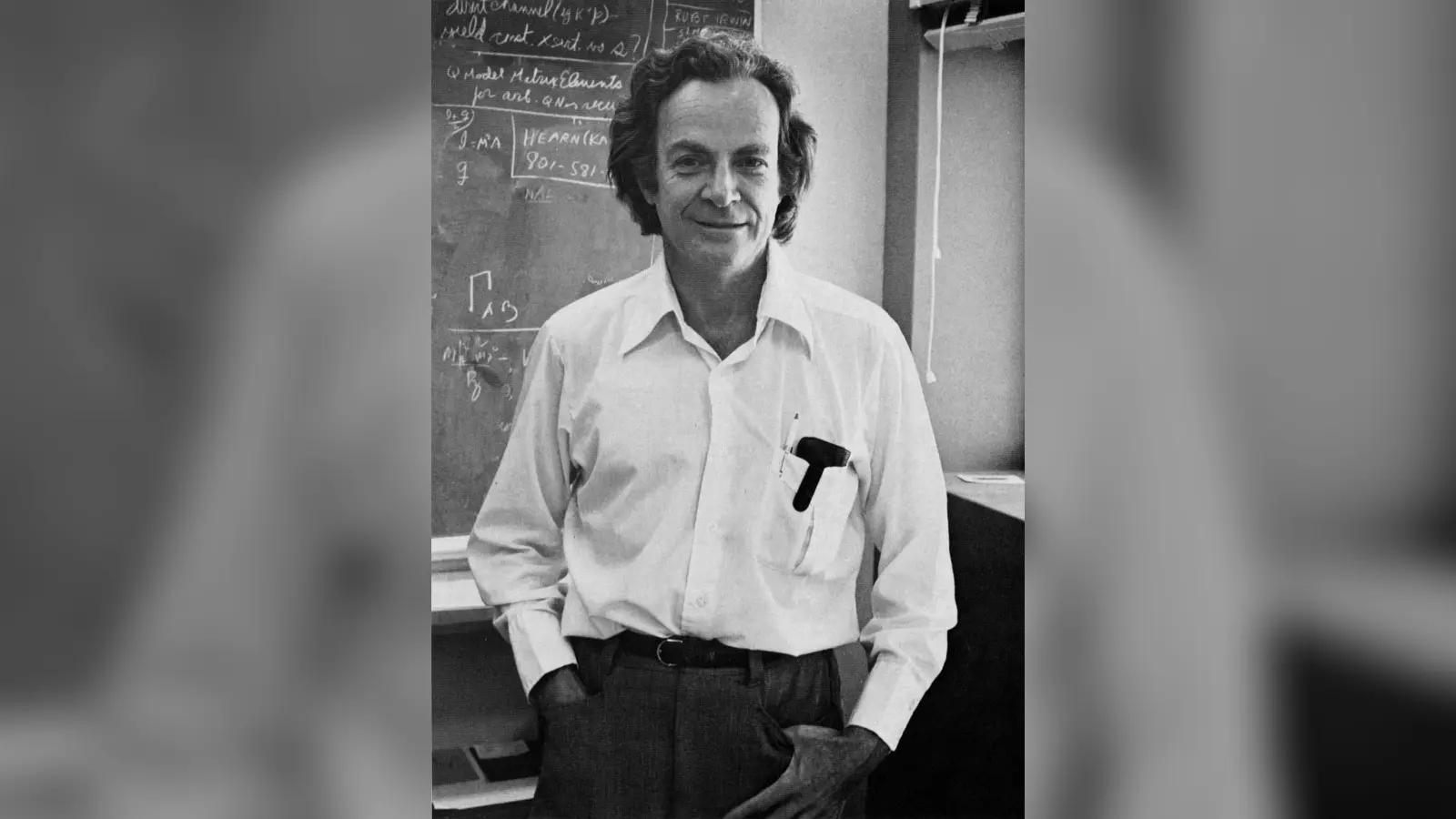
Richard Feynman (1918–1988) was an American theoretical physicist who shared the 1965 Nobel Prize in Physics with Julian Schwinger and Shinichiro Tomonaga for their fundamental work in quantum electrodynamics (QED). He was also known for the path integral formulation of quantum mechanics, the theory of superfluidity in supercooled liquid helium, the parton model and the famous diagrams that bear his name. In a 1999 Physics World poll, he was ranked the seventh-greatest physicist of all time.
Born in Queens, New York, in 1918, Feynman grew up in a Jewish family. His father encouraged him to question conventional wisdom and ask questions; his mother passed on her sense of humor. As a child, he repaired radios and kept a laboratory at home. In high school, he won New York University's mathematics competition, although his IQ was measured at 125 — “merely respectable,” according to biographer James Gleick.
He initially studied mathematics and electrical engineering at MIT before switching to physics; as an undergraduate, he published two papers in Physical Review. He earned his doctorate at Princeton in 1942 under John Archibald Wheeler, laying the groundwork for the path integral.
During World War II, he was recruited into the Manhattan Project. At Los Alamos, he joined Hans Bethe's theoretical division and became a group leader; together, they developed the Bethe–Feynman formula for the yield of a fission bomb. He led a team of human computers, helped introduce IBM punched cards and worked on neutron calculations. At Oak Ridge, he insisted on teaching nuclear physics to workers so they could understand the dangers of enriched uranium. Meanwhile, he amused himself by picking the locks on office furniture as a prank.
His first wife, Arline Greenbaum, died of tuberculosis on June 16, 1945; Feynman attended the Trinity test a few weeks later and watched the explosion through a truck windshield.
After the war, he taught at Cornell. He initially suffered from depression following his father's death in 1946 and wrote a letter to Arline that was sealed and opened only after his own death. When he began solving physics problems for his own enjoyment — such as the motion of a plate spinning in the air — he found his way again.
Problems in QED were discussed at the Shelter Island conference in 1947; Feynman presented his own approach at Pocono in 1948, but his new diagrams confused the audience. In 1949, Freeman Dyson published rules that made the method understandable. From 1948 to 1951, Feynman published a series of papers that laid the foundations of modern QED and introduced the Feynman propagator; his diagrams quickly became the dominant tool.
His personal life at Cornell was turbulent. According to Gleick, he often pursued married female friends and female students and visited sex workers, which strained his friendships. In 1952, he married Mary Louise Bell, but their divorce was finalized in 1958.
His former wife reportedly testified that he squeezed her neck and broke furniture when she interrupted him while he was doing calculations or playing African drums; she reportedly described him as having a “violent temper.” The FBI compiled an extensive file on Feynman, and a woman close to him — possibly his former wife — sent a statement to J. Edgar Hoover describing him as “a communist or strongly pro-communist” and “a danger to public trust.” These are allegations, not proven facts, but they reflect the dark imprint of his personality.
In 1951–1952, he spent a sabbatical year in Brazil, where he became fascinated by samba and learned to play the frigideira, a metal percussion instrument. He played bongos and congas as an amateur.
After returning, he settled at Caltech, where he held the Richard Tolman chair. In 1958, while in Geneva for the Atoms for Peace conference, he met Gweneth Howarth, a British woman.
Beyond his research, Feynman was a skilled science communicator. His undergraduate lectures were published as The Feynman Lectures on Physics; he also wrote The Character of Physical Law and QED: The Strange Theory of Light and Matter. Ralph Leighton's collections of anecdotes, Surely You're Joking, Mr. Feynman! and What Do You Care What Other People Think?, made him famous among the general public.
He is considered a pioneer of quantum computing and introduced the concept of nanotechnology in his 1959 talk “There's Plenty of Room at the Bottom.”
In the 1980s, he joined the Rogers Commission, which investigated the space shuttle Challenger disaster.


Comments