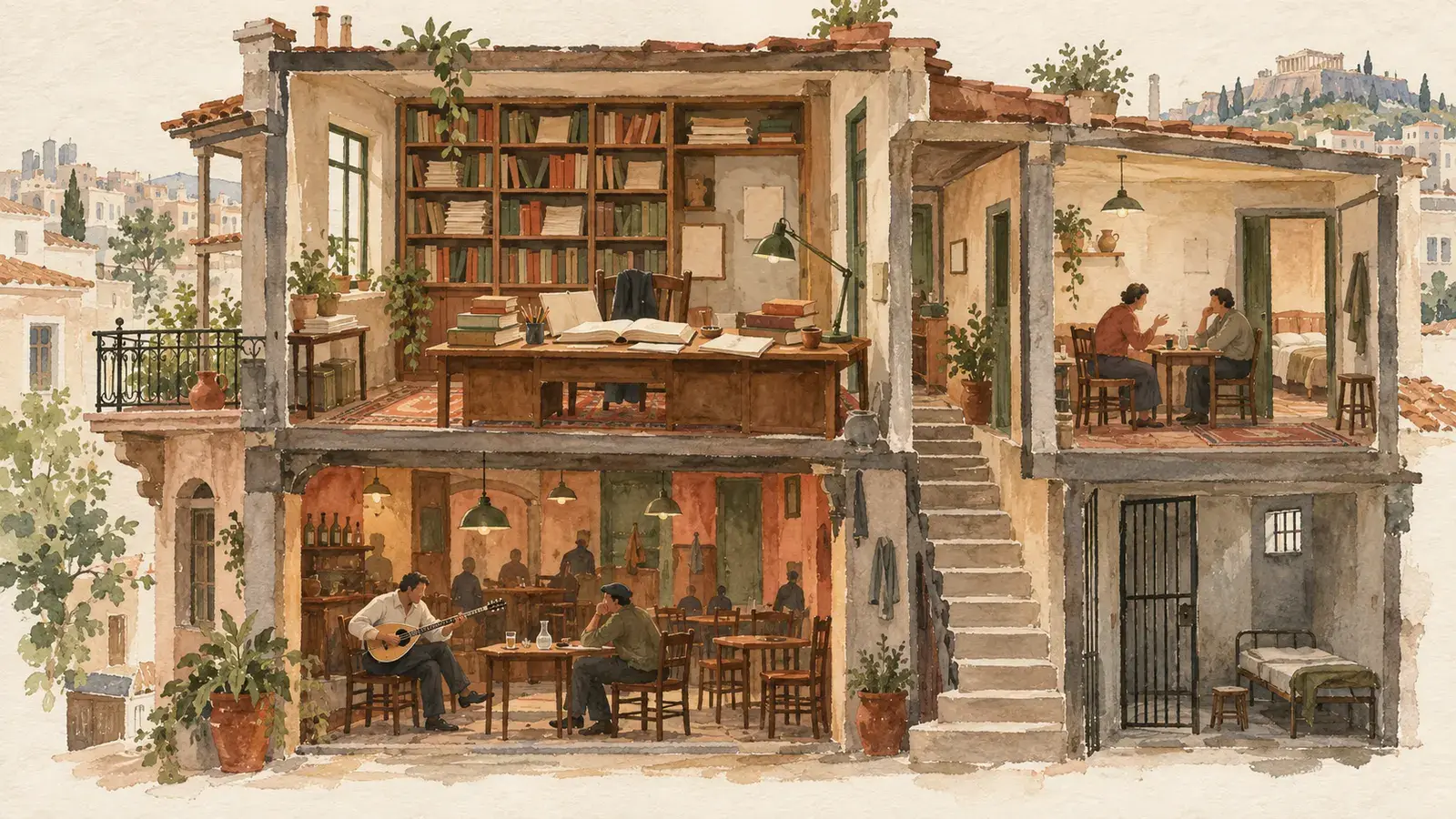
Ilias Petropoulos turned folklore research towards people, languages and everyday practices that were rarely considered subjects for serious study in Greece at the time. A researcher, writer, poet, journalist, photographer and collector, he called his field “urban folklore”. He studied rebetiko, gay communities, prostitution, prison and the underworld, gathering evidence about aspects of society that remained on the margins of the dominant historical narrative.
He was born in Athens on 26 June 1928 and moved to Thessaloniki at the age of six because his father, a civil servant, was transferred there. The family settled in an Ottoman house, from which his father removed distinctive Turkish features. According to anthropologist Christos Panagiotopoulos, the memory of this transformation resurfaced in Petropoulos’s later work as an example of the rejection of Ottoman heritage and the loss of distinctive features of Greek culture.
During the Nazi occupation, he took part in the Resistance, while his father was killed at the front. In 1947, he was briefly imprisoned for his involvement in the Democratic Army of Greece, and in 1949 he was dismissed from his job at the Municipality of Thessaloniki after being accused of being a communist. Eight years of unemployment and social marginalisation followed, according to the English biographical account. He studied law at the University of Thessaloniki but left before obtaining a degree.
His acquaintance with Vasilis Tsitsanis, dating back to his teenage years, was linked to his lasting interest in rebetiko. He also wrote about literature and the visual arts, with the essay “Elytis, Moralis, Tsarouchis” and monographs on painters and cartoonists. The collection and study “Rebetiko songs”, published in 1968, brought him to a wider audience and was reissued with additions and corrections. His research relied on direct contact with musicians and members of the communities he described.
In 1971, he published “Kaliarda”, a dictionary of gay slang, with a preface that attacked social conventions and also criticised the dictatorship. In 1972, he published the poem “Body” in the magazine Tram; one of its lines was considered anti-national by some. He faced prosecutions and prison sentences of a few months for “Rebetiko songs”, “Kaliarda” and the poem. That same year, he managed to obtain an identity card listing his religion as “atheist”, while a conviction for insulting religion remained pending until 1998.
In the mid-1970s, he settled permanently in Paris, where he studied Turkish studies and continued writing about Greece with emotional and financial support from his partner, Mary Koukoule. “The good thief’s handbook”, published in 1979, examined the underworld’s relationships with those in power, police practices and conditions in Greek prisons. The book was banned, copies were seized, and both the author and publisher Giannis Douvitsas faced prosecution. Its distribution was permitted after a series of legal battles.
His research also covered coffee, kiosks, cars, balconies, courtyards and other details of everyday life. He published photographic albums and books such as “Turkish coffee in Greece”, “The brothel”, “Thessaloniki: the memory of a city”, “The moustache” and “Rebetology”. In total, he published around 80 books and more than a thousand articles, often illustrating his texts with his own sketches and collages. Many of his works took the form of a monograph or a collection of articles on a common theme.
In his poetry, eroticism coexisted with cynicism and opposition to political and intellectual authority, while he was an early supporter of antipoetry. His final poetry collection, “Never and nothing”, was published in 1993, and poems from it were set to music by Marina Kanavaki on an album of the same name in 2000. He remained committed to the polytonic writing system and criticised the propriety he associated with political correctness. Provocative language was a consistent feature of his public presence.
Assessments of his work also include serious criticism. The Greek biographical account records the view that, towards the end of his life, the pursuit of provocation overshadowed research in some texts, with personal attacks and derogatory descriptions, particularly in the collection “The turd cutter”. It also records unsupported attacks on Aris Velouchiotis and controversial descriptions of Dionysios Solomos, while he himself admitted in an interview that he had made mistakes. These objections coexist with recognition of his contribution to preserving material from neglected areas of social and cultural life.
Petropoulos died of cancer in Paris on 3 September 2003, aged 75, without having returned to Greece after settling in France. He had rejected invitations to return, despite informal assurances that he would not face prosecution. In accordance with his wishes, his body was cremated and Mary Koukoule poured his ashes into a Paris sewer. The material he collected remains relevant to the study of everyday urban life, social exclusion and the boundaries between research, polemic and literary expression.

Comments