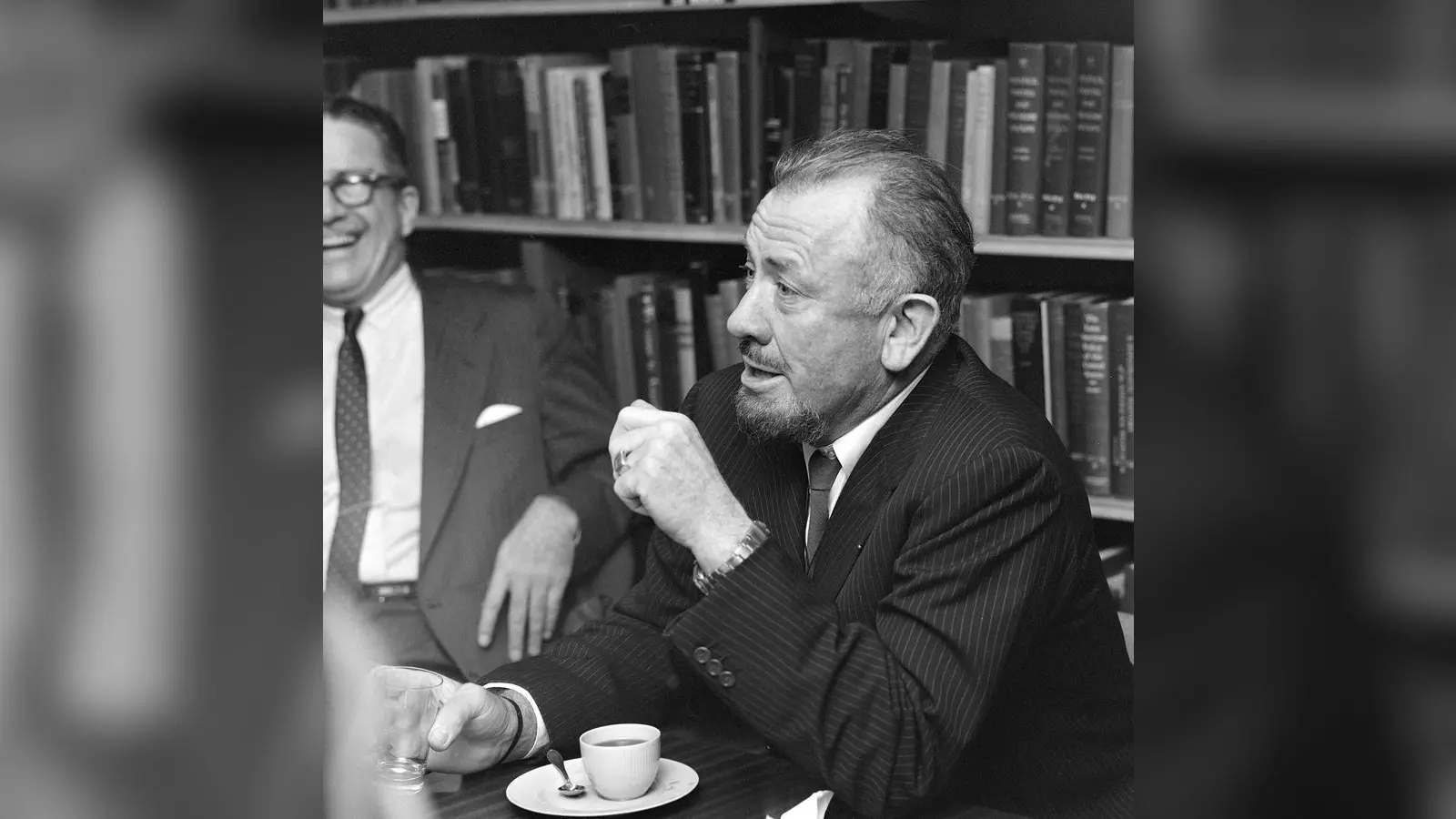
John Steinbeck was born on February 27, 1902, in Salinas, California, and died on December 20, 1968, in New York. He was one of the most widely read writers of the 20th century, with 33 books to his name, and was awarded the Nobel Prize in Literature in 1962 “for his realistic and imaginative writing, which combines sympathetic humor and keen social perception.” His work focused on the poor, migrant workers and ordinary people of central California.
With German, English and Irish ancestry, Steinbeck grew up in a fertile agricultural valley near the Pacific. He worked on ranches during the summers and later alongside migrant workers in sugar beet fields, experiences that provided material for his writing. He studied English literature at Stanford but left without a degree in 1925, worked occasional jobs in New York and returned to California. During the Great Depression, he and his first wife, Carol Henning, lived on very little, received welfare payments and sometimes stole bacon from the local market. In 1930, he met marine biologist Ed Ricketts, who became a close friend and mentor, teaching him about philosophy and ecology.
His first major success came in 1935 with Tortilla Flat, about a group of young people in Monterey after World War I. It was preceded by The Red Pony (1933), while novellas and novels such as Of Mice and Men and In Dubious Battle followed. In 1936, the San Francisco News sent him to document conditions in camps for poor migrants, an experience that led to the novel The Grapes of Wrath (1939). The book became a bestseller, won the Pulitzer Prize and was adapted into a film by John Ford, starring Henry Fonda. But it also provoked a backlash: Kern County banned the book in schools and libraries, and Steinbeck received so many threats that he bought a pistol. First Lady Eleanor Roosevelt publicly defended him, saying she had never believed the book was exaggerated.
Ricketts profoundly influenced Steinbeck's thinking, as seen in their joint book Sea of Cortez (1941), a blend of travel writing and natural history based on their expedition to the Gulf of California. The narrative section was republished in 1951 as The Log from the Sea of Cortez. Ricketts was the model for “Doc” in Cannery Row and other works, and ecological themes recur in the novels of that period. Ricketts's premature death in 1948 plunged Steinbeck into deep depression.
During World War II, Steinbeck worked as a war correspondent for the New York Herald Tribune and collaborated with the OSS, the predecessor of the CIA. He took part in commando operations in the Mediterranean, was wounded by shrapnel and returned with psychological trauma. He wrote the screenplay for Alfred Hitchcock's film Lifeboat, but asked for his name to be removed because he felt the final version had racist undertones. Cannery Row (1945) was written as a love letter to Monterey, followed later by The Pearl and the screenplay for Viva Zapata!, directed by Elia Kazan. In 1947, he traveled to the Soviet Union with photographer Robert Capa and recorded the experience in A Russian Journal.
In 1952, he completed East of Eden, which he considered his magnum opus. He wrote its first draft in 276 days, sending daily letters to his editor, and the 1955 film marked James Dean's film debut. He later devoted time to the legends of King Arthur while staying in Somerset, England, but the manuscript remained unfinished and was published after his death as The Acts of King Arthur and His Noble Knights (1976). The travelogue Travels with Charley describes his journey across America with his poodle, while his final novel, The Winter of Our Discontent (1961), examines moral decline in the United States.
The award of the Nobel Prize in 1962 prompted strong reactions. A Swedish newspaper called it “one of the Academy's biggest mistakes,” and The New York Times questioned the choice. When asked whether he deserved the prize, Steinbeck himself replied: “Frankly, no.” In his acceptance speech, he argued that writers have a duty to celebrate humanity's capacity for greatness of spirit, courage, compassion and love. In 2012, the Swedish Academy's archives revealed that Steinbeck had been a “compromise choice” among candidates such as Robert Graves and Karen Blixen.
Steinbeck married three times: to Carol Henning, Gwyn Conger, with whom he had two sons, and Elaine Scott, who stayed with him until the end. In 1964, he received the Presidential Medal of Freedom from Lyndon B. Johnson. In 1967, he went to Vietnam as a correspondent for Newsday, viewed the war as a heroic undertaking and was regarded as a supporter of it. His sons served there, and on one occasion Steinbeck manned a machine gun position at a base while his son slept. He died in 1968 from heart disease and congestive heart failure during the flu pandemic and was cremated according to his wishes. His ashes were buried in the family grave in Salinas.
Many of Steinbeck's works are taught in American high schools, but they have also been withdrawn or banned. In England, Of Mice and Men was removed from the examination syllabus, and in Wales it was withdrawn over concerns about racist language, while The Grapes of Wrath was burned in Salinas and banned in schools. Steinbeck was among the most frequently banned authors in the United States from 1990 to 2004. His childhood home and the National Steinbeck Center in Salinas preserve his memory, and the area is often called “Steinbeck Country.” His legacy remains alive through his perspective on the downtrodden and his insistence on human dignity.



Comments