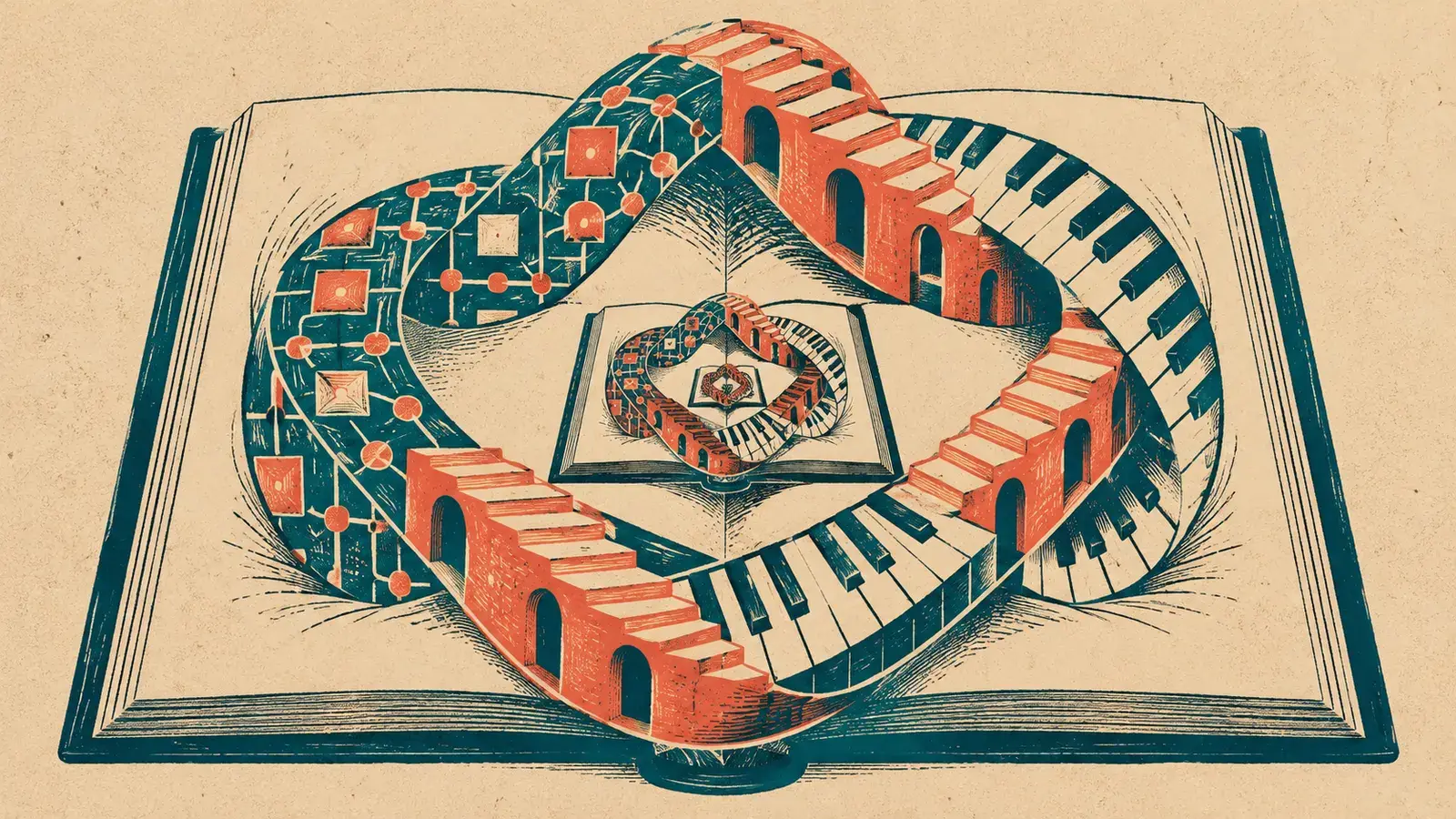
“Gödel, Escher, Bach: an Eternal Golden Braid” (1979) by Douglas Hofstadter is a book about the shared intellectual themes in the lives and work of logician Kurt Gödel, artist M. C. Escher and composer Johann Sebastian Bach. Through short stories, images and analysis, it explains how systems acquire meaning from the “meaningless” elements that make them up, and examines self-reference, formal rules, isomorphism, the nature of communication, the representation of knowledge and the limits of symbolism. The book won the Pulitzer Prize for General Nonfiction and the US National Book Award in the science category.
As a cognitive scientist, Hofstadter has said that the book is not simply about the relationships between mathematics, art and music, but about how cognition emerges from hidden neurological mechanisms. He gives the example of how individual neurons in the brain coordinate to create a coherent mind. The central question, in other words, is how thought emerges from simple, “silent” parts.
The book's structure alternates narratives with dialogues between fictional characters, usually Achilles and the Tortoise, first used by Zeno of Elea and later by Lewis Carroll. These narratives are often self-referential and metafictional. Hofstadter uses wordplay to connect ideas: for example, “Magnificrab, Indeed” refers to Bach's Magnificat, while “SHRDLU, Toy of Man's Designing” refers to “Jesu, Joy of Man's Desiring”. “Typographical Number Theory” is called “TNT” and reacts explosively when it tries to talk about itself.
One dialogue is written in the form of a crab canon: each line before the midpoint corresponds to an identical line after it, and the conversation still makes sense thanks to phrases that serve as both greetings and farewells. There is also a “sloth canon”, in which one character repeats another's words more slowly and in negated form. These show how form and content can mirror each other.
The book is full of examples of self-reference and recursion. Hofstadter coins the term “quining” in honor of Willard Van Orman Quine, for programs that produce their own source code. A fictional record player, “Record Player X”, destroys itself by playing a record titled “I Cannot Be Played on Record Player X”, in an analogy with Gödel's incompleteness theorems. Concepts from computer science, such as call stacks, are presented as an adventure in which Achilles and the Tortoise use a “push potion” and a “pop tonic”, while Hofstadter also creates the languages BlooP and FlooP to illustrate his thinking.
To describe such self-referential objects, the author introduces the term “strange loop”, which he developed further in a later book. To escape logical contradictions, he also discusses Zen koans, suggesting that the very premise of a paradoxical question be rejected. The puzzles include Hofstadter's MU puzzle, which contrasts reasoning within a particular system with reasoning about the system itself. He also discusses Bongard problems, visual pattern-recognition puzzles, while in the chapter “Contracrostipunctus”, an acrostic reveals the phrase “Hofstadter's Contracrostipunctus Acrostically Backwards Spells J. S. Bach”.
Martin Gardner wrote in Scientific American in July 1979 that every few decades a book appears with such depth, clarity, breadth, wit, beauty and originality that it is immediately recognized as a major literary event. In 2007, MIT created an online course for high school students based on the book, and in 2019, British mathematician Marcus du Sautoy curated a series of events at London's Barbican Centre for its fortieth anniversary. On an unusual note, the FBI reported in 2010 that Bruce Edwards Ivins allegedly drew inspiration from the book to hide codes in bold type in letters contaminated with the anthrax bacillus.
Hofstadter has said that the idea of translation never crossed his mind while he was writing, but he was delighted when his publisher suggested it. Translation was difficult because the book relies not only on wordplay but also on “structural wordplay”, in which form and content mirror each other. For example, in French, the word tortue is feminine, so the character became “Madame Tortue”, while in Italian she became “Signorina Tartaruga”. The author annotated every sentence for the translators, and in the Chinese edition the subtitle became “Jí Yì Bì”, a phrase that sounds the same as GEB. He later expressed disappointment that many readers had not understood that strange loops were the central theme, which is why he published the more focused “I Am a Strange Loop” in 2007.

Comments