Around 30,000 pounds of N95 masks and hot and cold packs, worth an estimated $250,000, were removed from an OhioHealth facility in Columbus in early August to be reused. The supplies were still packaged and sealed, with expiration dates one or two years away, but were considered unlikely to be used in time and would eventually have been discarded. Through Project MedBridge, they were loaded onto a truck bound for Pittsburgh, the first stop on a journey to a clinic with limited resources on another continent.
Project MedBridge was founded by 16-year-old Ben Kurian, a student at Olentangy Liberty High School in Powell, Ohio. The idea emerged from conversations with his mother, an advanced practice nurse, and with doctors and nurses in their family's circle: large facilities discard thousands of pounds of usable supplies every year because they do not expect to use them before they expire. According to the report, the buildup of excess stock during the pandemic worsened the problem. After learning that the Carnegie Young Leaders Program funds social initiatives of this kind, Kurian contacted redistribution organizations and eventually secured a partnership with Brother’s Brother Foundation to handle shipments.
His initiative is part of a broader network of young people who collect surplus medical supplies and direct them to people who need them. Established organizations such as Project C.U.R.E. and World Medical Relief have full-time staff and operate on a large scale. Meanwhile, school and university student groups undertake similar work, relying almost entirely on volunteers. Their members combine classes and exams with warehouse work, sorting supplies and organizing deliveries to clinics in the US and abroad.
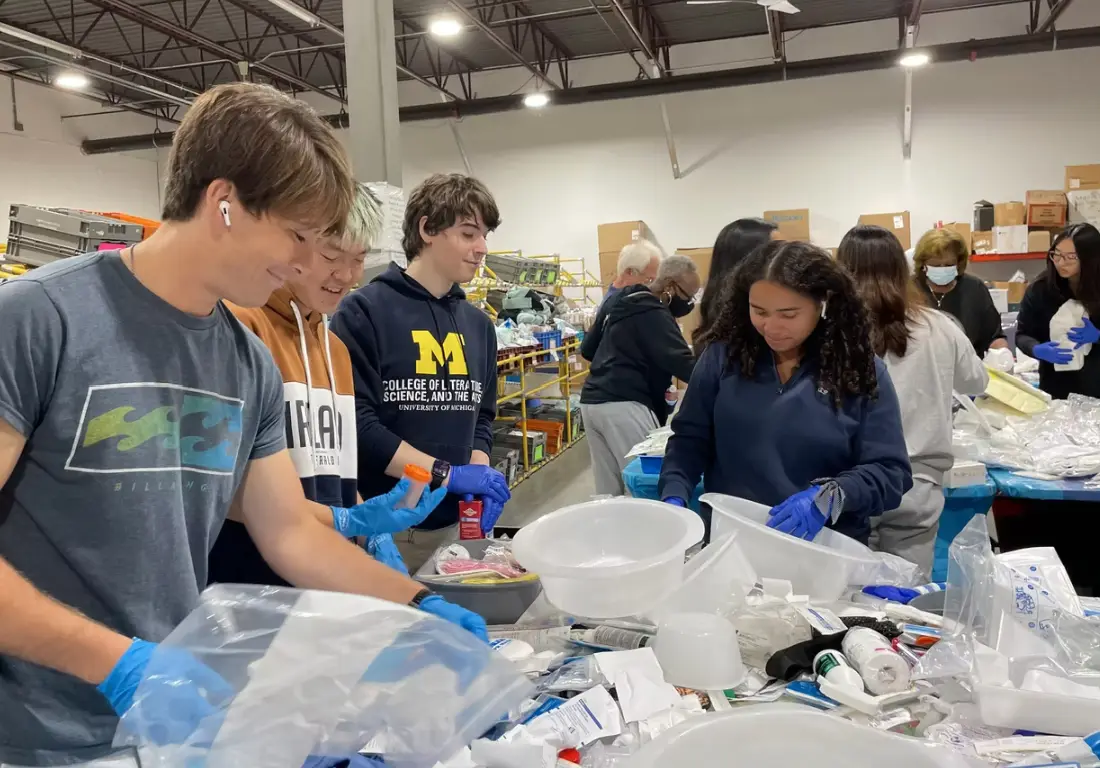
United2Heal, founded at the University of Michigan in 2007 and run by undergraduate students, works closely with World Medical Relief. Every Saturday, more than a hundred volunteers check expiration dates and sort incoming supplies, with some arriving as early as six in the morning. Its president, Leah Beel, says participation is open to anyone who wants to help. One practical constraint is the availability of cars, as students share rides to the facilities, around forty minutes from the university.
Blueprints for Pangea was founded in 2013 and now has chapters from Ann Arbor to Los Angeles. It works directly with Michigan Medicine, which provides pallets of surplus supplies roughly every two weeks, while students organize both local deliveries and shipments by sea that can take weeks. Recipients include Venice Family Clinic in Los Angeles and Hope Clinic in Ypsilanti, Michigan. Hope Clinic's communications manager explains that, for a nonprofit serving uninsured people, every donation saves money that can be used to improve care.
International shipments also respond to specific crises. According to the report, Blueprints is preparing a shipment of essential supplies to the Democratic Republic of the Congo because of an Ebola outbreak. Project MedBridge shipments through Brother’s Brother Foundation have reached maternal health facilities in Nigeria and the front lines in Ukraine. In the US, the article places the groups' work in a context of increasing difficulty accessing healthcare and concerns over cuts to Medicaid and Medicare, where free clinics provide a critical safety net.
Redistribution also has an environmental dimension, as it keeps useful supplies out of the waste stream. Students say avoiding waste influences their decisions about where and how each delivery will be used. At United2Heal, for example, sutures that cannot be shipped are used in practical training workshops instead of being thrown away. Blueprints' director of operations, Liya Berry, describes the work as a way to turn surplus supplies that would end up in landfills into something useful.
For several participants, the experience also changes how they view their future work in healthcare. Students who initially imagined mainly providing care to individual patients gain a broader understanding of the barriers to accessing equipment and services. Some are even considering a change of direction toward health policy, believing this would allow them to help more communities. Conversations with local clinics and health centers also allow them to learn directly which supplies are missing and which are used most.
Running the groups requires constant problem-solving, from managing a nonprofit organization to transport and customs forms. At Blueprints' warehouse in Michigan, incoming deliveries are sometimes so large that the challenge is finding recipients in time. When the space fills up, the group turns to Project C.U.R.E., transferring pallets to another redistribution organization. This cooperation helps put available stock to use and shows how student action can connect with established aid networks.
Comments