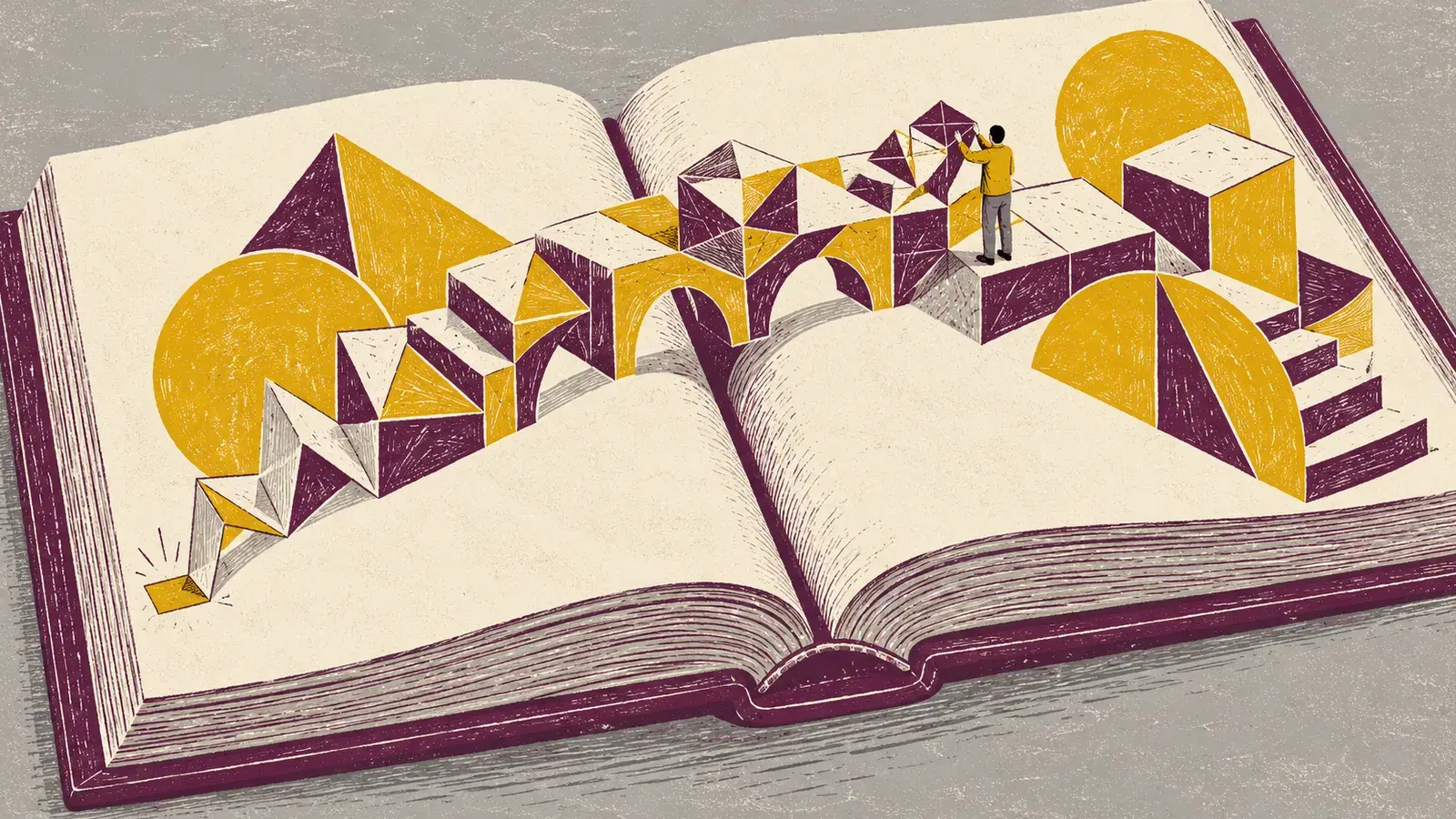
“Fermat's Last Theorem” (published in the US as “Fermat's Enigma: The Epic Quest to Solve the World's Greatest Mathematical Problem”) is a popular science book by Simon Singh, published in 1997. It tells the story of the search for a proof of Fermat's Last Theorem, formulated by Pierre de Fermat in 1637, and follows the efforts of many mathematicians — including Évariste Galois — who failed to prove it. The book became the first mathematics book to reach number one on the UK bestseller list, while Singh's documentary “The Proof,” on which it was based, won a BAFTA award in 1997.
The theorem is notorious because it is so simply stated: the equation x^n + y^n = z^n has no solutions in positive integers x, y, z for any integer exponent n greater than 2. It is a variation on the Pythagorean equation, but while the Pythagorean equation has infinitely many integer solutions, Fermat claimed that for higher exponents there are none. The theorem's fame also owes much to a note Fermat himself left in the margin of a book: “I have discovered a truly marvelous proof of this proposition, but this margin is too narrow to contain it.”
For 350 years after it was formulated, the theorem remained unproven in its general form, even though proofs had been found for many specific values of n — first by hand and later by computer, up to values of around four million. The search for a general proof drove the development of entire new areas of number theory. Singh's book tells this story through the personalities of the mathematicians who tackled the problem, their partial successes and their famous failures.
The story's hero is Andrew Wiles, a mathematics professor at Princeton, who had been obsessed with the theorem since the age of ten and had spent his whole life wanting to solve it. When Ken Ribet proved the connection between Fermat's theorem and the Taniyama–Shimura conjecture in 1986, Wiles began working on the proof in secret. Ribet later remarked that Wiles was “probably one of the few people on earth who had the audacity to dream that you could actually go and prove it.”
On June 21–23, 1993, Wiles announced his proof in three lectures at the Isaac Newton Institute for Mathematical Sciences in Cambridge. However, in September of that year, while mathematician Nick Katz was reviewing the manuscript, an error was found at a crucial point in the proof: the Euler system used to extend the method of Kolyvagin and Flach was incomplete. Without this part, there was no actual proof of the theorem. Wiles spent almost a year trying to repair his proof, initially alone and then with his former student Richard Taylor, without success.
The solution came on the morning of September 19, 1994. Wiles was on the verge of giving up when he had an idea that allowed him to fix the proof. He described the moment as “the most important of my working life.”
The corrected proof was published in 1995 in Annals of Mathematics, in two papers totaling 129 pages — one by Wiles and the other coauthored with Richard Taylor. The research had taken more than seven years of Wiles's work. The proof uses techniques from algebraic geometry and number theory, and relies on twentieth-century mathematical tools that were unavailable to Fermat — making it almost certain that Fermat, if he really had proved the theorem, took a different route, something we will probably never know.
Wiles's proof concerned a special case of the Taniyama–Shimura conjecture, which links two seemingly unrelated branches of mathematics: elliptic curves and modular forms. This conjecture is part of the Langlands program, a series of conjectures about a deep unity between distant branches of mathematics that, if proven, would allow techniques from one branch to be used for problems in another. John Conway called the result “the proof of the [twentieth] century,” while Wiles was knighted for this work and received, among other honors, the Abel Prize in 2016.
The book has also faced criticism. The reviewer at eyrie.org notes that Singh, in trying to hold the attention of an audience without a mathematical background, sometimes resorts to excessive drama and repetition — for example, using the domino analogy to explain proof by induction to the point of exhaustion. The reviewer would have liked more mathematical detail about the proof's significance for modern mathematics. Even so, the book is considered worthwhile for its accessibility and especially for its final section, which tells the story of Wiles's proof in a compelling way.
Singh's book remains one of the most accessible introductions to one of the greatest achievements of modern mathematics. As readers note, it manages to bring even the driest and most complex mathematical topics to life, connecting the story of a proof with human perseverance, obsession and the joy of discovery.

Comments