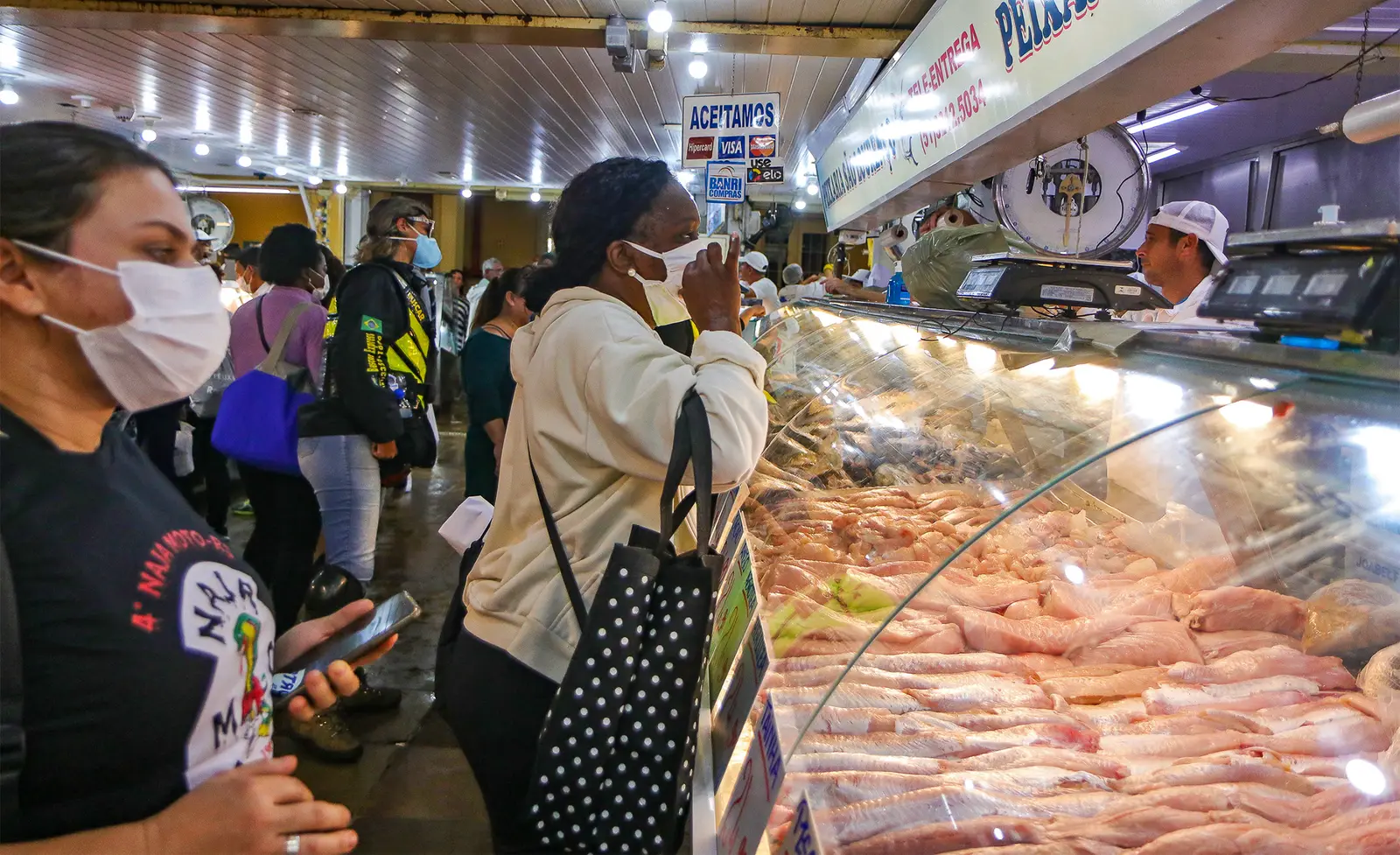
In mid-September 2026, an employee at a fish shop in Porto Alegre’s Municipal Market enthusiastically recommended “angel fish” (peixe anjo): “We sell a lot of it. It’s very good and has no bones.” The product was available at at least four stalls, priced at 30–37 reais per kilogram ($5.70–7). In fact, this is no ordinary fish, but an angelshark of the genus Squatina — represented in Brazil by three of the most threatened shark species: Squatina guggenheim, S. occulta and S. argentina — and catching them is prohibited.
For many years, the Brazilian government allowed angelshark imports from neighboring countries. According to Federal Revenue Service data obtained by Mongabay through a freedom of information request, 48 metric tons of S. guggenheim meat and 194.6 metric tons of S. argentina meat entered the country between January 2021 and September 10, 2026, totaling 242.6 metric tons. Most shipments came from Argentina through the customs offices in São Borja, Uruguaiana and Dionísio Cerqueira. IBAMA environmental analyst Luiz Eduardo Bonilha says the imported product was mixed with large quantities of angelshark caught illegally within Brazil. “Illegally caught angelsharks were ‘laundered’ using import invoices,” he said.
On March 27, 2026, IBAMA published a regulation banning imports of all sharks on the National List of Threatened Species, closing every legal loophole for angelshark sales. The rule took effect on April 3. “Today, every kilogram, regardless of origin, is illegal,” Bonilha said. However, sellers at Porto Alegre’s Municipal Market said they were unaware of the new rule. Two traders said they imported the frozen product from Argentina and considered the process legal; when told about the ban, one expressed skepticism, saying: “Given the quantity arriving here in the south every week, I don’t think so.” Other traders said the fish came from the state’s own coast, from the municipalities of Tramandaí and Rio Grande.
Bonilha said inspections of retailers would be stepped up after he learned that angelshark was being sold freely at the municipal market: “This constitutes criminal conduct.” Rio Grande do Sul’s Environment Secretariat, however, did not clarify whether it had taken steps to enforce compliance in the state. The regulation came months after a series of Mongabay reports on shark meat purchases by government bodies. In Rio Grande do Sul, the investigation identified orders for 211 metric tons of angelshark from municipal and state authorities between 2015 and 2025 — enough to fill ten shipping containers. Under the pretext that it was cheap, boneless fish, it ended up in school meals, hospitals, clinics and shelters.
Despite the new ban, Mongabay identified four recent tenders in Rio Grande do Sul for the supply of angelshark. One, published on August 10 by the state Health Secretariat, requested 960 kilograms for São Pedro Psychiatric Hospital in Porto Alegre; the process has already been completed. An earlier investigation in 2025 identified 11 tenders totaling 16 metric tons, and the state government said at the time that it would remove the species from tender notices. It now says that “the necessary steps are being taken to revise the procedure” and that guidance to the relevant departments will be strengthened.
Mongabay also identified similar procedures in municipalities. Gravataí opened a tender on July 27, 2026, for up to 250 kilograms, but no supplier was selected, and the municipality did not respond to questions. Gramado issued a tender on July 1 for 2,156 kilograms, saying that the 2025 purchase had been canceled and that this year’s procedure was expected to be revised. Colinas requested 250 kilograms for school meals, but said no purchase had been made and that, because of the environmental regulation, “the purchase of this species will not proceed.” At least three public bodies thus said they would suspend or revise their plans after being contacted by Mongabay.
Eating shark meat does more than harm marine ecosystems. Because sharks sit at the top of the food chain, they accumulate heavy metals such as mercury, arsenic and lead. The U.S. Food and Drug Administration (FDA) recommends that children and pregnant women avoid shark meat. Nevertheless, Brazil’s Health Ministry continues to recommend it as a boneless fish option for children up to two years old. In August, environmental NGO Sea Shepherd Brasil filed a lawsuit against the ministry seeking the removal of this recommendation, arguing that “including this meat in school meals or public institutions exposes vulnerable populations to carcinogenic and neurotoxic risks.”
The import ban was a longstanding demand of Sea Shepherd Brasil. According to the organization’s president and executive director, Nathalie Gil, 39% of shark species in Brazil are at risk of extinction, and “it is an absurdly permissive market.” She considers IBAMA’s regulation a step forward, but not a solution: shark meat is still sold under the generic label “cação,” without species identification, allowing threatened species to be sold “disguised” as blue shark (Prionace glauca), which is generally legal. “The import issue has been resolved, but the domestic market remains left to its own devices,” she said.
IBAMA’s biodiversity enforcement coordinator, Igor de Brito Silva, describes generic product descriptions as a bottleneck: “There is no excuse. It is simply an opportunistic convenience that encourages fraud.” The shortage of inspectors compounds the problem — just ten for the entire state of Rio Grande do Sul, according to Bonilha. At the border, the Federal Revenue Service says the initial check is IBAMA’s responsibility and that shipments also undergo physical inspection by the Agriculture Ministry; the greatest difficulty is detecting falsely declared cargo and smuggling. Lais Belsito, technical adviser to the Brazilian Association of Fishing Industries (Abipesca), noted that the new rules align with conservation policy, but added that species’ conservation status needs periodic assessment and that it is not yet possible to estimate the regulations’ impact on imports.


Comments