Donald David Hoffman (Donald D. Hoffman) was born on December 29, 1955, and is an American cognitive psychologist and popular science author. He is a professor emeritus in the Department of Cognitive Sciences at the University of California, Irvine (UCI). He studies consciousness, visual perception and evolutionary psychology using mathematical models and psychophysical experiments.
He received a bachelor's degree in quantitative psychology from UCLA in 1978 and a doctorate in computational psychology from MIT in 1983, under the supervision of David Marr and Whitman Richards. He briefly worked as a researcher at MIT's Artificial Intelligence Laboratory and then became an assistant professor at UCI in 1983, where he has remained ever since, with a sabbatical at Bielefeld University during the 1995–1996 academic year.
He has co-authored two technical books: Observer Mechanics: A Formal Theory of Perception (1989) offers a theory of consciousness and its relationship to physics, while Automotive Lighting and Human Vision (2005) applies vision science to vehicle lighting. His book Visual Intelligence: How We Create What We See (1998) presents modern visual perception science to a general audience.
In his 2015 TED talk, titled "Do we see reality as it is?", he argued that our perceptions have evolved to hide reality from us. This was followed in 2019 by the book The Case Against Reality: How Evolution Hid the Truth from Our Eyes, in which he develops the same idea.
Hoffman notes that the widely accepted view that brain activity causes conscious experience has so far proved scientifically difficult to resolve. He proposes a solution to the hard problem of consciousness by adopting the opposite view: that consciousness causes brain activity and, in fact, creates all the objects and properties of the physical world. To this end, he has developed and combined two theories: the "multimodal user interface" (MUI) theory and "conscious realism."
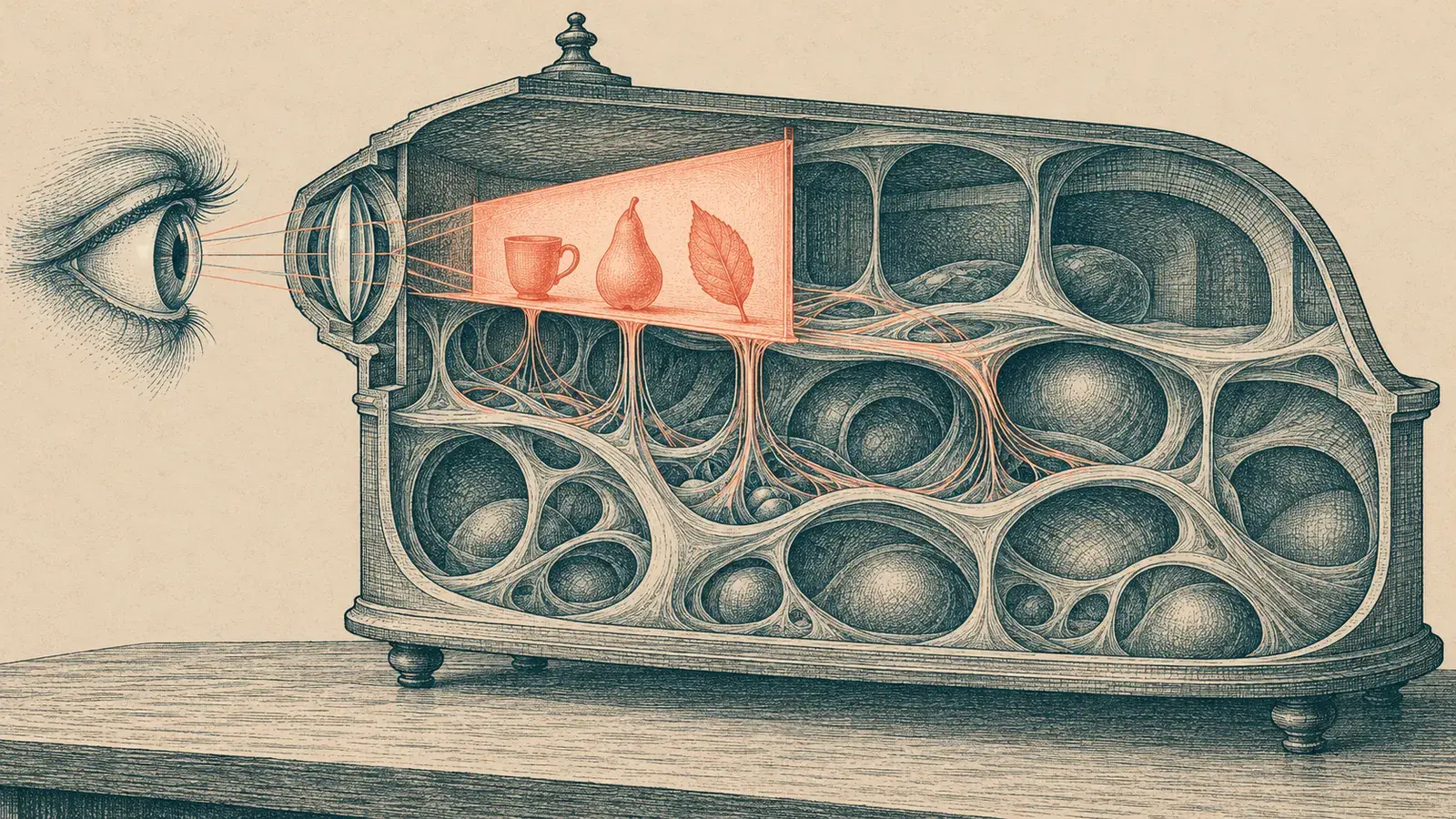
MUI theory holds that perceptual experiences neither correspond to nor approximate the properties of the objective world, but provide a simplified, species-specific user interface to that world. Hoffman argues that conscious beings have evolved to perceive the world in a way that maximizes "fitness payoffs," rather than as it really is. He uses the metaphor of a computer desktop and its icons: the icons provide a functional interface so that users do not need to deal with the underlying programming and electronics to use the computer effectively. Similarly, the objects humans perceive in time and space are metaphorical icons that serve as their interface with the world. This theory implies that physical objects such as quarks, brains and stars are constructed by conscious agents but have no causal power.
Unlike panpsychism, conscious realism does not claim that objects themselves are conscious, but that they are icons in a conscious agent's user interface. The interface theory of perception holds that human perceptual experiences do not necessarily correspond to what exists in reality itself. This conflicts with the popular view of critical realism, according to which some perceptual experiences correspond to the reality of the physical world. In the interface theory of perception, neither primary nor secondary qualities necessarily correspond to reality.
Conscious realism is described as a non-physicalist monism that holds that consciousness is the primary reality and the physical world emerges from it. The objective world consists of conscious agents and their experiences. Together, MUI theory and conscious realism form the basis of an overarching theory that the physical world is not objective, but an epiphenomenon caused by consciousness.
Hoffman has said that some form of reality may exist, but it may be entirely different from the reality our brains model and perceive. Reality may not consist of spacetime and physical objects. By assuming that consciousness is fundamental, Hoffman offers a possible solution to the hard problem of consciousness: we have conscious experiences because consciousness is considered a fundamental aspect of reality. He also addresses the problem of how conscious beings could arise from seemingly non-conscious matter by changing the concept of non-conscious matter: perceptions of non-conscious matter are simply byproducts of consciousness and do not necessarily reflect reality.
Hoffman argues that natural selection necessarily favors fitness payoffs and that organisms develop internal models of reality that increase those payoffs. This means organisms develop a perception of the world geared toward fitness rather than reality. This led him to argue that evolution has developed sensory systems in organisms that provide high fitness but do not offer an accurate perception of reality.



Comments