Robert Sapolsky is an American neuroscientist, biologist and primatologist, and a professor at Stanford University, where he holds the John A. and Cynthia Fry Gunn chair and teaches in the departments of biology, neurology and neurosurgery. His research focuses on neuroendocrinology, particularly the biology of stress, and he is also a research associate at the National Museums of Kenya.
He was born on April 6, 1957, in Brooklyn, New York, to Jewish immigrants from the Soviet Union. His father, Thomas Sapolsky, was an architect who renovated the restaurants Lüchow's and Lundy's. He was raised as an Orthodox Jew and spent his time reading about gorillas and imagining living with them. By the age of twelve, he was already sending fan letters to primatologists. In high school, he read books on the subject and taught himself Swahili.
Sapolsky describes himself as an atheist. As he said in his acceptance speech for the Emperor Has No Clothes Award, he was raised in a religious environment until around the age of thirteen, when one of the defining acts of his life was his break with all religious belief. In an interview on Light Watkins's podcast, he described how, while still a teenager, he woke one night at two in the morning after a lesson at the synagogue about how God “hardened Pharaoh's heart” and realized that there was no God or free will, and that the universe was a vast, empty, indifferent place.
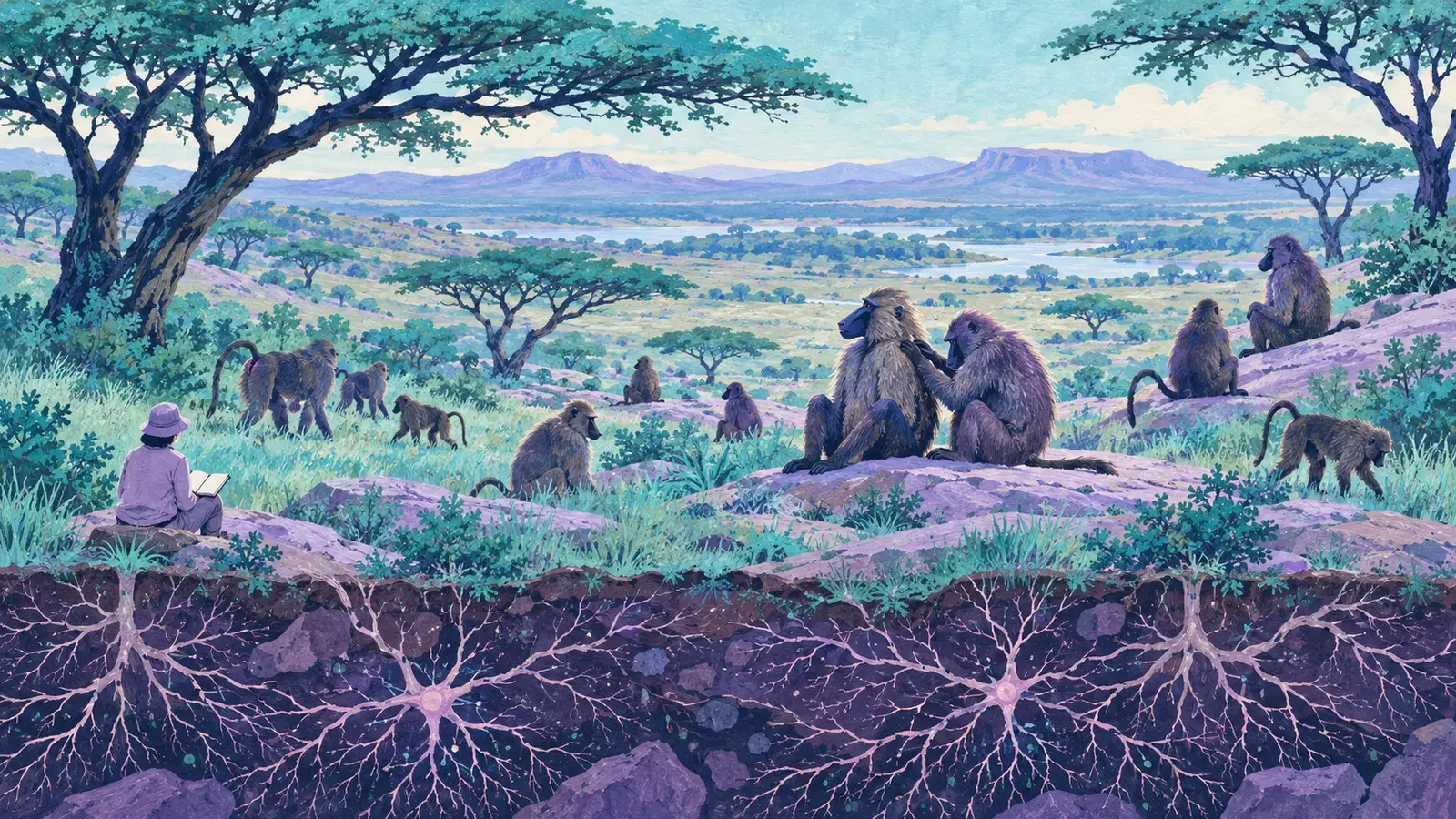
In 1978, he graduated summa cum laude from Harvard with a degree in biological anthropology. He then traveled to Kenya to study the social behavior of wild baboons. When the Uganda–Tanzania War broke out, he decided to cross into Uganda to see the war firsthand—“I was twenty-one and wanted adventure,” he later said. He reached Kampala and traveled as far as the border with Zaire, witnessing battles, including the capture of the Ugandan capital by the Tanzanian army and allied rebels on April 10–11, 1979. He then returned to New York and completed his doctorate in neuroendocrinology at Rockefeller University, in the laboratory of endocrinologist Bruce McEwen.
After his initial year and a half of fieldwork in Africa, Sapolsky returned every summer for another 25 years to observe the same troop of baboons. He spent eight to ten hours a day, for about four months each year, recording the animals' behavior. In particular, he studied differences in cortisol levels between the alpha male and alpha female and lower-ranking members to assess stress and the relationship between personality and stress-related diseases. An early example of his work was published in Scientific American in 1990 under the title “Stress in the Wild.”
As a neuroendocrinologist, Sapolsky has focused on stress and neuronal degeneration, as well as the potential of gene therapy to protect vulnerable neurons from disease. He works on gene transfer techniques to strengthen neurons against the harmful effects of glucocorticoids. He has also written about neurological damage and the insanity defense in the American legal system. His work has received extensive media coverage, notably in the National Geographic documentary Stress: Portrait of a Killer and in articles in The New York Times, Wired and Stanford magazine, while in April 2017 he gave a TED talk.
Sapolsky strongly advocates a deterministic view of human behavior. In his words, “there is no free will, or at least there is far less than we assume when it really matters”; human actions are determined by neurobiology, hormones, childhood and living conditions. This position is developed in his book Determined: A Science of Life Without Free Will. However, critic Jessica Riskin, in a review in The New York Review of Books, counters that science cannot prove the absence of free will because the question is philosophical rather than scientific; presenting it as scientific is, in her view, a characteristic example of scientism.
He has received many honors: a MacArthur Fellowship in 1987, an Alfred P. Sloan Fellowship, a Klingenstein Fellowship in neuroscience, the National Science Foundation's Presidential Young Investigator Award, and awards from the Society for Neuroscience, the International Society of Psychoneuroendocrinology and the Society of Biological Psychiatry. In 2007, he received the John P. McGovern Award for the behavioral sciences from the American Association for the Advancement of Science, and the following year Wonderfest's Carl Sagan Prize for Science Popularization. In 2010, he was named to the honorary board of the Freedom From Religion Foundation.
Sapolsky is also interested in the role of schizotypal disorders in the emergence and development of shamanism and the major Western religions, pointing to similarities between obsessive-compulsive behavior and religious rituals. He is married to Lisa Sapolsky, a doctor of neuropsychology, and they have two children. In 2024, he launched a series called “Father-Offspring Interviews” on YouTube and Spotify with his daughter Rachel. In Determined, he describes his personal experiences with depression and the moments of relief that medication offered him.
His books include Stress, the Aging Brain, and the Mechanisms of Neuron Death (1992), Why Zebras Don't Get Ulcers (1994), The Trouble with Testosterone (1997), A Primate's Memoir (2002), Monkeyluv (2005), Behave: The Biology of Humans at Our Best and Worst (2017) and Determined (2023). His speaking style—on shows such as Radiolab and The Joe Rogan Experience, as well as in his university lectures on human behavioral biology—has made him a central figure in public discussion of mental health and human relationships from an evolutionary perspective.


Comments