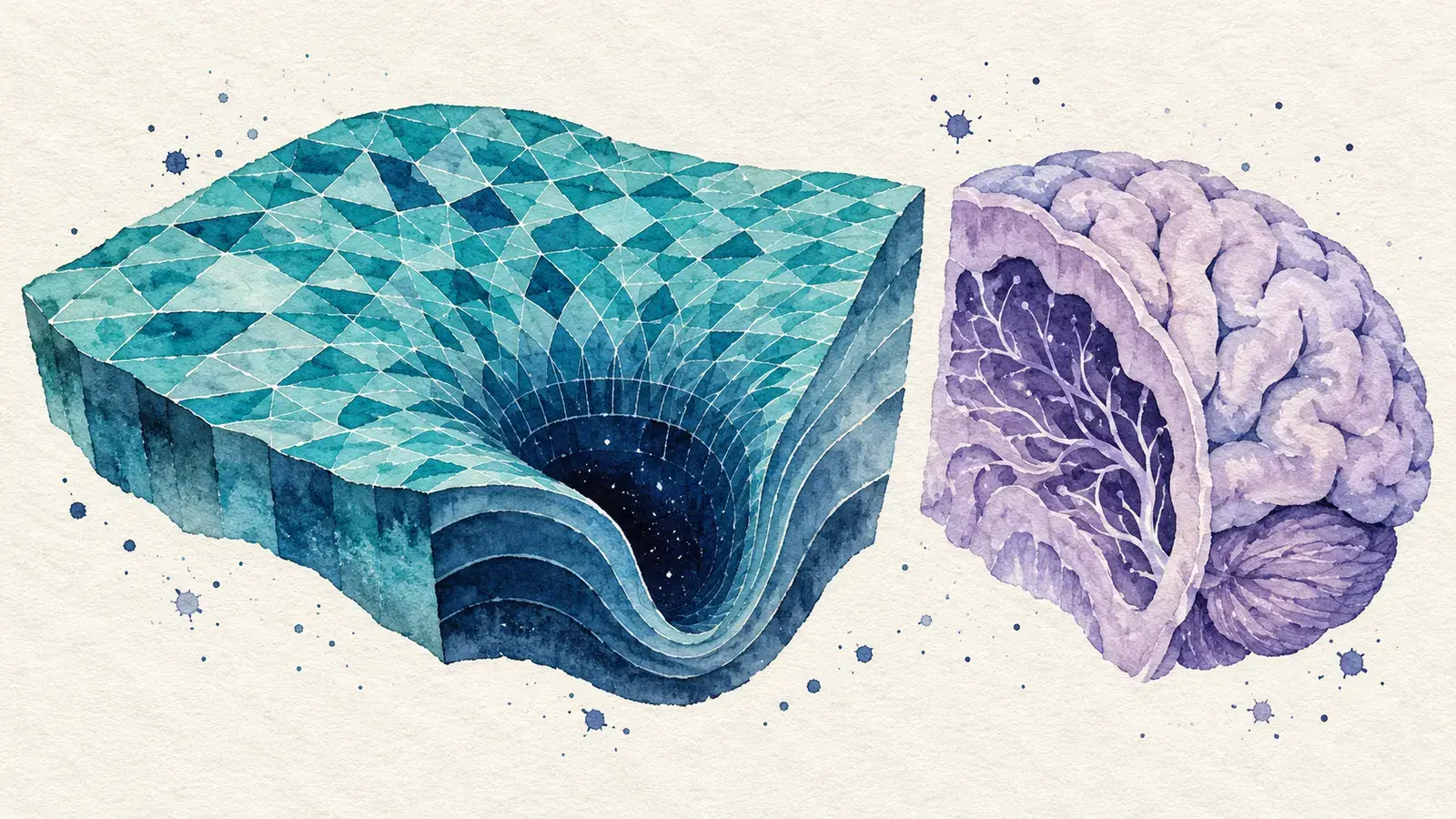
Sir Roger Penrose was born on 8 August 1931 in Colchester, England, and is a mathematician, mathematical physicist and philosopher of science. He is the Emeritus Rouse Ball Professor of Mathematics at the University of Oxford, an emeritus fellow of Wadham College, Oxford, and an honorary fellow of St John's College, Cambridge, and University College London. In 2020, he shared the Nobel Prize in Physics with Reinhard Genzel and Andrea Ghez, receiving his share “for the discovery that black hole formation is a robust prediction of the general theory of relativity”, while Genzel and Ghez were honoured for discovering a supermassive compact object at the centre of our galaxy. Earlier, in 1988, he had shared the Wolf Prize in Physics with Stephen Hawking for the Penrose–Hawking singularity theorems.
Penrose grew up in a family of scientists: his mother Margaret was a doctor and his father Lionel a psychiatrist and geneticist, while his siblings included the physicist Oliver, the geneticist Shirley and the chess grandmaster Jonathan. His stepfather was the mathematician and computer scientist Max Newman. He has said that George Gamow’s books featuring the stories of Mr Tompkins inspired his interest in physics as a young child. He studied mathematics at University College London, earned a PhD in algebraic geometry from St John's College, Cambridge, in 1957, and in 1955 reintroduced the Moore–Penrose generalised inverse matrix. Together with his father, he devised the Penrose triangle, which he described as “impossibility in its purest form”, and corresponded with the artist M. C. Escher, influencing works such as Waterfall and Ascending and Descending.
Dennis Sciama drew his attention from mathematics to physics. In 1964, as a reader at Birkbeck College, Penrose, according to Kip Thorne, “revolutionised the mathematical tools” for analysing spacetime. Rather than solving Einstein’s equations only in symmetrical cases, he proposed focusing on the topology and conformal structure of space, which determines the paths of light and causal relationships. His paper “Gravitational Collapse and Space-Time Singularities” showed that if a dying star collapses beyond a certain limit, nothing can prevent a singularity from forming, and paved the way for similar conclusions about the Big Bang in collaboration with Hawking. In 1969, he formulated the cosmic censorship conjecture, which holds that singularities are confined behind event horizons, and proposed the Penrose process for extracting gravitational energy.
He went on to develop twistor theory (1967), discover spin networks (1971) and Penrose tiles (1974), which form nonperiodic tilings, the first with fivefold rotational symmetry; similar patterns were observed in quasicrystals in 1984. He also popularised Penrose diagrams for the causal structure of spacetime. His book The Road to Reality (2004) is presented as a guide to the laws of the universe, from Euclid’s axioms to his own theories. The Penrose interpretation predicts that a quantum state remains in superposition until the difference in spacetime curvature reaches a significant level.
In cosmology, Penrose proposed conformal cyclic cosmology. In 2010, he reported possible evidence, based on concentric circles in data from the Wilkinson Microwave Anisotropy Probe satellite, that a previous universe existed before the Big Bang. In Cycles of Time, he argues that eventually all matter will end up inside black holes, which will evaporate through Hawking radiation, leaving only photons that experience neither time nor space; thus, an infinitely large universe of photons is essentially no different from an infinitely small one. He considers the Big Bang singularity to be apparent, like the one at a black hole’s horizon, and removable by changing the coordinate system.
The most controversial aspect of his work concerns consciousness. In The Emperor's New Mind (1989), he argues that the known laws of physics are insufficient to explain consciousness and that the mind is not algorithmic; he uses a variation of Alan Turing’s theorem on the undecidability of the halting problem and Kurt Gödel’s incompleteness theorems to argue that a computer cannot reproduce mathematical insight. The Penrose–Lucas argument, associated with the philosopher John Lucas, drew criticism from mathematicians and philosophers; Marvin Minsky wrote that Penrose was seeking new principles instead of studying the actual details, while Minsky himself believed that humans were machines that could be explained by physics.
Together with the anaesthesiologist Stuart Hameroff, he proposed the Orch-OR theory, according to which consciousness arises from quantum gravitational phenomena in neurons’ microtubules. In Physical Review E, Max Tegmark calculated that the timescale of excitations in microtubules is at least 10 billion times slower than the decoherence time, and his paper was widely used by critics. Even Phillip Tetlow, a supporter of Penrose’s ideas, acknowledges that this is a minority view in scientific circles. In 2014, the two researchers cited evidence of quantum vibrations in microtubules from Anirban Bandyopadhyay as support for the theory.
Penrose married Joan Wedge in 1959 and they had three sons; he is now married to Vanessa Thomas, with whom he has a son. He is an admirer of Johann Sebastian Bach and said on Desert Island Discs that he would choose almost exclusively Bach’s works, with the Mass in B minor as his first choice. He describes himself as agnostic and does not believe in any established religion, while also saying that the universe has a purpose and that the presence of consciousness is no accident. He is a patron of Humanists UK. Among many honours, he received a knighthood in 1994, the Order of Merit in 2000, the Royal Society’s Copley Medal in 2008 and an honorary doctorate from the Athens University of Economics and Business in 2005.
Comments