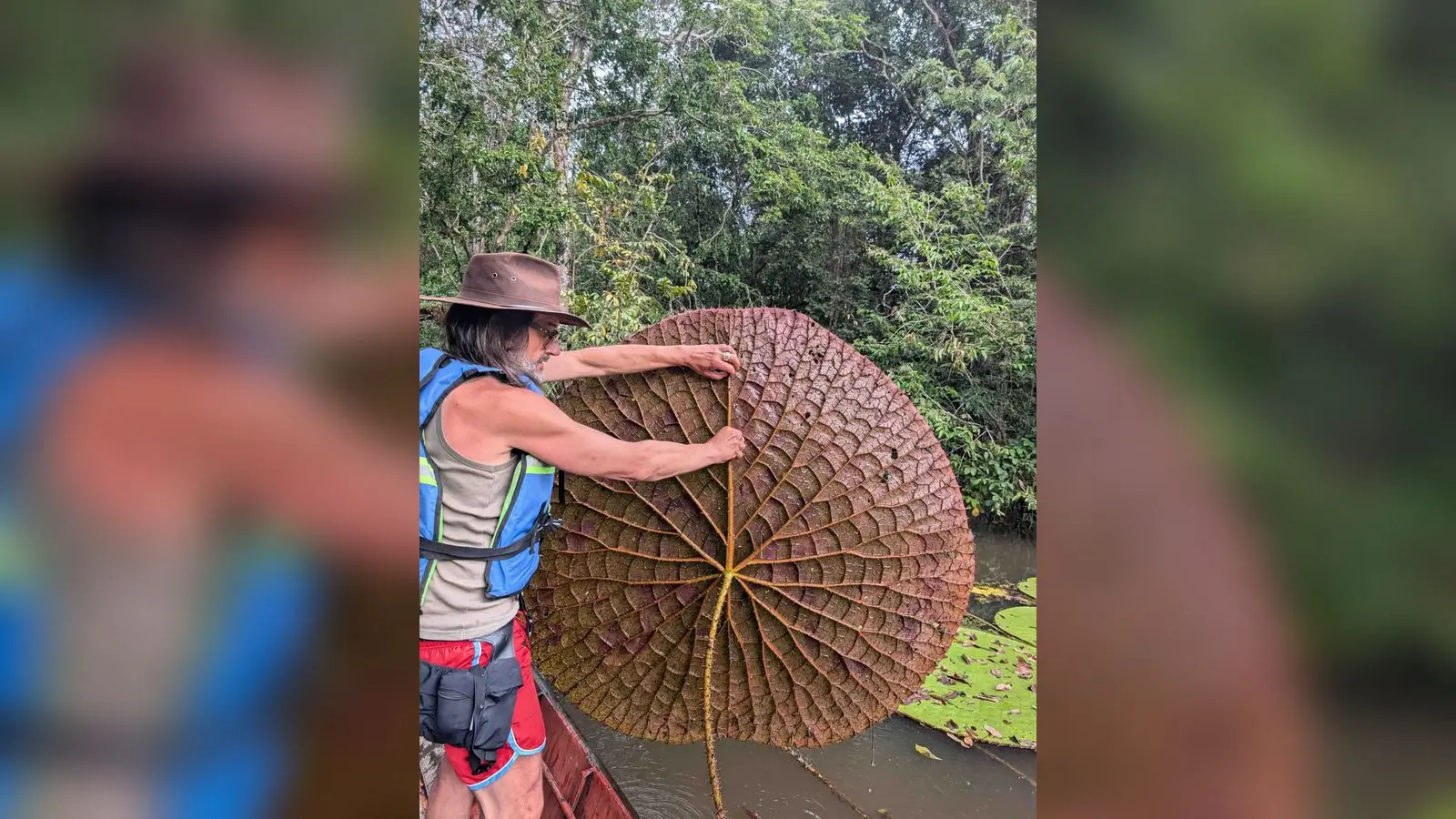
A species of giant water lily new to science has been confirmed in Colombia’s Inírida River, but researchers estimate that it is already critically endangered. They named it Victoria colombiana and estimate that there may be only 30–50 plants in the wild. Its leaves reach two meters across, but its large size was not enough to ensure that it was scientifically documented.
The research began in 2021, when Carlos Magdalena, a giant water lily expert and horticultural researcher at the Royal Botanic Gardens, Kew, in Britain, happened to see photographs on Instagram. They had been posted by Jeremiah Harris, who runs a carnivorous plant nursery in the US and was shown swimming beside giant leaves in the Inírida. Harris had identified the plant as a wild Victoria amazonica, but the location made Magdalena suspect it was worth further investigation.
No known species of South American giant water lily in the genus Victoria had previously been reported in the Orinoco basin, which includes the Inírida. Magdalena turned to satellite images and located additional floating leaves in the river and nearby lakes. The plants’ large, circular leaves, which in other species of the genus can exceed three meters in diameter, made it possible to observe them from space.
For the field search, Magdalena assembled a team of researchers and worked with Nilo Rodríguez, Jaime Hernández and Gustavo Melo. The three come from the Indigenous territories of Río Atabapo, Caranacoa-Yurí-Laguna Morocoto and Puinave-Piapoco el Paujil. Together, they undertook a five-day expedition into the flooded tropical forest of the Inírida region.
Toward the end of the expedition, they had found two plants, but neither had flowers, which were essential for identifying the species. On the final night, with only ten hours remaining, Melo led them to a small lake deep in the forest. There they located a second population, which included a flowering plant. The research ultimately confirmed that the Inírida water lilies belong to a species previously unknown to science.
Speaking to Mongabay, Magdalena stressed that working with the three Indigenous men was essential to the research. He described their extensive knowledge of the area and their ability to navigate dense, flooded forest without GPS or a mobile phone connection. According to him, the expedition would not have been possible without their contribution.
Magdalena attributes the plant’s late scientific recognition to its extreme rarity and the fact that it grows in places rarely visited by people and researchers. The estimate of only 30–50 wild plants highlights how small its population may be. The team is now trying to collect seeds to propagate the species in botanical gardens and near Indigenous communities.

Comments