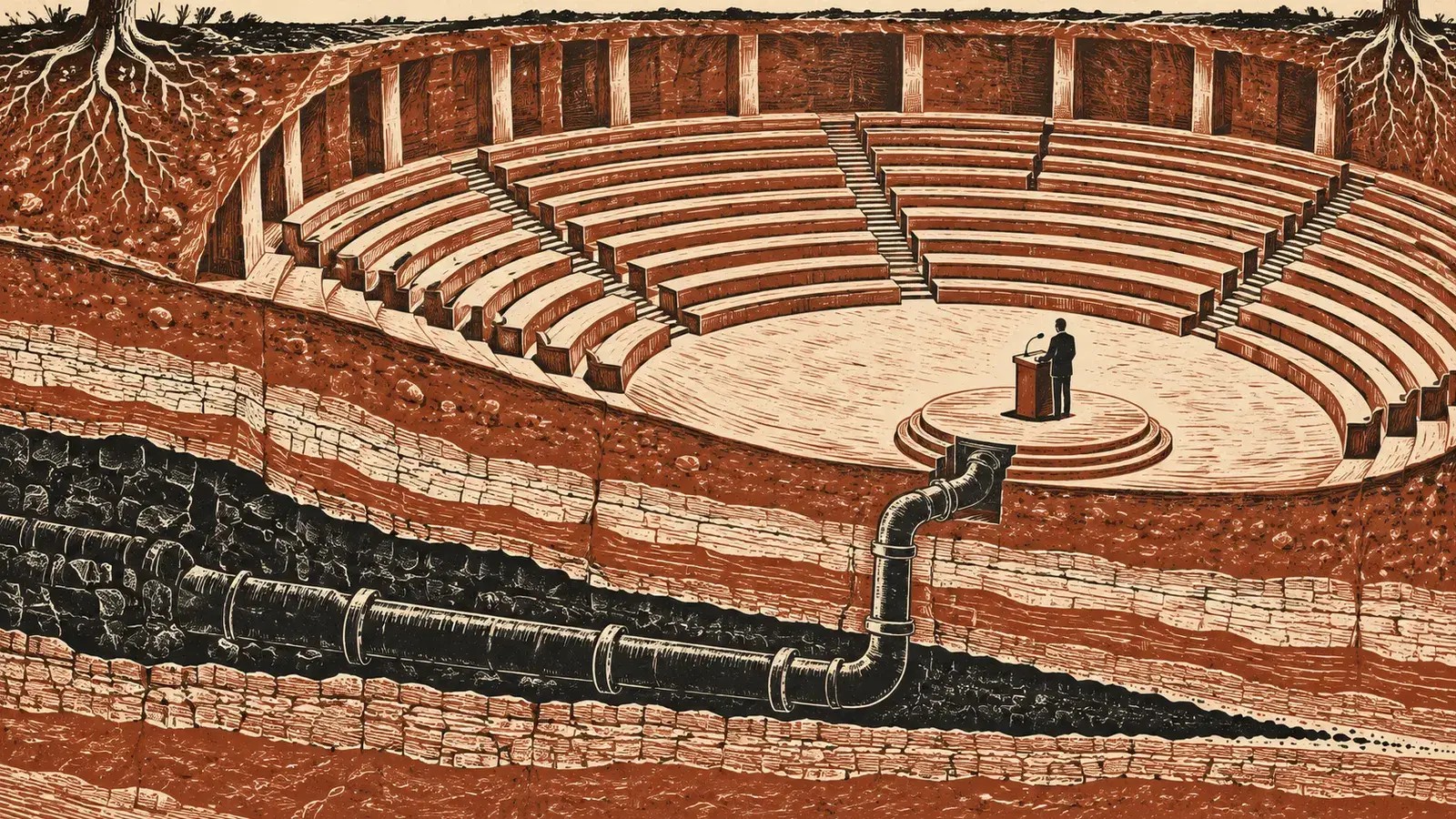
In this episode of Frankly, prompted by Climate Week in New York, Nate Hagens proposes a thought experiment: what would a global leader with no elections to win, donors to please or borders to defend say if they decided to speak honestly? The result is a “state of the world address” that, he says, no politician today would dare to deliver.
The speaker begins by dismantling the two dominant narratives. The first denies the problem: “the climate has always changed”, scientists exaggerate, and jobs are threatened by elites who fly in private jets. This story wins elections, but it does not change the chemistry of the atmosphere or the oceans. The second says there is a problem and that we are solving it by replacing bad energy with good energy, using solar panels and electric cars, so that life can continue as before, but cleaner. This also wins elections, but it treats an ecological emergency like a product recall, where we change parts but keep driving in the same direction at the same or greater speed.
He then explains the role of fossil fuels as the “ancient sunlight” on which we built our civilisation. A barrel of oil costs about as much as a good dinner, but through the machines it powers, it is equivalent to five years of human physical labour. If we hired someone to do the same work at minimum wage, it would cost tens of thousands of dollars. We pay less than a hundred dollars, or between one hundredth and one thousandth of its economic value, and burn about a hundred million barrels every day, along with coal and natural gas. That is why, when the price of energy rises, everything rises with it.
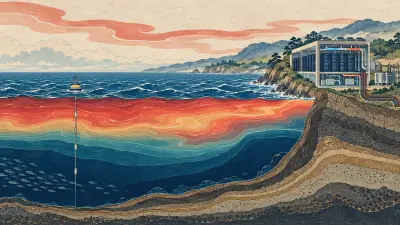
Global warming is neither an accident nor a conspiracy, but the exhaust of our material success. When we burn these fuels, some heat stays on Earth, acting like a blanket around the atmosphere and reducing the heat that escapes into space. Carbon dioxide is now higher than at any time in millions of years. The oceans have absorbed most of the additional heat and about a third of the carbon, and are becoming warmer, more acidic and less alive. The heatwaves, floods, fires and crop failures we see on our screens are only the beginning.
The speaker notes that next year, 2027, will be the hottest of our lives because of the super El Niño on top of existing warming, and probably the coolest for the rest of our lives. Such things are usually said in science fiction films, but here it is science, not fiction. At the same time, energy will move from the background to the foreground: the cheapest barrels have already been burned, and what remains costs more and is unevenly distributed. The fossil fuel miracle that created modernity will not be here forever.
Political failure has a structural explanation. There are nearly two hundred states. If all reduced their energy use together, everyone and future generations would benefit. But if one country limits itself while its neighbours do not, it falls behind: its economy shrinks, its military weakens, and its leaders are replaced by someone promising growth, which requires energy from Earth's vault. What is best for everyone is not best for each individual.
This is not the only crisis. Scientists have identified nine planetary boundaries that have kept Earth hospitable to humans for the past ten thousand years. We have crossed seven. Climate is only one of them, and perhaps not the most dangerous. We have cut down forests and ploughed grasslands faster than they can recover. The nitrogen and phosphorus we put on fields end up in rivers and create dead zones in the seas. We drain rivers and ancient groundwater faster than rain replenishes them. Wildlife populations have fallen by three quarters since 1970, and plastics and synthetic chemicals are now found in rain, soil and the blood of newborn babies.
None of these statistics appears in any country's economic indicators, yet all are the foundation on which those indicators stand. They all trace back to the same source: a species using more energy and more materials every year on a finite planet. Even if we captured every molecule of carbon and kept everything else the same, we would hit the same walls by a different route.
When it comes to solutions, honesty becomes dangerous. If we turned off the fossil fuel tap tomorrow, hundreds of millions of people would die of starvation within a year, because fertilisers, tractors, ships and trucks depend on hydrocarbons. If we substantially reduced the flow, economic chaos and recession, or worse, would follow. In 2026, this has not happened yet, at least so far, because we are drawing down enormous stocks of crude oil and products accumulated before the US–Israel–Iran war.
If we sprinted to replace everything with machines that harness the sun and wind, we would need the largest mining expansion in human history, concentrated in a handful of countries that would become the new Persian Gulfs, with all the rivalries and conflicts that entails, and above all with energy from the fossil fuel vault directed towards powering it. If we do nothing, warming intensifies, seas rise, and the regions where billions of people live gradually become more difficult to live in and eventually uninhabitable.
So who is in control? We are animals, built for small groups. We pay attention to hierarchy, reward the loud and confident, take today's reward and leave tomorrow to look after itself. A starling turns for its own reasons, but ten thousand starlings form a shape in the evening sky that none chose and none can stop. We are like that too: desire multiplied by billions and connected through money, trade and incentives produces behaviour that belongs to the whole but to no one within it.
The speaker calls for neither optimism nor despair, but maturity. There are no answers, only responses, and he cannot pretend they will be fair: the countries that caused the least will probably suffer the most. But every response counts and adds up: how we grow our food, how we use our energy, how much and what kind, and how we treat our neighbours, human and animal.
The default is sleepwalking and denial; the potential remains vast. He cannot promise the world our grandparents expected to hand down to us, because that world is already gone. But he can promise that facing what is coming with open eyes and hearts is better than any alternative, and that the bends in the road can be navigated by people who see them coming. We were the generation that burned the ancient sunlight; let us also be the generation that finally told the truth. Good night, “Gaia speed” and good luck to us all.
Comments