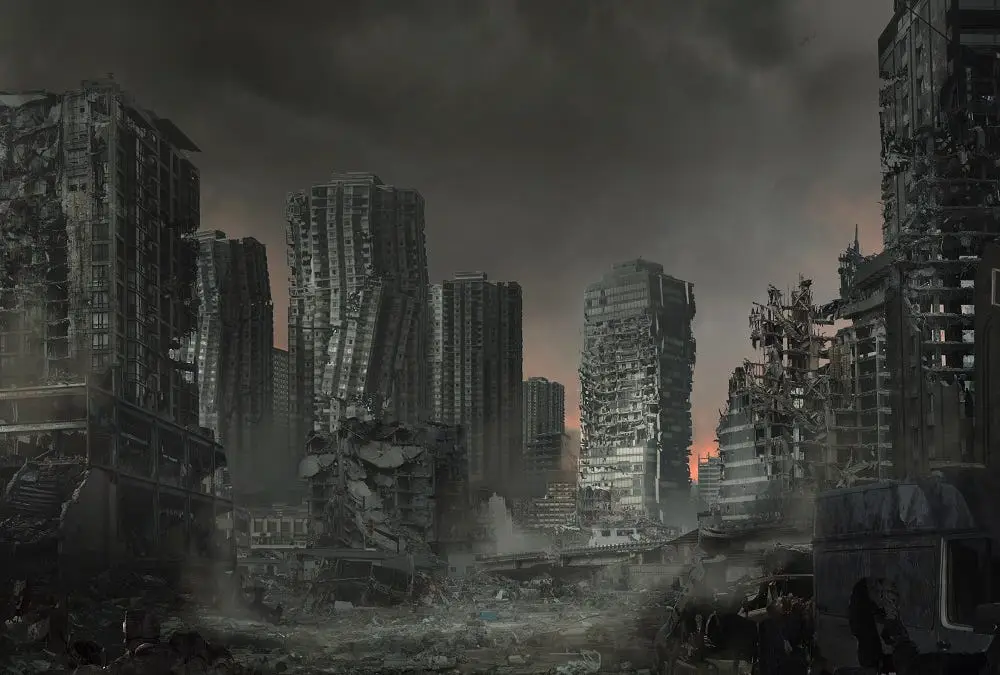
Our industrial civilization is heading for collapse — not in a hundred or a thousand years, but within the lifetimes of most people alive today, argues the essay published on CollapseMusings. Climate change, biodiversity loss and resource depletion are not the real problems, but symptoms of a deeper phenomenon: ecological overshoot. Ecological overshoot occurs when a species’ demands exceed the regenerative capacity of the ecosystem that supports it.
The classic example is St. Matthew Island in the Bering Sea: in 1944, the US Coast Guard left 29 reindeer there as a reserve food supply for the soldiers. With no predators and abundant food, the population multiplied — 1,350 animals in 1957 and 6,000 in 1963. When biologist Dave Klein returned in 1966, he found just 42 emaciated reindeer: the population had collapsed by 99% within a few years because the animals had consumed their food faster than it could regenerate.
The author argues that humanity is following the same path. Around 10,000 BC, roughly 12,000 years ago, the stabilization of the climate during the Holocene allowed agriculture to expand and the human population to grow gradually. From the 18th century onward, technological inventions, and especially the discovery of oil deposits across America in the early 20th century, gave humans access to enormous amounts of energy, enabling exponential growth in population and material goods. The Green Revolution of the 1970s — with chemical fertilizers, pesticides, mechanization and groundwater pumping — sent food production soaring and disproved Paul Ehrlich’s predictions of mass famine.
But according to the author, this increased carrying capacity is an illusion: William Catton called it “phantom carrying capacity” because feeding 8 billion people depends entirely on fossil fuels. Fifty percent of global food production relies on fertilizers made from natural gas using the Haber–Bosch process — and there is no substitute. The author believes that oil production may already have reached its peak, as new discoveries are at their lowest level in 75 years. Renewable sources, he adds, are insufficient: building them requires fossil fuels and rare metals such as lithium, cobalt and nickel, whose reserves may not be enough for a global energy transition.
Meanwhile, the planet’s carrying capacity is declining. Topsoil is eroding faster than it regenerates — more than 50 billion tonnes have been lost in the Midwest alone since the 19th century. Aquifers are being drained: the Ogallala, which stretches from South Dakota to Texas, could be depleted within 20 years. Forests are being cut down faster than they grow, and fish stocks are being depleted — the author estimates that the oceans could be almost empty of fish by 2048.
The Global Footprint Network calculates that Earth Overshoot Day fell on July 28 — from that point onward, our civilization consumes resources accumulated in the past, over millions of years in the case of fossil fuels. According to the data cited in the essay, humanity has been in overshoot since 1971, when the world population was around 3.7 billion — an indication that the planet’s actual carrying capacity is below that level.
The Limits to Growth study by MIT and the Club of Rome (1972) simulated five factors using the World3 model. Its “business-as-usual” scenario predicted that economic growth would peak in the 2030s and collapse would begin around 2040. Gaya Herrington’s graduate research at Harvard found that empirical data from recent decades align most closely with that very scenario.
Climate change, according to the author, accelerates the process. The planet has already warmed by around 1.2°C since the late 19th century, but half of that increase occurred in the last 30 years — an exponential rather than linear progression. Droughts are affecting aquifers, floods recently destroyed half of Pakistan’s “breadbasket,” Alaska’s snow crab fishing season was canceled for the first time in history because billions of crabs had disappeared, and the Mississippi River is at a historic low, blocking the US supply chain.
The author attributes many people’s refusal to accept collapse to our cultural conditioning: we have learned to equate technology with progress, and the idea that technology might be part of the problem seems unthinkable. A second obstacle is fear — he admits that he tried hard to convince himself that “green growth” would work before concluding that sustainable growth is an oxymoron.
Despite its bleak message, the essay closes with a call for understanding and cooperation. The author fears that, when the economy collapses, people will turn against one another — against immigrants, minorities or other nations. Collapse, he writes, “is not the fault of some malicious ‘other’ — it is the inevitable result of overshoot, and overshoot is the responsibility of us all.” Quoting Catton, he notes that understanding the nature of the problem will not help us escape it, but without that understanding we will continue to act in ways that make it worse.

Comments