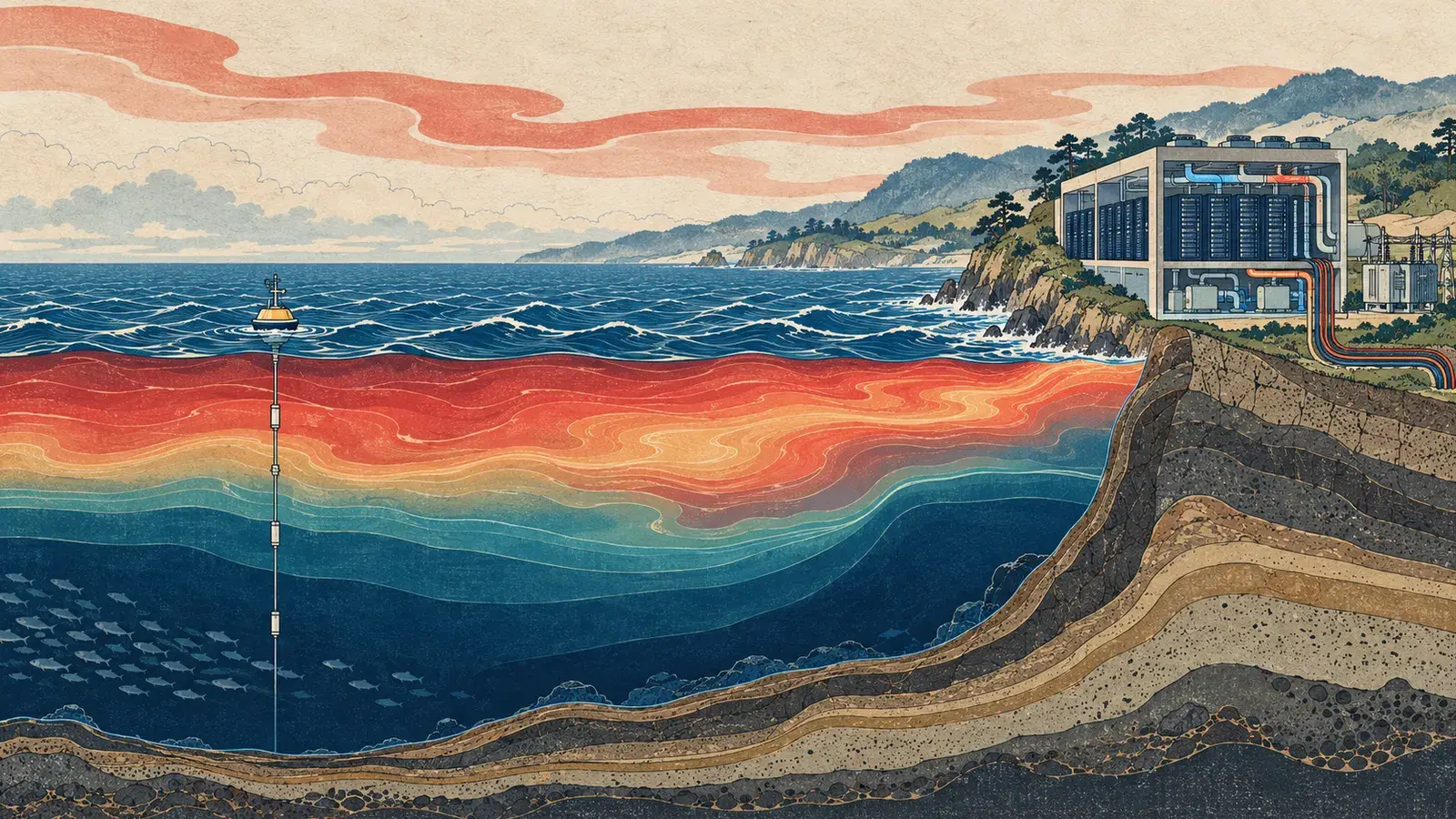
Nate Hagens opens by introducing Zeke Hausfather, a climate scientist and systems analyst who is a lead author of the IPCC Seventh Assessment Report, a Berkeley Earth research scientist, a Carbon Brief contributor, and lead climate researcher at Frontier. The conversation is framed around what the numbers, models and acronyms in climate science actually say about a rapidly changing biosphere.
Hausfather says his unusual mix of startup and academic experience has left him with a strong appreciation for how messy and friction-filled the real world is. In his earlier clean-tech work helping utilities reduce their customers’ energy use, he found that sustained behaviour change is very hard, especially when it demands sacrifice. The approaches that worked best were ‘set and forget’ solutions such as efficient appliances, better light bulbs and electric cars that perform the same job without requiring ongoing effort.
Asked how global temperature records are produced, he explains that measuring Earth’s temperature is non-trivial. Historical methods, such as lowering buckets from ships, introduced biases, while Antarctica had no measurements until 1950 and the mix of weather stations and ocean data contains gaps. Research groups make different choices about how to combine those data, but the results are similar enough to conclude the world has warmed about 1.4C since pre-industrial times. For the next IPCC report, groups are trying to build a large ‘canonical ensemble’ that shows uncertainty across all the datasets rather than many competing lines.
He describes the IPCC as a politically neutral, policy-prescriptive-averse scientific process, with working groups covering physical science, impacts and adaptation, and mitigation. A lot of the basics—that the world is warming, that CO2 is a greenhouse gas—are settled physics. The value of the assessment, he says, is sorting through tens of thousands of studies to refine understanding of questions such as whether warming is accelerating and what future pathways are plausible. He says the global collaboration gives him some optimism.
On scenarios, Hausfather walks through the lineage from IS92 and SRES to RCPs, SSPs and the new CMIP7 scenarios. He explains that the old numerical names such as RCP4.5 referred to radiative forcing in 2100, not temperature, and that the newest generation simply uses high, medium, low and very low. Scenarios are needed because half the uncertainty is human decisions—how much coal, oil and gas the world burns—and those cannot be answered by physics-based models alone.
He then details the chain from emissions to warming. Emission scenarios are translated into concentrations and radiative forcing, a step that includes carbon-cycle feedbacks such as ocean acidification reducing CO2 uptake and changes in plants, droughts and wildfires. The final step is climate sensitivity. The last IPCC report’s likely range for equilibrium climate sensitivity was about 2–5C for a doubling of CO2. Hausfather also explains that if emissions are driven to zero, falling atmospheric CO2 and the continuing warming of the deep ocean largely cancel, so global temperature roughly stops at whatever warming has already occurred.
A major part of the conversation is the current strong El Niño. Hausfather says such events usually peak near the end of the year, while global temperature response lags by three to five months. He points to 1997–98, 2015–16 and 2023–24, and expects 2027 to be much warmer than 2026, possibly around 1.8C above pre-industrial. He calls a strong El Niño a sneak peek of the new normal a decade later, because human emissions add about 0.2C every eight years—essentially a permanent super El Niño’s worth of heat.
Hausfather says SSP3, a world of resurgent nationalism, regional conflicts, weak international cooperation and persistent poverty, feels uncomfortably relevant. The high scenario in the new set is tied to SSP3, but high-end outcomes are less extreme than older RCP8.5 because clean energy has become far cheaper and a future dominated by ever-growing coal use is less plausible. He notes coal use has plateaued, wind and solar will generate more than gas globally this year for the first time, and the UK has phased out coal. Still, he says current policy trajectories lead to roughly 3C warming by 2100.
On recent warming acceleration, Hausfather attributes most of it to cuts in sulfur dioxide aerosol pollution. Aerosols cool the planet directly and by helping low clouds form; models suggest they have masked between 0.2C and 1.2C of warming. Global sulfur emissions have fallen about 40% since their 1980s peak, with dramatic cuts in China and from shipping fuel standards. He estimates warming has moved from about 0.2C to 0.3C per decade, and cautions that if the additional warming were instead driven by cloud feedbacks, that would be more worrying.
The Earth’s energy imbalance, now measured by satellites such as CERES, is another central topic. Hausfather says it has been increasing, likely due to aerosol reductions on top of greenhouse gases. A key open question is how much of the change reflects sulfur cuts versus temperature-mediated cloud feedback. On methane, he says it is a shorter-lived lever than CO2 and could produce faster cooling if emissions were cut, but recent methane growth appears to be coming substantially from wetlands, possibly a feedback to warming.
The conversation turns to artificial intelligence. Hausfather says a simple Gemini prompt was reported at 0.24 watt-hours and a ChatGPT prompt at 0.34 watt-hours, but reasoning models use five to ten times more, and AI agents can spawn many sub-agents and run for long periods. Using his own cloud coding data, he found a session could use 0.2–1.2 kilowatt-hours and a typical day of agent use 1.2–6 kilowatt-hours—roughly equivalent to adding two refrigerators. He sees a Jevons paradox: as AI gets cheaper and more powerful, it will be embedded in more processes.
Hausfather also thinks AI may help recentre expertise because it behaves like a consensus machine: people of very different political leanings are likely to get broadly the same scientific answer on climate from the same models. But he does not expect AI to simply ingest all climate data and solve the physics, because machine learning struggles with out-of-sample physical inference, even though weather models have been impressive and coding-side improvements are valuable.
Looking at future warming, he says the three big uncertainties are human choices, the Earth’s biogeochemical response, and climate sensitivity. If emissions stay roughly flat at current levels, he puts the central 2100 warming at about 3C, with a range between about 2C and 4C, and a high-emissions world could reach about 3.5C. He stresses tail risks and notes land warms faster than the global average. He also says US cuts to NOAA data and observations are worrying because satellite gaps cannot be filled retroactively, though Copernicus and others are trying to provide independent data.
His closing advice is to stay politically engaged, contact policymakers, and adopt clean technologies early because adoption drives down costs for everyone. He urges young people not to give in to doom or apathy. His magic-wand policy would be a carbon price that internalises social costs. At Stripe and Frontier he works on carbon removal—enhanced rock weathering on farmland, river liming, ocean alkalinity enhancement and biomass-based approaches—which he says is perhaps 10% of the solution, with 90% still being emissions reductions.
Comments