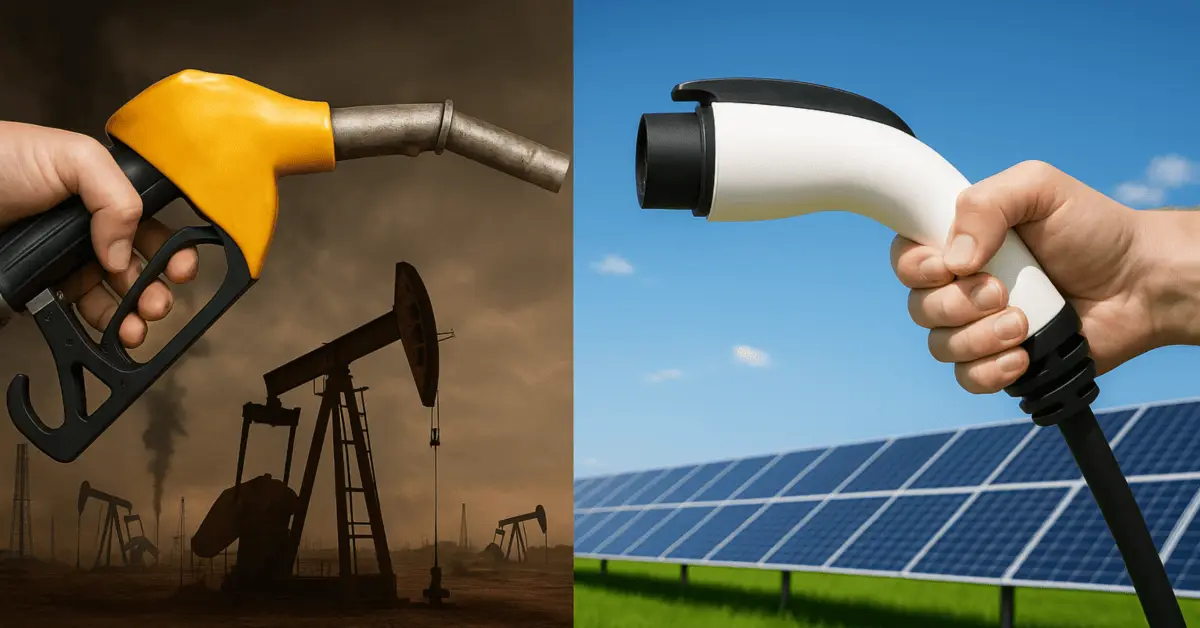
For the first time ever, cars powered solely by gasoline account for a minority of global new vehicle sales. According to data from Mobility Global—the automotive data company formerly known as S&P Global Mobility—their share fell to 49% in the first half of 2026, from 73% in 2021. Their sales fell 10% in a year, to 20.25 million units between January and June.
The decline does not mean that all the remaining cars are electric. Sales of battery electric cars rose 12% to 6.87 million, giving them a 17% share, while conventional hybrids rose 10% to 7.27 million and took 18%. The remaining 16% consists of diesel cars, plug-in hybrids and a few other fuels. Only the fully electric 17% burn no fuel at all; about 83% of new vehicles worldwide still have an engine.
The largest decline in gasoline cars was in China, where sales fell 26%, followed by Europe at 13%. In China, sales of gasoline cars and conventional hybrids fell 40% in August, while in the EU, fully electric cars outsold gasoline cars in the period through August, according to ACEA: 1,641,333 versus 1,634,733, with gasoline cars down 18.6%.
Regionally, battery electric car sales rose 32% in Europe to 1.81 million, 81% in Southeast Asia to 350,000, and more than doubled in Oceania to 110,000. In China, they fell 3% to 3.44 million, but the country still accounts for half the global market. In North America, they fell 15%.
The acceleration is linked to fuel prices. Nikkei attributes the shift to rising prices caused by the conflict in the Middle East, which led buyers to seek lower running costs. According to the International Energy Agency (IEA), the overall car market shrank about 5% in the first half, meaning sales of gasoline-only cars fell at twice the rate of the market.
Yoshiaki Kawano, an executive at Mobility Global, told Nikkei that very few electric car buyers return to gasoline cars or hybrids. He predicts that demand will be driven by actual consumer needs rather than subsidies as prices fall. This is consistent with a CDK survey covered by Electrek in July: 94% of electric car owners say they will not return to a gasoline car.
The picture is different in the US. Following the expiration of the federal tax credit, Cox Automotive expects about 239,000 new electric car sales in the third quarter, around 6% of the market and down 45% from 437,000 last year, when buyers rushed to purchase before the September 30 deadline. Ford announced that its electric car sales fell 80% in the quarter.
However, according to Cox, American buyers did not return to gasoline-only cars. Hybrid sales volume rose 23% and their share reached a record 16.3%, while the share of internal combustion engines fell. Electrified vehicles as a whole rose from 22.4% to 23.2% of the market. Gasoline in the US is near $4.50 a gallon, up 41% in a year.
North America as a whole may show a 15% decline, but sales in Canada rose 15.8% and in Mexico 44% year over year, so the decline in the US is greater than 15%. This explains why headlines about an “electric car collapse” mainly concern the US, rather than the rest of the world.
The milestone is real: gasoline-only cars fell from 73% to 49% in less than five years, and nothing in the data suggests they will regain their lost share. The last time gasoline was not in first place was in the early 1900s, when steam-powered and electric cars outsold it in the US. It remains to be seen whether the full-year figure for 2026 will end below 50%, since this is a six-month figure amid an oil shock, but the trend appears to be accelerating.




Comments