In this episode, the host of The Great Simplification temporarily sets aside his usual data analysis to discuss something more subjective: the different philosophical ways people look at the future. As he explains, discussions about the future usually involve facts, syntheses and descriptions concerning energy, the economy, money, geopolitics, the environment and planetary boundaries. But before the facts come different value systems and philosophical lenses, and we cannot assume everyone views the future through the same logical framework.
One of his first points is that we do not all care about the same things. Some focus on wealthy nations or the wealthy within nations. Others care more about people who are materially poor, as opposed to spiritually or emotionally poor. Another group cares about other species and the ecosystems of our one blue and green planet. There are also people who think more deeply about future generations, the unborn members of our species and other species a hundred, a thousand or a million years from now. These groups, he clarifies, are not entirely separate but overlap.
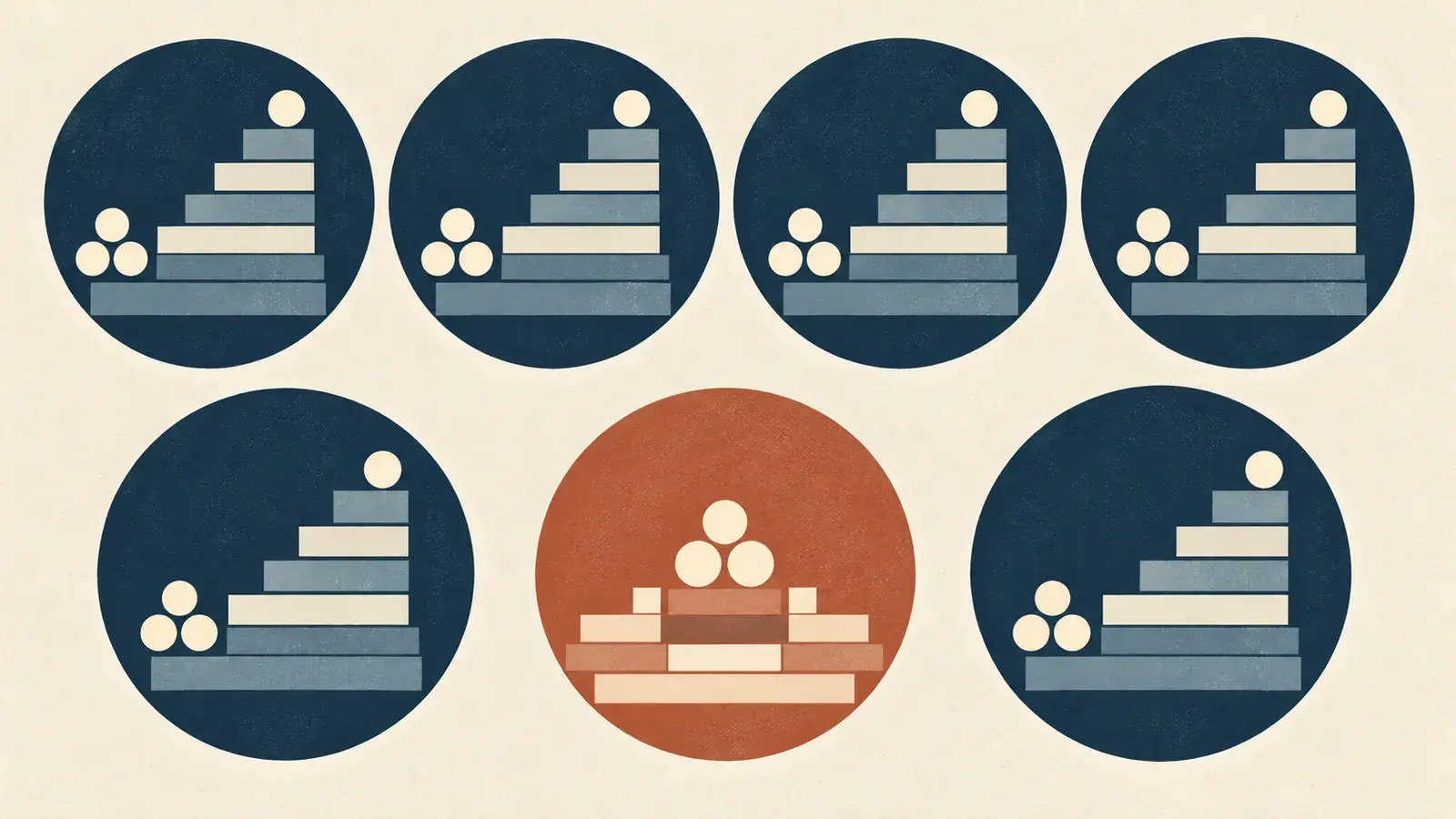
The episode's main subject is seven categories of thinking about the future. The first category, he says, consists of people who simply do not think about it. Many people today, and throughout most of the past, are so busy securing food, safety, warmth, shelter and basic necessities that the future essentially means tomorrow, or even tonight. They cannot even imagine five or a hundred years ahead because they are completely absorbed in the needs of the present.
The second category includes people who are busy or distracted and have essentially never given the future serious thought. For them, as he describes it, the future is most likely an extension of the past. Because things are fairly good now, and this month looks like the previous one, they predict that in five, ten or fifty years, recent trends will simply continue.
The third category is somewhat better read and more reflective, but deeply believes in a predetermined narrative: that humans will grow indefinitely, expand beyond Earth into the solar system and the stars, and that growth is something like a law of nature. The host notes that he can think of many biophysical reasons why this is unlikely and unrealistic, but many people consider it humanity's destiny: with 8 billion people and approaching AD 2025, we are still a very young species, only 300,000 years old, with hundreds of thousands or millions of years ahead of us in space.
The fourth category broadly encompasses degrowth. These people understand the downsides of our material footprint on the planet. They know that growth has not worked for most people, that we are degrading the natural world's ability to absorb our impacts, and that we are moving slowly but at an accelerating pace away from the stability of the Holocene across the various planetary boundaries. They therefore believe continued growth must be avoided and that the goal should be degrowth: reducing our impacts, consumption and the scale of the human enterprise. They believe we can live with fewer things and share with others, but that the overall size and scale of the human enterprise must shrink.
The fifth category is an offshoot of the previous one, a supercharged version of degrowth: collapse. It includes people who essentially want or expect collapse for various psychological or deterministic reasons. When they hear something negative about the future, rather than placing it within a probability distribution, they reach absolute conclusions—for example, that there will be no humans in ten years. It is, as he puts it, a fanatical version of degrowth that is not even intentional: it assumes we can do nothing and that the trajectory is a straight red line downward.
The sixth category resembles the third in supporting continued growth, but is more subtle and nuanced. These people have studied biophysical limits, ecology, the environment, complexity and past civilizations, but believe degrowth is precisely what must be avoided, quite possibly rightly, because the system does not easily go into reverse. The host uses the analogy of a rental car reversing over spikes and blowing out all its tires. In the global system, the equivalent would be the unraveling of letters of credit and just-in-time supply chains across six continents, leaving us without medicines and spare parts for small things we had never even imagined. For them, degrowth would be an uncontrolled catastrophe involving war, violence and Mad Max-style scenes. Because degrowth would be a catastrophe, we have no choice but to keep innovating and growing, socially and technologically, even if that will not work perfectly either.
The seventh category, which the host says includes many listeners and himself, accepts that degrowth could be catastrophic if it is unplanned. He does not want it in the short term, because he wants more time for people, governments and communities to prepare for the range of "bend or break" outcomes. At the same time, however, he believes growth will no longer be possible in the not-too-distant future, whether we like it or not, and that we will not keep expanding the world's economies, particularly Western ones.
The main reason, according to the speaker, is that we keep kicking the growth can down the road using financial credit. The more financial claims we create, the closer we come to a sudden Wile E. Coyote-style fall, driven by bond and currency markets. There are other reasons too: complexity, geopolitics, supply chains, and even the stability of ecosystems and the climate. But he believes the critical mechanism will be the financial system, because we will no longer be able to afford the scale and complexity we have created. Degrowth will therefore arrive involuntarily rather than voluntarily.
This is why the host argues that we must actively plan for this prospect, which, he says, is the entire focus of his work. He presents the seven categories as his own synthesis and acknowledges that there may be others. The purpose is not to label people, but to show that in a conversation about the future, the person we are talking to may belong to a different category from us.
As he explains, the facts, the things we care about and the synthesis we put together may land differently with someone who has another worldview or another lens through which they see the future. Remembering this is part of dialogue, learning, exchange and communication with other people in this dangerous, exciting and significant time.
Overall, the episode offers a framework for how we think about tomorrow rather than a data analysis. Its conclusion is that, whichever of the seven philosophies someone finds most convincing, the quality of the discussion depends on recognizing that not everyone sees the same future, and that preparation requires time, cooperation and realism about limits.

Comments